
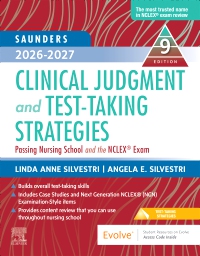

Saunders 2026-2027 Clinical Judgment and Test-Taking Strategies - Elsevier E-Book on VitalSource, 9th Edition
Elsevier eBook on VitalSource
Now $36.89
-
- NEW! Increased focus and additional content on practice readiness supports your transition from test to practice
- NEW! Thoroughly updated content incorporates clinical updates and reflects the latest NCLEX® test plans
- UNIQUE! Student-to-Student Hints highlight real-life strategies that have helped other students graduate from nursing school and pass the NCLEX® exam
- Tips for the Nursing Student highlights the most important concepts needed for exam success and includes tips on advocating for accommodations
- Lab test questions presented with reference ranges authentically mirror practice and help increase clinical judgment
- 1,200 review questions in the book and online provide a 2-in-1 approach in which you benefit from learning strategies and practicing test-taking skills
- Focus on helping beginner-level students develop clinical judgment skills and includes a section devoted to clinical judgment, as well as strategies addressing decision-making, question data, and client abnormalities
- Practice questions on the Evolve companion website are organized by content area, cognitive level, client needs area, integrated process, clinical judgment/cognitive skill, and priority concepts, allowing for completely customizable exams or study sessions
- Clearly defined cognitive skill levels help you understand this terminology and its significance
-
Part I: Study and Test Preparation
1. Clinical Judgment and Nursing Examinations
2. Developing Study Skills
3. Breaking Through Testing Barriers
4. NCLEX® Preparation
Part II: Strategies for Success
5. Alternate Item Formats and Next Generation NCLEX® Item Types
6. How to Avoid “Reading Into the Question”
7. Positive and Negative Event Queries
8. Questions Requiring Prioritization
9. Leading and Managing, Delegating, and Assignment-Making Questions
10. Communication Questions
11. Pharmacology, Medication, and Intravenous Calculation Questions
12. Additional Pyramid Strategies
Part III: Practice Tests
13. Foundations of Care Questions
14. Adult Health Questions
15. Mental Health Questions
16. Obstetrics Questions
17. Pediatric Questions
18. Pharmacology Questions
19. Delegating/Prioritizing Questions
20. Leadership/Management Questions -
-
Ways of Reading
- The appearance of the text and page layout can be modified according to the capabilities of the reading system (font family and font size, spaces between paragraphs, sentences, words, and letters, as well as color of background and text)
- This e-publication is accessible to the full extent that the file format and types of content allow, on a specific reading device, by default, without necessarily including any additions such as textual descriptions of images or enhanced navigation
- No information about nonvisual reading is available
-
Conformance
- For detailed accessibility information, see Elsevier's website at https://www.elsevier.com/about/accessibility
- For queries regarding accessibility information, contact [email protected]
- The publication was certified on 18-11-2025
-
Navigation
- Table of contents to all chapters of the text via links
-
Rich Content
- No information is available
-
Hazards
- No information is available
-
Product Content
- No information is available
-
Legal Considerations
- No information is available
-
Additional Accessibility Information
- For readers with color vision deficiency, use of color (e.g., in diagrams, graphics and charts, in prompts, or on buttons inviting a response) is not the sole means of graphical distinction or of conveying information
- E-publication includes basic navigation (usually less detailed than TOC-based navigation)
- Where links, controls or buttons are included in the content, the purpose or functionality of each link, control or button is apparent from the associated text alone - or where it is unclear, separate link, control or button descriptions are provided
- All (or substantially all) textual matter is arranged in a single logical reading order (including text that is visually presented as separate from the main text flow, e.g., in boxouts, captions, tables, footnotes, endnotes, citations, etc.). Non-textual content is also linked from within this logical reading order. (Purely decorative non-text content can be ignored).
- The language of the text has been specified (e.g., via the HTML or XML lang attribute) to optimise text-to-speech (and other alternative renderings), both at the whole document level and, where appropriate, for individual words, phrases or passages in a different language.
-
Ways of Reading


 as described in our