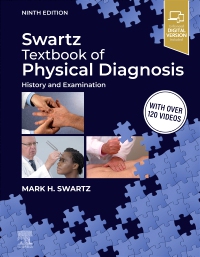

Textbook of Physical Diagnosis Elsevier eBook on VitalSource, 9th Edition
Elsevier eBook on VitalSource
Now $79.09
Offering a compassionate, humanistic approach in this critical area, Swartz Textbook of Physical Diagnosis, Nineth Edition, helps you master each aspect of the art and science of interviewing and physical examination. This highly regarded text clearly teaches how your interpersonal awareness is just as crucial during the patient interview and physical exam as your level of skill—and why clinical competence in this area is essential for physicians, osteopathic physicians, nurse practitioners, physician assistants, nurses, and all other members of the healthcare profession. From cover to cover, you’ll learn fundamental skills and concepts that result in more accurate diagnoses, more effective patient management, and better patient outcomes.
-
- Offers fully revised content throughout, including clear, easy-to-understand explanations of interviewing and examination techniques, clinical presentations, pathophysiology, complementary and alternative medicine, and physical diagnosis standards and tests
- Includes three new chapters: The Transgender Patient; Artificial Intelligence in Clinical Encounters: Opportunities and Challenges; and Telehealth: Adapting Clinical Assessment
- Explores how cultural differences can influence communication, diet, family relationships, and health practices and beliefs—which may affect your approach to a patient’s treatment
- Features hundreds of high-quality color images, an easy-to-use design, and detailed descriptions of practical techniques throughout
- Contains new end-of-chapter review questions in most chapters.
- Highlights clinical ethics and professionalism
- Includes more than 6 hours of in-depth instruction, with 40+ updated videos featuring step-by-step aspects of the physical examination for adults, toddlers, and newborns, important interviewing scenarios, and audio of heart and lung sounds
- Features online appendices covering English-to-Spanish Translations Useful in the Medicine Setting, Commonly Misused Substances, Signs and Symptoms of Deficiency States, and more
- An eBook version is included with purchase. The eBook allows you to access all of the text and figures, with the ability to search, customize your content, make notes and highlights, and have content read aloud
-
-
 Swartz Textbook of Physical DiagnosisHardcover
-
-
SECTION 1: Mastering the Art of Interviewing
1. The Interviewer’s Questions
2. The Patient’s Responses
3. Understanding Complementary and Alternative Medicine
4. Putting the History Together
SECTION 2: Valuing Diversity: Race, Gender, and Ethnicity
5. Anti-Racist and Anti-Oppressive Clinical Skills
SECTION 3: Understanding the Science of the Physical Examination
6. The Physical Examination
7. Assessment of Nutritional Status
8. The Skin
9. The Head and Neck
10. The Eye
11. The Ear and Nose
12. The Oral Cavity and Pharynx
13. The Chest
14. The Heart
15. The Peripheral Vascular System
16. The Breast
17. The Abdomen
18. Male Genitalia and Hernias
19. Female Genitalia
20. The Musculoskeletal System
21. The Nervous System
22. Putting the Examination Together
SECTION 4: Evaluating Specific Patients
23. The Pregnant Patient
24. The Pediatric Patient
25. The Geriatric Patient
26. The Transgender Patient
27. The Acutely Ill or Injured Patient
SECTION 5: Putting the Data to Work
28. Precision, Accuracy, and Critical Thinking in Clinical Assessment
29. The Clinical Record
30. The Focused History and Physical Examination
31. Artificial Intelligence in Clinical Encounters: Opportunities and Challenges
32. Telehealth: Adapting Clinical Assessment
SECTION 6: Analyzing Ethical Issues in Clinical Medicine
33. Clinical Ethics and Professionalism
Epilogue: A Journey Through Physical Diagnosis
Appendix A: Answers to Review Questions
e-Appendix B: Commonly Misused Substances
e-Appendix C: Signs and Symptoms of Deficiency States
e-Appendix D: Conversion Tables
e-Appendix E: English-to-Spanish Translations Useful in the Medical Setting
e-Appendix F: The Rational Clinical Examination: Evidence-Based Clinical Diagnosis -
-
Ways of Reading
- The appearance of the text and page layout can be modified according to the capabilities of the reading system (font family and font size, spaces between paragraphs, sentences, words, and letters, as well as color of background and text)
- This e-publication is accessible to the full extent that the file format and types of content allow, on a specific reading device, by default, without necessarily including any additions such as textual descriptions of images or enhanced navigation
- No information about nonvisual reading is available
-
Conformance
- No information is available
-
Navigation
- Table of contents to all chapters of the text via links
- Page list to go to pages from the print source version
-
Rich Content
- No information is available
-
Hazards
- No information is available
-
Product Content
- No information is available
-
Legal Considerations
- No information is available
-
Additional Accessibility Information
- Content is enhanced with ARIA roles to optimize organization and facilitate navigation
- Page breaks included from the original print source
- For readers with color vision deficiency, use of color (e.g., in diagrams, graphics and charts, in prompts, or on buttons inviting a response) is not the sole means of graphical distinction or of conveying information
- E-publication includes basic navigation (usually less detailed than TOC-based navigation)
- Where links, controls or buttons are included in the content, the purpose or functionality of each link, control or button is apparent from the associated text alone - or where it is unclear, separate link, control or button descriptions are provided
- All (or substantially all) textual matter is arranged in a single logical reading order (including text that is visually presented as separate from the main text flow, e.g., in boxouts, captions, tables, footnotes, endnotes, citations, etc.). Non-textual content is also linked from within this logical reading order. (Purely decorative non-text content can be ignored).
- The language of the text has been specified (e.g., via the HTML or XML lang attribute) to optimise text-to-speech (and other alternative renderings), both at the whole document level and, where appropriate, for individual words, phrases or passages in a different language.
-
Ways of Reading

 as described in our