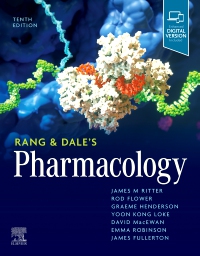
Evolve Resources for Rang & Dale's Pharmacology, 10th Edition
by James M. Ritter, DPhil FRCP FBPhS FMedSci, Rod J. Flower, PhD DSc FBPhS FMedSci FRS, Graeme Henderson, BSc PhD FBPhS FSB, Yoon Kong Loke, MB, BS, MRCP, MD, David MacEwan, PhD, FRSB, FBPhS, SFHEA, Emma Robinson, PhD, FBPhS and James Fullerton, MA, MBChB, MRCP, PhD, FHEA.
Resources
ISBN: 9780443250415
Copyright:
Publication Date: 06-07-2023
Imprint: Elsevier
List Price: $0.00
For Qualified Instructors.
Important note
This is a Faculty Product!
Any student who attempts to register for access will be reported to the school's faculty and administration.
SECTION 1 GENERAL PRINCIPLES 1. What is pharmacology? 2. How drugs act: general principles 3. How drugs act: molecular aspects 4. How drugs act: cellular aspects - excitation, contraction and secretion 5. How drugs act: Biopharmaceuticals and gene therapy 6. Cell proliferation, apoptosis, repair and regeneration 7. Cellular mechanisms: host defence 8. Method and measurement in pharmacology 9. Absorption and distribution of drugs 10. Drug metabolism and elimination 11. Pharmacokinetics 12. Individual variation, pharmacogenomics and personalised medicine
SECTION 2 CHEMICAL MEDIATORS 13. Chemical mediators and the autonomic nervous system 14. Cholinergic transmission 15. Noradrenergic transmission 16. 5-Hydroxytryptamine and purines 17. Local hormones: histamine, lipids, peptides and proteins 18. Cannabinoids 19. Nitric oxide and related mediators
SECTION 3 DRUGS AFFECTING MAJOR ORGAN SYSTEMS 20. The heart 21. The vascular system 22. Atherosclerosis and lipoprotein metabolism 23. Haemostasis and thrombosis 24. Haemopoietic system and treatment of anaemia 25. Anti-inflammatory and immunosuppressant drugs 26. Skin 27. Eye 28. Respiratory system 29. The kidney and urinary system 30. The gastrointestinal tract 31. The control of blood glucose and drug treatment of diabetes mellitus 32. Obesity 33. The pituitary and the adrenal cortex 34. Thyroid 35. The reproductive system 36. Bone metabolism
SECTION 4 NERVOUS SYSTEM 37. Chemical transmission and drug action in the central nervous system 38. Amino acid transmitters 39. Other transmitters and modulators 40. Neurodegenerative diseases 41. General anaesthetic agents 42. Headache 43. Analgesic drugs 44. Local anaesthetics and other drugs affecting sodium channels 45. Anxiolytic and hypnotic drugs 46. Antiepileptic drugs 47. Antipsychotic drugs 48. Antidepressant drugs 49. Psychoactive drugs 50. Drug use and addiction
SECTION 5 DRUGS USED FOR THE TREATMENT OF INFECTIONS AND CANCER 51. Basic principles of antimicrobial chemotherapy 52. Antibacterial drugs 53. Antiviral drugs 54. Antifungal drugs 55. Antiprotozoal drugs 56. Antihelminthic drugs 57. Anticancer drugs
SECTION 6 SPECIAL TOPICS 58. Harmful effects of drugs 59. Lifestyle drugs and drugs in sport 60. Drug discovery and development
James M. Ritter, DPhil FRCP FBPhS FMedSci, Emeritus Professor of Clinical Pharmacology, King’s College London, and Medical Research Director, Quintiles, London, UK, Rod J. Flower, PhD DSc FBPhS FMedSci FRS, Professor, Biochemical Pharmacology, The William Harvey Research Institute, Barts and the London School of Medicine and Dentistry, Queen Mary University of London , London, UK, Graeme Henderson, BSc PhD FBPhS FSB, Professor of Pharmacology, University of Bristol, Bristol, UK, Yoon Kong Loke, MB, BS, MRCP, MD, Senior Lecturer in Clinical Pharmacology, School of Medicine, Health Policy and Practice, University of East Anglia, Norwich, UK, David MacEwan, PhD, FRSB, FBPhS, SFHEA, Professor of Molecular Pharmacology/Toxicology & Head of Department, Department of Molecular and Clinical Pharmacology, University of Liverpool, Liverpool, UK, Emma Robinson, PhD, FBPhS, Professor of Psychopharmacology, University of Bristol, Bristol, UK and James Fullerton, MA, MBChB, MRCP, PhD, FHEA., Associate Professor of Clinical Therapeutics and Honorary Consultant in Acute General Medicine and Clinical Pharmacology, University of Oxford, Oxford, UK
We use cookies which are necessary to make our site work. We may also use additional cookies to analyse, improve and personalise our content and your digital experience. For more information, see our Cookie Policy and the list of Google Ad-Tech Vendors.
You may choose not to allow some types of cookies. However, blocking some types may impact your experience of our site and the services we are able to offer. See the different category headings below to find out more or change your settings.
You may also be able to exercise your privacy choices as described in our Privacy Policy
Manage Consent Preferences
Strictly Necessary Cookies
Always active
These cookies are necessary for the website to function and cannot be switched off in our systems. They are usually only set in response to actions made by you which amount to a request for services, such as setting your privacy preferences, logging in or filling in forms. You can set your browser to block or alert you about these cookies, but some parts of the site will not then work.
Functional Cookies
These cookies enable the website to provide enhanced functionality and personalisation. They may be set by us or by third party providers whose services we have added to our pages. If you do not allow these cookies then some or all of these services may not function properly.
Performance Cookies
These cookies allow us to count visits and traffic sources so we can measure and improve the performance of our site. They help us to know which pages are the most and least popular and see how visitors move around the site.
Targeting Cookies
These cookies may be set through our site by our advertising partners. They may be used by those companies to build a profile of your interests and show you relevant adverts on other sites. If you do not allow these cookies, you will experience less targeted advertising.
