ISBN:
9780443260544
Copyright:
2025
Publication Date:
04-09-2024
Page Count:
352
Imprint:
Elsevier
List Price:
$34.99

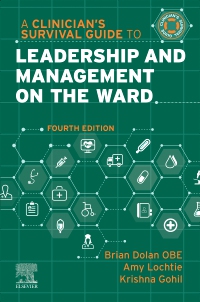
A Clinician's Survival Guide to Leadership and Management on the Ward - Elsevier E-Book on VitalSource, 4th Edition
by Brian Dolan, OBE, FFNMRCSI, FRSA, MSc (Oxon), MSc (Nurs), RMN, RGN, Amy Lochtie, FRSA, RGN, FSBP and Krishna Gohil, MSc, FHEA, PgCert, BSc (Hons) Podiatry, FRCPod, FFPM, RCPS (Glasg)
Elsevier eBook on VitalSource
ISBN:
9780443260544
Copyright:
2025
Publication Date:
04-09-2024
Page Count:
352
Imprint:
Elsevier
List Price:
$34.99
Was
$34.99
Now $31.49
Or $0.00 with a valid access code
When you become a ward or unit manager or allied health professionals team leader, your responsibilities change and you need a very different set of skills compared with your previous roles. You are now required to manage a team of staff with a set budget and are responsible for maintaining an environment in which people can work together efficiently and effectively. This new fourth edition of the Survival Guide to Leadership and Management on the Ward welcomes AHP Krishna Gohil to the author team of nurses Brian Dolan and Amy Lochtie, and thereby extends its guidance on these crucial skills to both nurses and allied health professionals.
-
- Focuses on both nursing and allied health professionals who are in the role of ward managers, unit managers or team leaders, or aspire to be so
- Significantly builds on how to understand your role, work with different generations in the workplace and manage difficult situations
- Includes greater emphasis on self-care and self-compassion for leaders and managers
- Covers leading teams in the context of enduring financial and staffing constraints
-
1. The Role of the Ward Manager
2. Manage Your Time
3. Create a Positive Working Environment
4. Manage Staff Performance
5. Make Sure Care Is Person Centred
6. Manage Your Budget
7. Improve Quality and Safety
8. Instigate a Rolling Recruitment Programme
9. Be Politically Aware
10. Look After Yourself
11. Be a Good Role Model
12. Manage Your Manager
13. Manage Difficult Situations
14. Manage Challenging Team Behaviours
15. Get the Best Advice -
-
Ways of Reading
- The appearance of the text and page layout can be modified according to the capabilities of the reading system (font family and font size, spaces between paragraphs, sentences, words, and letters, as well as color of background and text)
- This e-publication is accessible to the full extent that the file format and types of content allow, on a specific reading device, by default, without necessarily including any additions such as textual descriptions of images or enhanced navigation
- No information about nonvisual reading is available
-
Conformance
- No information is available
-
Navigation
- Table of contents to all chapters of the text via links
- Page list to go to pages from the print source version
-
Rich Content
- No information is available
-
Hazards
- No information is available
-
Product Content
- No information is available
-
Legal Considerations
- No information is available
-
Additional Accessibility Information
- Content is enhanced with ARIA roles to optimize organization and facilitate navigation
- Page breaks included from the original print source
- For readers with color vision deficiency, use of color (e.g., in diagrams, graphics and charts, in prompts, or on buttons inviting a response) is not the sole means of graphical distinction or of conveying information
- E-publication includes basic navigation (usually less detailed than TOC-based navigation)
- Where links, controls or buttons are included in the content, the purpose or functionality of each link, control or button is apparent from the associated text alone - or where it is unclear, separate link, control or button descriptions are provided
- All (or substantially all) textual matter is arranged in a single logical reading order (including text that is visually presented as separate from the main text flow, e.g., in boxouts, captions, tables, footnotes, endnotes, citations, etc.). Non-textual content is also linked from within this logical reading order. (Purely decorative non-text content can be ignored).
- The language of the text has been specified (e.g., via the HTML or XML lang attribute) to optimise text-to-speech (and other alternative renderings), both at the whole document level and, where appropriate, for individual words, phrases or passages in a different language.
-
Ways of Reading

Was
$34.99
Now $31.49
Or $0.00 with a valid access code

 as described in our