ISBN:
9780443260605
Copyright:
2026
Publication Date:
10-17-2025
Page Count:
544
Imprint:
Elsevier
List Price:
$104.99

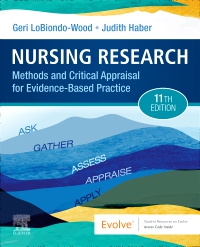
Nursing Research - Elsevier E-Book on VitalSource, 11th Edition
by Geri LoBiondo-Wood, PhD, RN, FAAN and Judith Haber, PhD, RN, FAAN
Elsevier eBook on VitalSource
ISBN:
9780443260605
Copyright:
2026
Publication Date:
10-17-2025
Page Count:
544
Imprint:
Elsevier
List Price:
$104.99
Most review copies are eBooks – how fast!
A review copy request is most likely to be fulfilled as an eBook on VitalSource rather than a print product, unless no eBook is available. eBooks become available in as little as a few hours. Print products will take between 7 and 10 days to arrive. To request a print copy, please contact us through the Evolve Support Center for further assistance or contact your Elsevier Sales Rep.
Teach students how to understand and apply nursing research to everyday practice with LoBiondo-Wood & Haber’s Nursing Research: Methods and Critical Appraisal for Evidence-Based Practice, 11th Edition. Written by an all-star team of educators and research experts, this book features well-balanced coverage of both qualitative and quantitative research methods, as well as the evidenced-based practice (EBP) process. Its easy-to-read, easy-to-understand approach has made this book a four-time recipient of the American Journal of Nursing Book-of-the-Year award and a student favorite for more than 40 years! This new edition has been thoroughly updated to reflect the most current practices in nursing research and EBP. New examples using recent clinical studies are included throughout each chapter, and new Research Vignettes showcase the work of leaders in the field of nursing research and EBP. LoBiondo-Wood & Haber’s Nursing Research, 11th Edition, is a must-have resource for appraising and using nursing research and quality improvement studies!
-
- NEW! Expanded statistics content in Chapter 16 (Data Analysis: Descriptive and Inferential Statistics) includes additional content on common statistical tests (e.g., correlation, t-test, regression, chi square) to minimize the need for a separate statistics textbook or workbook
- NEW! Research examples updated throughout to reflect the latest applicable high-quality literature
-
- NEW! Updated content reflects the most current methods in nursing research and evidence-based practice (EBP)
- NEW! Research examples using recent clinical studies are included throughout each chapter
- NEW! Engaging Research Vignettes showcase the work of leaders in the fields of nursing research and EBP
- Expanded coverage of statistics makes a separate statistics textbook unnecessary
- Streamlined and refocused coverage of ethics in the introductory section of the text helps set the stage for the remainder of the chapters
- This title is also available in Sherpath! Sold separately, this innovative teaching and learning technology offers interactive course content and resources that streamline class preparation and assessment and give students personalized help to reach their learning goals. Sherpath fully includes the ebook of this title for all-in-one digital course delivery
- Innovative approach aligns with the AACN Essentials Core Competencies for Professional Nursing Education (2021) evidence-based practice concept
- Cutting-edge content on quality improvement highlights how to integrate quality improvement into clinical practice
- Balanced coverage explores both the nursing research process (including both qualitative and quantitative research methodologies) and the EBP process
- User-friendly writing style and engaging learning aids include full-text Research Examples, innovative teaching-learning tools, Helpful Hints, EBP Tips, IPE Highlights, and Clinical Judgment Challenges
- Chapter-specific Critical Appraisal Criteria guides students through evaluating the strengths and weaknesses of research and quality improvement studies
- "All-star" team of contributors leverages diverse expertise in nursing research, quality improvement, and EBP
-
-
 Sherpath for LoBiondo - Wood Nursing ResearchSherpath Book-Organized
 -
 Evolve Resources for Nursing ResearchResources
 -
 Nursing ResearchPaperback
-
-
PART I Overview of Research and Evidence-Based Practice
1. Integrating Research, Evidence-Based Practice, and Quality Improvement Processes
2. Appraising Research Questions, Hypotheses, and Clinical Questions
3. Appraising Legal and Ethical Issues
4. Gathering and Appraising the Literature
5. Theoretical Frameworks for Research
PART II Processes and Evidence Related to Qualitative Research
RESEARCH VIGNETTE
6. Qualitative Research: Principles and Utilization
7. Qualitative Approaches to Research
8. Appraising Qualitative Research
PART III Processes and Evidence Related to Quantitative Research
RESEARCH VIGNETTE
9. Introduction to Quantitative Research
10. Appraising Experimental and Quasi Experimental Designs
11. Appraising Nonexperimental Designs
12. Appraising Systematic Reviews and Clinical Practice Guidelines
13. Appraising Sampling
14. Appraising Data Collection Methods
15. Appraising Reliability and Validity
16. Appraising Data Analysis: Descriptive and Inferential Statistics
17. Understanding Research Findings
18. Appraising Quantitative Research
PART IV Application of Research: Evidence-Based Practice
RESEARCH VIGNETTE
19. Strategies and Tools for Developing an Evidence-Based Practice
20. Developing an Evidence-Based Practice
21. Quality Improvement -
-
Ways of Reading
- The appearance of the text and page layout can be modified according to the capabilities of the reading system (font family and font size, spaces between paragraphs, sentences, words, and letters, as well as color of background and text)
- This e-publication is accessible to the full extent that the file format and types of content allow, on a specific reading device, by default, without necessarily including any additions such as textual descriptions of images or enhanced navigation
- All content can be read as read aloud speech or dynamic braille
- Has alternative text descriptions for images
-
Conformance
- The certifier's credential is https://bornaccessible.benetech.org/certified-publishers/
- For detailed accessibility information, see Elsevier's website at https://www.elsevier.com/about/accessibility
- For queries regarding accessibility information, contact [email protected]
- The publication was certified on 13-11-2025
-
Navigation
- Table of contents to all chapters of the text via links
- Index with links to referenced entries
- Elements such as headings, tables, etc. for structured navigation
- Page list to go to pages from the print source version
-
Rich Content
- Information-rich images are described by extended descriptions
-
Hazards
- The publication contains no hazards
-
Product Content
- Content includes any type of illustrations.
- The primary content is text.
- Content includes a significant number of actionable (clickable) web links to external content, downloadable resources, supplementary material, etc.
- Content includes a significant number of actionable (clickable) cross-references, hyperlinked notes and annotations, or with other actionable links between largely textual elements (e.g., quiz/test questions, 'choose your own ending', etc.).
- Content includes additional textual content such as an interview, feature article, essay, bibliography, quiz/test, other background material, or text that is not included in a primary or 'unenhanced' version.
- Content includes figures, diagrams, charts and/or graphs, including other 'mechanical' (i.e. non-photographic) illustrations.
- Content includes a significant number of web links (printed URLs, QR codes etc.).
- Content includes assessment material, e.g., Questions or student exercises, problems, quizzes or tests (as an integral part of the work).
- Product includes actionable (clickable) links to external interactive content.
-
Legal Considerations
- No information is available
-
Additional Accessibility Information
- Content is enhanced with ARIA roles to optimize organization and facilitate navigation
- Page breaks included from the original print source
- For readers with color vision deficiency, use of color (e.g., in diagrams, graphics and charts, in prompts, or on buttons inviting a response) is not the sole means of graphical distinction or of conveying information
- The body text is presented with a contrast ratio of at least 4.5:1 (or 3:1 for large/heading text)
- Text-to-speech has been optimized through provision of PLS lexicons, SSML or CSS Speech synthesis hints or other speech synthesis markup languages or hinting
- Ultra-high contrast between text and background
- E-publication includes basic navigation (usually less detailed than TOC-based navigation)
- Where links, controls or buttons are included in the content, the purpose or functionality of each link, control or button is apparent from the associated text alone - or where it is unclear, separate link, control or button descriptions are provided
- All (or substantially all) textual matter is arranged in a single logical reading order (including text that is visually presented as separate from the main text flow, e.g., in boxouts, captions, tables, footnotes, endnotes, citations, etc.). Non-textual content is also linked from within this logical reading order. (Purely decorative non-text content can be ignored).
- Content provides explanations for unusual words, abbreviations, acronyms, idioms, jargon in an accessible form, such as glossaries, scripted pop-ups.
- Where interactive content is included in the product, controls are provided (e.g., for speed, pause and resume, reset) and labelled to make their use clear.
- The language of the text has been specified (e.g., via the HTML or XML lang attribute) to optimise text-to-speech (and other alternative renderings), both at the whole document level and, where appropriate, for individual words, phrases or passages in a different language.
-
Ways of Reading
Most review copies are eBooks – how fast!
A review copy request is most likely to be fulfilled as an eBook on VitalSource rather than a print product, unless no eBook is available. eBooks become available in as little as a few hours. Print products will take between 7 and 10 days to arrive. To request a print copy, please contact us through the Evolve Support Center for further assistance or contact your Elsevier Sales Rep.

 as described in our