
ISBN:
9780443268762
Copyright:
2027
Publication Date:
01-23-2026
Page Count:
1168
Imprint:
Elsevier
List Price:
$121.99

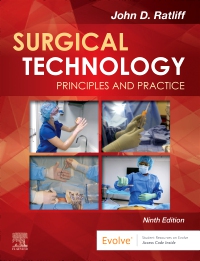
Surgical Technology - Elsevier E-Book on VitalSource, 9th Edition
by John D. Ratliff, MHA, CST, FAST
Elsevier eBook on VitalSource
ISBN:
9780443268762
Copyright:
2027
Publication Date:
01-23-2026
Page Count:
1168
Imprint:
Elsevier
List Price:
$121.99
Was
$121.99
Now $109.79
Or $0.00 with a valid access code
**Selected for 2026 Doody's Core Titles in General Surgery**
Prepare to deliver the best patient care before, during, and after surgery with this approachable guide to surgical skills and operating room procedures. In addition to covering all the content in the AST Core Curriculum, this one-of-a-kind text offers a unique mentoring approach and engaging learning features that make even complex skills and techniques easy to understand.
Prepare to deliver the best patient care before, during, and after surgery with this approachable guide to surgical skills and operating room procedures. In addition to covering all the content in the AST Core Curriculum, this one-of-a-kind text offers a unique mentoring approach and engaging learning features that make even complex skills and techniques easy to understand.
-
-
 Surgical TechnologyResources
 -
 Workbook for Surgical TechnologyPaperback
 -
 Workbook for Surgical Technology - Elsevier E-Book on VitalSourceElsevier eBook on VitalSource
-
-
- Comprehensive coverage addresses all areas of the AST Core Curriculum for Surgical Technology
- Reader-friendly writing style and organization builds content from fundamental concepts, aseptic technique, and the role and function of the surgical technologist, to the specialty surgical procedure chapters
- Consistent chapter format breaks down surgical procedures in an easy-to-understand way that helps you understand the key elements of more than 200 procedures
- Approximately 1,150 full-color illustrations and clinical photos bring concepts and procedures to life
- Robust practice opportunities include review questions and case studies at the end of each chapter, along with additional review questions and surgical practice videos on the Evolve companion website
- Learning features, including learning objectives, key terms, references and bibliographies, key concepts, and Important to Know boxes, keep you on track and organized as you move through the chapters
- Pathology appendix summarizes the most commonly seen pathological processes and organizes them by body system
-
- UPDATED! Content correlates with the AST Core Curriculum for Surgical Technology, 7th Edition
- UPDATED! Expanded coverage includes the latest advances in robotics and minimally invasive procedures
- UPDATED! Vivid artwork includes additional photos to help bring key concepts to life
- Written by surgical technologists, for surgical technologists
-
PART 1 SURGICAL TECHNOLOGY PRINCIPLES
1. Surgical Technology: The Profession and the Professional
2. Health Care Facility Structure and Environment
3. Communication and Teamwork
4. Medicolegal Aspects of Surgical Technology
5. Death, Dying, and the Psychosocial Needs of the Patient
6. Diagnostic and Assessment Procedures
7. Environmental Hazards
8. Energy Sources in Surgery
9. Disaster Preparedness and Response
10. Microbes and the Process of Infection
11. Decontamination, Sterilization, and Disinfection
12. Surgical Instruments
13. Principles and Practice of Aseptic Technique
14. Surgical Skills I: Planning a Case, Opening, and Start of Surgery
15. Surgical Skills II: Intraoperative and Immediate Postoperative Period
16. Moving, Handling, and Positioning the Surgical Patient
17. Surgical Skin Preparation and Draping
18. Perioperative Pharmacology
19. Anesthesia, Physiological Monitoring, and Postanesthesia Recovery
PART 2 SURGICAL TECHNOLOGY PRACTICE
20. General Surgery
21. Minimally Invasive Surgery
22. Robotic-Assisted Surgery
23. Gynecological and Obstetrical Surgery
24. Genitourinary Surgery
25. Surgery of the Ear, Nose, Pharynx, and Larynx
26. Ophthalmic Surgery
27. Oral and Maxillofacial Surgery
28. Plastic and Reconstructive Surgery
29. Orthopedic Surgery
30. Neurosurgery
31. Vascular and Microvascular Surgery
32. Thoracic and Pulmonary Surgery
33. Cardiac Surgery
34. Pediatric Surgery
35. Emergency Trauma Surgery -
-
Ways of Reading
- The appearance of the text and page layout can be modified according to the capabilities of the reading system (font family and font size, spaces between paragraphs, sentences, words, and letters, as well as color of background and text)
- This e-publication is accessible to the full extent that the file format and types of content allow, on a specific reading device, by default, without necessarily including any additions such as textual descriptions of images or enhanced navigation
- No information about nonvisual reading is available
-
Conformance
- No information is available
-
Navigation
- Table of contents to all chapters of the text via links
- Page list to go to pages from the print source version
-
Rich Content
- No information is available
-
Hazards
- No information is available
-
Product Content
- No information is available
-
Legal Considerations
- No information is available
-
Additional Accessibility Information
- Content is enhanced with ARIA roles to optimize organization and facilitate navigation
- Page breaks included from the original print source
- For readers with color vision deficiency, use of color (e.g., in diagrams, graphics and charts, in prompts, or on buttons inviting a response) is not the sole means of graphical distinction or of conveying information
- E-publication includes basic navigation (usually less detailed than TOC-based navigation)
- Where links, controls or buttons are included in the content, the purpose or functionality of each link, control or button is apparent from the associated text alone - or where it is unclear, separate link, control or button descriptions are provided
- All (or substantially all) textual matter is arranged in a single logical reading order (including text that is visually presented as separate from the main text flow, e.g., in boxouts, captions, tables, footnotes, endnotes, citations, etc.). Non-textual content is also linked from within this logical reading order. (Purely decorative non-text content can be ignored).
- The language of the text has been specified (e.g., via the HTML or XML lang attribute) to optimise text-to-speech (and other alternative renderings), both at the whole document level and, where appropriate, for individual words, phrases or passages in a different language.
-
Ways of Reading
Was
$121.99
Now $109.79
Or $0.00 with a valid access code

 as described in our