ISBN:
9780443279652
Copyright:
2028
Imprint:
Elsevier
List Price:
$77.99

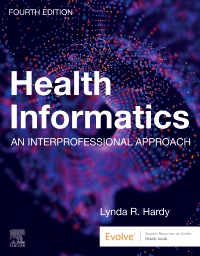
Health Informatics: An Interprofessional Approach, 4th Edition
by Lynda R. Hardy, PhD, RN
Elsevier eBook on VitalSource
ISBN:
9780443279652
Copyright:
2028
Imprint:
Elsevier
List Price:
$77.99
Not Yet Available
Most review copies are eBooks – how fast!
A review copy request is most likely to be fulfilled as an eBook on VitalSource rather than a print product, unless no eBook is available. eBooks become available in as little as a few hours. Print products will take between 7 and 10 days to arrive. To request a print copy, please contact us through the Evolve Support Center for further assistance or contact your Elsevier Sales Rep.
Coming Soon!
Expected availability date: 02-01-2027
-
• Updated chapters reflect the current and evolving practice of health informatics, using real-life healthcare examples to show how informatics applies to a wide range of topics and issues. • New topics included such as the growth and expansion of the use of artificial intelligence (AI), methods to increase health and health equity, and developing algorithmic approaches to predict and treat health-related problems. • Interactice Case Studies on Evolve provide suggested responses and extra practice for the content found in the chapters.
-
• 2021 AACN domains incorporated throughout as integral to BSN, Master’s, and DNP programs. • Chapters written by field experts provide the most current and accurate information on continually evolving subjects like evidence-based practice, EHRs, PHRs, mobile health, disaster recovery, and simulation. • Objectives, key terms, and an overview at the beginning of each chapter provide an snapshot of what each chapter will cover. • Case studies and discussion questions at the end of each chapter encourage higher-level thinking that can be applied to real world experiences. • “Conclusion and Future Directions” discussion at the end of each chapter reinforces topics and expands on how the topic will continue to evolve. • Open-ended discussion questions at the end of each chapter enhance students’ understanding of the subject covered. • “mHealth” chapter discusses all relevant aspects of mobile health, including global growth new opportunities in underserved areas, governmental regulations on issues such as data leaking and mining, implications of patient-generated data, legal aspects of provider monitoring of patient-generated data, and increased responsibility by patients. • Important content, including FDA- and state-based regulations, project management, big data, and governance models, prepares students for one of nursing’s key specialty areas. • Strategies for freeing algorithms and decision-making from implicit and explicit bias are integrated where applicable to promote healthcare equality.
-
Section 1: Fundamental Knowledge in Health Informatics 1. An Introduction to Health Informatics 2. Theoretical Frameworks 3. Health Systems and Information Flow 4. Informatics-Related Standards and Standard Setting 5. Evaluation of Health Information Systems—Purposes, Theories, and Methods Section 2: Health Information Systems and Applications 6. Technical Infrastructure 7. The Electronic Health Record and Precision Care 8. Administrative Applications in Healthcare 9. Community Health Systems 10. Public Health Informatics Section 3: Decision-Making and the Digitally Engaged Patient 11. Evidence-based Informatics 12. Clinical Decision Support 13. The Evolving ePatient 14. Digital Health: Managing Health and Wellness 15. Personal Health Records 16. Social Media Tools for Health Informatics Section 4: Lifecycle Management 17. Project Management Principles 18. Strategic Planning and Information System Selection 19. Contract Negotiations and Software Licensing 20. Implementing and Upgrading an Information System 21. Downtime and Disaster Recovery for Health Information Systems Section 5: Usability, Analytics, and Education 22. Improving the User Experience for Health Information Technology 23. Data Science and Analytics in Healthcare 24. Safety and Quality Initiatives in Health Informatics 25. Informatics in the Curriculum 26. Distance Education – A New Frontier Section 6: Data Governance, Legal and Regulatory Issues 27. Legal Issues, Federal Regulations, and Accreditation 28. Privacy and Security 29. MACRA and Interoperability 30. Health Policy and Health Informatics 31. Health Information Technology Governance Section 7: Global and Future Perspectives in Health Informatics 32. Global Health Informatics 33. Informatics and the Future of Healthcare
-
No accessibility information is available for this product.
Not Yet Available
Most review copies are eBooks – how fast!
A review copy request is most likely to be fulfilled as an eBook on VitalSource rather than a print product, unless no eBook is available. eBooks become available in as little as a few hours. Print products will take between 7 and 10 days to arrive. To request a print copy, please contact us through the Evolve Support Center for further assistance or contact your Elsevier Sales Rep.
Coming Soon!
Expected availability date: 02-01-2027

 as described in our