ISBN:
9780443280412
Copyright:
2028
Page Count:
796
Imprint:
Elsevier
List Price:
$115.99

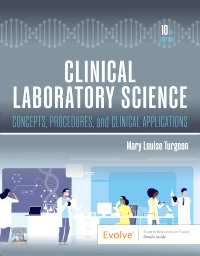
Clinical Laboratory Science: Concepts, Procedures, and Clinical Applications - Elsevier E-Book on VitalSource, 10th Edition
by Mary Louise Turgeon, EdD, MLS(ASCP)CM
Elsevier eBook on VitalSource
ISBN:
9780443280412
Copyright:
2028
Page Count:
796
Imprint:
Elsevier
List Price:
$115.99
Not Yet Available
Most review copies are eBooks – how fast!
A review copy request is most likely to be fulfilled as an eBook on VitalSource rather than a print product, unless no eBook is available. eBooks become available in as little as a few hours. Print products will take between 7 and 10 days to arrive. To request a print copy, please contact us through the Evolve Support Center for further assistance or contact your Elsevier Sales Rep.
Coming Soon!
Expected availability date: 02-12-2027
Prepare your students with the knowledge and skills needed to perform clinical lab tests! Clinical Laboratory Science, 10th Edition, provides a solid foundation in the basic concepts and techniques involved in performing routine clinical lab tests. Coverage includes key areas such as laboratory math, measurement techniques, and safety, and addresses specializations such as phlebotomy and hematology, urinalysis, and molecular diagnostics. Clear, straightforward instructions guide students through laboratory procedures and reflect CLSI (Clinical and Laboratory Standards Institute) standards. More than just a trusted reference, this CLS text prepares students for success on the ASCP board exam.
-
- NEW! Updated content and review questions align with the American Society for Clinical Pathology (ASCP) Board of Certification (BOC) exam outline
- NEW! Coverage of the latest advances in immunology and molecular diagnostics
- NEW! Historical vignettes provide context for specialty areas, including hematology, microbiology, and immunology
-
- NEW! Updated content and review questions align with the American Society for Clinical Pathology (ASCP) Board of Certification (BOC) exam outline
- NEW! Advances in immunology and molecular diagnostics
- NEW! Historical vignettes provide context for specialty areas, including hematology, microbiology, and immunology
- Broad scope of coverage makes this text an ideal companion for clinical laboratory science programs at various levels, including CLS/MLS, CLT/MLT, medical laboratory assistant, and medical assisting, and reflects the taxonomy levels of the CLS/MLS and CLT/MLT exams
- Case studies provide opportunities to apply content to real-life scenarios, and include critical thinking group discussion questions
- Full-color photographs and illustrations clarify concepts and show what can be seen under the microscope
- Helpful tables and summary boxes organize detailed information
- End-of-chapter, multiple-choice review questions are separated by topic, and help students assess their understanding and identify areas requiring additional study
- Detailed procedure guides and procedure worksheets on the Evolve companion website and in the ebook familiarize students with the exact steps performed in the lab
- The newest Entry Level Curriculum Updates for workforce entry, published by the American Society for Clinical Laboratory Science (ASCLS), and the American Society for Clinical Pathology (ASCP) Board of Certification Exam Content Outlines serve as content reference sources
- Convenient glossary makes it easy to look up definitions
- Evolve companion website offers students convenient access to helpful study resources, including animations, flash card sets, and additional review questions
-
Part I: Basic Laboratory Techniques
1. Fundamentals of the Clinical Laboratory
2. Safety: Patient and Clinical Laboratory Practices
3. Quality Assessment and Quality Control in the Clinical Laboratory
4. The Microscope
5. Systems of Measurement, Laboratory Equipment, and Reagents
6. Laboratory Mathematics and Solution Preparation
7. Basic and Contemporary Techniques in the Clinical Laboratory
8. Laboratory Testing: From Point of Care to Total Automation
Part II: Basic Clinical Laboratory Specializations
9. Phlebotomy: Collecting and Processing Patient Blood Specimens
10. An Introduction to the Principles and Practice of Clinical Hematology
11. Hemostasis and Blood Coagulation
12. Renal Physiology and Urinalysis
13. Examination of Body Fluids and Miscellaneous Specimens
14. Introduction to the Principles and Practice of Clinical Chemistry
15. New Frontiers in Molecular Diagnostics
16. Introduction to Medical Microbiology
17. Immunology and Serology
18. Immunohematology and Transfusion Medicine
Appendix A: Answers to Review Questions and Case Studies
Appendix B: AMA Recognized Disease/Organ Panels
Appendix C: Periodic Table
Appendix D: Overview of COVID-19
Appendix E: Molecular Testing Methods
Appendix F: Quick Calculations and Adult Reference Values -
-
Ways of Reading
- The appearance of the text and page layout can be modified according to the capabilities of the reading system (font family and font size, spaces between paragraphs, sentences, words, and letters, as well as color of background and text)
- This e-publication is accessible to the full extent that the file format and types of content allow, on a specific reading device, by default, without necessarily including any additions such as textual descriptions of images or enhanced navigation
- All content can be read as read aloud speech or dynamic braille
-
Conformance
- The certifier's credential is https://bornaccessible.benetech.org/certified-publishers/
- For detailed accessibility information, see Elsevier's website at https://www.elsevier.com/about/accessibility
- For queries regarding accessibility information, contact [email protected]
- The publication was certified on 03-09-2025
-
Navigation
- Table of contents to all chapters of the text via links
- Page list to go to pages from the print source version
-
Rich Content
- No information is available
-
Hazards
- No information is available
-
Product Content
- No information is available
-
Legal Considerations
- No information is available
-
Additional Accessibility Information
- Content is enhanced with ARIA roles to optimize organization and facilitate navigation
- Page breaks included from the original print source
- For readers with color vision deficiency, use of color (e.g., in diagrams, graphics and charts, in prompts, or on buttons inviting a response) is not the sole means of graphical distinction or of conveying information
- The body text is presented with a contrast ratio of at least 4.5:1 (or 3:1 for large/heading text)
- Ultra-high contrast between text and background
- E-publication includes basic navigation (usually less detailed than TOC-based navigation)
- Where links, controls or buttons are included in the content, the purpose or functionality of each link, control or button is apparent from the associated text alone - or where it is unclear, separate link, control or button descriptions are provided
- All (or substantially all) textual matter is arranged in a single logical reading order (including text that is visually presented as separate from the main text flow, e.g., in boxouts, captions, tables, footnotes, endnotes, citations, etc.). Non-textual content is also linked from within this logical reading order. (Purely decorative non-text content can be ignored).
- Where interactive content is included in the product, controls are provided (e.g., for speed, pause and resume, reset) and labelled to make their use clear.
- The language of the text has been specified (e.g., via the HTML or XML lang attribute) to optimise text-to-speech (and other alternative renderings), both at the whole document level and, where appropriate, for individual words, phrases or passages in a different language.
-
Ways of Reading

Not Yet Available
Most review copies are eBooks – how fast!
A review copy request is most likely to be fulfilled as an eBook on VitalSource rather than a print product, unless no eBook is available. eBooks become available in as little as a few hours. Print products will take between 7 and 10 days to arrive. To request a print copy, please contact us through the Evolve Support Center for further assistance or contact your Elsevier Sales Rep.
Coming Soon!
Expected availability date: 02-12-2027

 as described in our