
ISBN:
9780443281846
Copyright:
2027
Publication Date:
03-23-2026
Page Count:
512
Imprint:
Elsevier
List Price:
$82.99

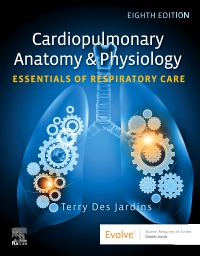
Cardiopulmonary Anatomy & Physiology: Essentials of Respiratory Care - Elsevier E-Book on VitalSource, 8th Edition
by Terry Des Jardins, MEd, RRT
Elsevier eBook on VitalSource
ISBN:
9780443281846
Copyright:
2027
Publication Date:
03-23-2026
Page Count:
512
Imprint:
Elsevier
List Price:
$82.99
Was
$82.99
Now $74.69
Or $0.00 with a valid access code
**Selected for 2026 Doody's Core Titles as an Essential Purchase in Respiratory Therapy**
Prepare for a successful career as a respiratory therapist with the newly redesigned Cardiopulmonary Anatomy & Physiology, 8th Edition, by Terry Des Jardins. This comprehensive resource gives you a solid foundation in the anatomy and physiology of the cardiopulmonary system with clear, concise coverage and a full-color design that helps clarify complex concepts. Practical learning exercises, case studies and review questions offer real-world examples that link chapter content to the daily experiences of respiratory therapists, helping you develop essential critical-thinking skills and preparing you for the challenges of your future career.
Prepare for a successful career as a respiratory therapist with the newly redesigned Cardiopulmonary Anatomy & Physiology, 8th Edition, by Terry Des Jardins. This comprehensive resource gives you a solid foundation in the anatomy and physiology of the cardiopulmonary system with clear, concise coverage and a full-color design that helps clarify complex concepts. Practical learning exercises, case studies and review questions offer real-world examples that link chapter content to the daily experiences of respiratory therapists, helping you develop essential critical-thinking skills and preparing you for the challenges of your future career.
-
- Comprehensive coverage details the structure and function of the cardiopulmonary system
- Case studies provide examples of the respiratory therapist’s role in successful patient care
- End-of-chapter review questions align with chapter learning objectives to ensure you understand important information
-
- NEW clinical anatomy illustrations and a new design throughout the text help enhance comprehension and visually clarify complex topics
- UPDATED Clinical Connections link chapter content to real-life situations in respiratory therapy
-
PART I: The Cardiopulmonary System—The Essentials
1. The Anatomy and Physiology of the Respiratory System
2. Mechanics of Ventilation
3. Pulmonary Function Measurements
4. The Diffusion of Pulmonary Gases
5. The Anatomy and Physiology of the Circulatory System
6. Oxygen and Carbon Dioxide Transport
7. Acid–Base Balance and Regulation
8. Ventilation-Perfusion Relationships
9. Control of Ventilation
10. Fetal Development and the Cardiopulmonary System
11. Aging and the Cardiopulmonary System
PART II: Advanced Cardiopulmonary Concepts and Related Areas—The Essentials
12. Electrophysiology of the Heart
13. The Standard 12-Electrocardiogram Lead System
14. Electrocardiogram Interpretation
15. Hemodynamic Measurements
16. Renal Failure and Its Effects on the Cardiopulmonary System
17. Sleep Physiology and Its Relationship to the Cardiopulmonary System
PART III: The Cardiopulmonary System During Unusual Environmental Conditions
18. Exercise and Its Effects on the Cardiopulmonary System
19. High Altitude and Its Effects on the Cardiopulmonary System
20. High-Pressure Environments and Their Effects on the Cardiopulmonary System
APPENDICES
Appendix A Symbols and Abbreviations
Appendix B Units of Measurement
Appendix C Poiseuille’s Law
Appendix D DuBois Body Surface Chart
Appendix E Cardiopulmonary Profile
Appendix F PCO₂/HCO₃⁻/pH Nomogram
Appendix G Calculating Heart Rate by Counting the Number of Large ECG Squares
Appendix H Answers to Review Questions in Text
Selected References and Bibliography
Glossary
INDEX
Essential Equations -
-
Ways of Reading
- The appearance of the text and page layout can be modified according to the capabilities of the reading system (font family and font size, spaces between paragraphs, sentences, words, and letters, as well as color of background and text)
- This e-publication is accessible to the full extent that the file format and types of content allow, on a specific reading device, by default, without necessarily including any additions such as textual descriptions of images or enhanced navigation
- No information about nonvisual reading is available
-
Conformance
- No information is available
-
Navigation
- Table of contents to all chapters of the text via links
- Page list to go to pages from the print source version
-
Rich Content
- No information is available
-
Hazards
- No information is available
-
Product Content
- No information is available
-
Legal Considerations
- No information is available
-
Additional Accessibility Information
- Content is enhanced with ARIA roles to optimize organization and facilitate navigation
- Page breaks included from the original print source
- For readers with color vision deficiency, use of color (e.g., in diagrams, graphics and charts, in prompts, or on buttons inviting a response) is not the sole means of graphical distinction or of conveying information
- E-publication includes basic navigation (usually less detailed than TOC-based navigation)
- Where links, controls or buttons are included in the content, the purpose or functionality of each link, control or button is apparent from the associated text alone - or where it is unclear, separate link, control or button descriptions are provided
- All (or substantially all) textual matter is arranged in a single logical reading order (including text that is visually presented as separate from the main text flow, e.g., in boxouts, captions, tables, footnotes, endnotes, citations, etc.). Non-textual content is also linked from within this logical reading order. (Purely decorative non-text content can be ignored).
- The language of the text has been specified (e.g., via the HTML or XML lang attribute) to optimise text-to-speech (and other alternative renderings), both at the whole document level and, where appropriate, for individual words, phrases or passages in a different language.
-
Ways of Reading

Was
$82.99
Now $74.69
Or $0.00 with a valid access code

 as described in our