ISBN:
9780443282225
Copyright:
2026
Publication Date:
09-04-2025
Page Count:
364
Imprint:
Mosby
List Price:
$74.99

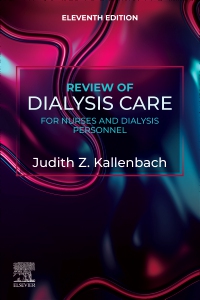
Review of Dialysis Care for Nurses and Dialysis Personnel - Elsevier E-Book on VitalSource, 11th Edition
by Judith Z. Kallenbach, MSN, RN, CNN
Elsevier eBook on VitalSource
ISBN:
9780443282225
Copyright:
2026
Publication Date:
09-04-2025
Page Count:
364
Imprint:
Mosby
List Price:
$74.99
Most review copies are eBooks – how fast!
A review copy request is most likely to be fulfilled as an eBook on VitalSource rather than a print product, unless no eBook is available. eBooks become available in as little as a few hours. Print products will take between 7 and 10 days to arrive. To request a print copy, please contact us through the Evolve Support Center for further assistance or contact your Elsevier Sales Rep.
Give your students complete dialysis coverage and an excellent review for the certification exam! Review of Dialysis Care for Nurses and Dialysis Personnel, 11th Edition, uses a concise Q&A format to cover the principles, diseases, and problems of dialysis treatment for kidney failure. Dialysis expert Judy Kallenbach provides clear, easy-to-read guidelines that will apply to every member of the dialysis team, from technicians and nurses to social workers and patients.
-
- Info on changes to the certification exam
- Updated medication and dialysis content
- Information on new dialysis machines
- Updated info on infection control
- New info on vascular access
-
- NEW! Comprehensive coverage reflects the latest changes to the certification exam
- NEW! Updated content includes the most recent information on dialysis medication and infection control, as well as new content on dialysis machines and vascular access
- Engaging question-and-answer format streamlines the learning process and makes this book suitable for independent learning
- Approachable content assumes no prior dialysis knowledge and introduces new concepts and terms in easy-to-understand language
- Lifespan coverage features separate pediatric chapters and content on end-stage kidney disease in the elderly, preparing students to work with patients of all ages
- Thorough coverage provides the knowledge needed to care for dialysis patients and prepare for the certification exam, including a review of fluid and electrolytes through transplantation, infection control, and important psychosocial aspects of dialysis treatment
- Multidisciplinary approach includes a chapter on the dialysis team, helping students understand how dialysis care is coordinated and what patients experience during their treatment
- Chapter on home dialysis therapies prepares students for this important aspect of care that is becoming more prevalent in today’s cost-conscious healthcare environment
- 70 illustrations complement the review content to help students master all aspects of dialysis treatment and care
-
1. The Hemodialysis Team
2. History of Dialysis
3. Basic Chemistry of Body Fluids and Electrolytes
4. Kidney Physiology and the Pathology of Kidney Failure
5. Clinical Manifestations of Chronic Kidney Disease
6. Dialyzers, Dialysate, and Delivery Systems
7. Principles of Hemodialysis
8. Water Treatment
9. Infection Control
10. Anticoagulation and Heparin Administration
11. Access to the Bloodstream
12. Patient and Machine Monitoring and Assessment
13. Nutrition Management
14. Laboratory Data: Analysis and Interpretation
15. Diabetes and Chronic Kidney Disease
16. Medication Considerations and Dialysis
17. Acute Kidney Injury and Renal Replacement Therapies
18. Peritoneal Dialysis and Home Dialysis Therapies
19. Transplantation
20. Pediatric Dialysis
21. Chronic Kidney Disease in the Elderly
22. Case Management in Chronic Kidney Disease
23. Psychosocial Aspects of Dialysis Therapy
24. Patient Education Guidelines
25. Management of Quality in Dialysis Care
26. On Being a Preceptor
27. Basic Math Calculations
28. Test-Taking Guidelines -
-
Ways of Reading
- The appearance of the text and page layout can be modified according to the capabilities of the reading system (font family and font size, spaces between paragraphs, sentences, words, and letters, as well as color of background and text)
- This e-publication is accessible to the full extent that the file format and types of content allow, on a specific reading device, by default, without necessarily including any additions such as textual descriptions of images or enhanced navigation
- All content can be read as read aloud speech or dynamic braille
- Has alternative text descriptions for images
-
Conformance
- The certifier's credential is https://bornaccessible.benetech.org/certified-publishers/
- For detailed accessibility information, see Elsevier's website at https://www.elsevier.com/about/accessibility
- For queries regarding accessibility information, contact [email protected]
- The publication was certified on 06-02-2026
-
Navigation
- Table of contents to all chapters of the text via links
- Index with links to referenced entries
- Elements such as headings, tables, etc. for structured navigation
- Page list to go to pages from the print source version
-
Rich Content
- Math formulas in accessible format (MathML)
- Information-rich images are described by extended descriptions
-
Hazards
- The publication contains no hazards
-
Product Content
- The primary content is text.
- Content includes a significant number of actionable (clickable) web links to external content, downloadable resources, supplementary material, etc.
- Content includes a significant number of actionable (clickable) cross-references, hyperlinked notes and annotations, or with other actionable links between largely textual elements (e.g., quiz/test questions, 'choose your own ending', etc.).
- Content includes figures, diagrams, charts and/or graphs, including other 'mechanical' (i.e. non-photographic) illustrations.
- Content includes images displayed in a specific order for the purpose of graphic storytelling or giving information (e.g. graphic novels, comics and manga). May include text integrated into the image (as speech and thought bubbles, textual 'sound' effects, captions etc.).
- Content includes text within images, including text-as-text embedded in diagrams, charts, or within images containing speech balloons, thought bubbles, captions, etc.
- Content includes chemical notations, formulae.
- Content includes mathematical notations, formulae.
- At least some text - including text within other images - is 'text as an image' (i.e., a picture of text).
-
Legal Considerations
- No information is available
-
Additional Accessibility Information
- Content is enhanced with ARIA roles to optimize organization and facilitate navigation
- Page breaks included from the original print source
- For readers with color vision deficiency, use of color (e.g., in diagrams, graphics and charts, in prompts, or on buttons inviting a response) is not the sole means of graphical distinction or of conveying information
- The body text is presented with a contrast ratio of at least 4.5:1 (or 3:1 for large/heading text)
- Ultra-high contrast between text and background
- E-publication includes basic navigation (usually less detailed than TOC-based navigation)
- Where links, controls or buttons are included in the content, the purpose or functionality of each link, control or button is apparent from the associated text alone - or where it is unclear, separate link, control or button descriptions are provided
- All (or substantially all) textual matter is arranged in a single logical reading order (including text that is visually presented as separate from the main text flow, e.g., in boxouts, captions, tables, footnotes, endnotes, citations, etc.). Non-textual content is also linked from within this logical reading order. (Purely decorative non-text content can be ignored).
- Content provides explanations for unusual words, abbreviations, acronyms, idioms, jargon in an accessible form, such as glossaries, scripted pop-ups.
- Where interactive content is included in the product, controls are provided (e.g., for speed, pause and resume, reset) and labelled to make their use clear.
- The language of the text has been specified (e.g., via the HTML or XML lang attribute) to optimise text-to-speech (and other alternative renderings), both at the whole document level and, where appropriate, for individual words, phrases or passages in a different language.
-
Ways of Reading

Most review copies are eBooks – how fast!
A review copy request is most likely to be fulfilled as an eBook on VitalSource rather than a print product, unless no eBook is available. eBooks become available in as little as a few hours. Print products will take between 7 and 10 days to arrive. To request a print copy, please contact us through the Evolve Support Center for further assistance or contact your Elsevier Sales Rep.

 as described in our