ISBN:
9780443284953
Copyright:
2026
Publication Date:
10-07-2025
Page Count:
392
Imprint:
Saunders
List Price:
$87.99

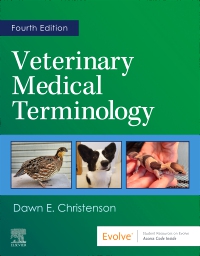
Veterinary Medical Terminology- Elsevier E-Book on VitalSource, 4th Edition
by Dawn E. Christenson, LVT
Elsevier eBook on VitalSource
ISBN:
9780443284953
Copyright:
2026
Publication Date:
10-07-2025
Page Count:
392
Imprint:
Saunders
List Price:
$87.99
Was
$87.99
Now $61.59
Or $0.00 with a valid access code
Organized by body system, this user-friendly textbook helps you quickly gain a solid understanding of veterinary terminology. Essential word parts and terms are presented in the context of basic anatomy, physiology, and disease conditions, enabling you to immediately apply new terms to practical clinical situations. A companion Evolve website features interactive exercises that reinforce your mastery of veterinary terminology, as well as audio clips to help you learn proper pronunciation. Learning exercises at the end of each chapter test your knowledge, challenging you to go beyond simple memorization and become fluent in the language of veterinary medicine. With the latest advancements in the field and all-new learning exercises throughout, Veterinary Medical Terminology, 4th Edition, is an essential resource for learning medical terms and understanding basic principles of veterinary medicine.
-
- NEW! Nora AI - an AI-powered learning assistant exclusive to Elsevier ebooks on VitalSource's Bookshelf® platform - offers built-in AI learning support that provides personalized answers based on content from the Elsevier ebook
- UPDATED! Case studies on the Evolve companion website reflect modern veterinary practice
- UPDATED! Coverage of advancements in veterinary technology include all-new drugs, today’s most prevalent diseases, and all-new procedures in orthopedics
- UNIQUE! Goals and Objectives sections at the beginning of each chapter help you focus your study time and check your recall and understanding of key facts and terminology
- UNIQUE! Self-study sections at the beginning of each chapter summarize key terms and concepts you need to grasp, testing recall of fact, recognition of concepts, and prediction of principles
- Accessible Evolve companion website offers interactive games and audio pronunciations to help reinforce your understanding of key word parts and terms
- Logical body-systems approach and consistent chapter format make it fun and easy to learn veterinary terminology
- More than 200 illustrations clearly demonstrate key anatomy and physiology concepts and terminology
- Helpful appendices provide information on chemical symbols and elements and common veterinary medical abbreviations
- Complete glossary of word parts on the companion Evolve website gives you quick access to the spelling and meaning of every prefix, suffix, root, and combining form covered in the book
- Presentation of anatomic, physiologic, and/or pathophysiologic concepts and principles, included in all chapters, serves as a vehicle for immediate application of newly learned terms
- Self-tests at the ends of chapters allow you to review your mastery of key content
-
-

-
 Veterinary Medical TerminologyPaperback
-
-
1. Fundamentals and Applied Directional Terminology
2. Body Building Applied Atomic, Molecular, and Cellular Terminology
3. Applied Terminology for Blood, Lymphatics, and Immunity
4. Applied Terminology for Muscles, Bones, and Joints
5. Applied Cardiovascular and Respiratory Terminology
6. Applied Urinary Terminology
7. Applied Digestive Terminology
8. Applied Terminology for the Integumentary System
9. Applied Reproductive Terminology
10. Applied Endocrine Terminology
11. Applied Terminology for Neurology and Special Senses
12. Applied Terminology for Pharmacology -
-
Ways of Reading
- The appearance of the text and page layout can be modified according to the capabilities of the reading system (font family and font size, spaces between paragraphs, sentences, words, and letters, as well as color of background and text)
- This e-publication is accessible to the full extent that the file format and types of content allow, on a specific reading device, by default, without necessarily including any additions such as textual descriptions of images or enhanced navigation
- All content can be read as read aloud speech or dynamic braille
- Has alternative text descriptions for images
-
Conformance
- The certifier's credential is https://bornaccessible.benetech.org/certified-publishers/
- For detailed accessibility information, see Elsevier's website at https://www.elsevier.com/about/accessibility
- For queries regarding accessibility information, contact [email protected]
- The publication was certified on 22-09-2025
-
Navigation
- Table of contents to all chapters of the text via links
- Index with links to referenced entries
- Elements such as headings, tables, etc. for structured navigation
- Page list to go to pages from the print source version
-
Rich Content
- Math formulas in accessible format (MathML)
- Information-rich images are described by extended descriptions
-
Hazards
- The publication contains no hazards
-
Product Content
- Content includes any type of illustrations.
- The primary content is text.
- Content includes a significant number of actionable (clickable) web links to external content, downloadable resources, supplementary material, etc.
- Content includes a significant number of actionable (clickable) cross-references, hyperlinked notes and annotations, or with other actionable links between largely textual elements (e.g., quiz/test questions, 'choose your own ending', etc.).
- Content includes photographs, whether in a plate section / insert or not.
- Content includes figures, diagrams, charts and/or graphs, including other 'mechanical' (i.e. non-photographic) illustrations.
- Content includes images displayed in a specific order for the purpose of graphic storytelling or giving information (e.g. graphic novels, comics and manga). May include text integrated into the image (as speech and thought bubbles, textual 'sound' effects, captions etc.).
- Content includes text within images, including text-as-text embedded in diagrams, charts, or within images containing speech balloons, thought bubbles, captions, etc.
- Content includes mathematical notations, formulae.
- At least some text - including text within other images - is 'text as an image' (i.e., a picture of text).
-
Legal Considerations
- No information is available
-
Additional Accessibility Information
- Content is enhanced with ARIA roles to optimize organization and facilitate navigation
- Page breaks included from the original print source
- For readers with color vision deficiency, use of color (e.g., in diagrams, graphics and charts, in prompts, or on buttons inviting a response) is not the sole means of graphical distinction or of conveying information
- The body text is presented with a contrast ratio of at least 4.5:1 (or 3:1 for large/heading text)
- Ultra-high contrast between text and background
- E-publication includes basic navigation (usually less detailed than TOC-based navigation)
- Where links, controls or buttons are included in the content, the purpose or functionality of each link, control or button is apparent from the associated text alone - or where it is unclear, separate link, control or button descriptions are provided
- All (or substantially all) textual matter is arranged in a single logical reading order (including text that is visually presented as separate from the main text flow, e.g., in boxouts, captions, tables, footnotes, endnotes, citations, etc.). Non-textual content is also linked from within this logical reading order. (Purely decorative non-text content can be ignored).
- Where interactive content is included in the product, controls are provided (e.g., for speed, pause and resume, reset) and labelled to make their use clear.
- The language of the text has been specified (e.g., via the HTML or XML lang attribute) to optimise text-to-speech (and other alternative renderings), both at the whole document level and, where appropriate, for individual words, phrases or passages in a different language.
-
Ways of Reading
Was
$87.99
Now $61.59
Or $0.00 with a valid access code

 as described in our