ISBN:
9780443285288
Copyright:
2026
Publication Date:
12-15-2025
Page Count:
432
Imprint:
Mosby
List Price:
$95.99

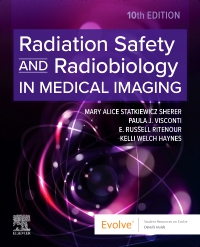
Radiation Safety and Radiobiology In Medical Imaging - Elsevier E-Book on VitalSource, 10th Edition
by Mary Alice Statkiewicz Sherer, AS, RT(R), FASRT, Paula J. Visconti, PhD, DABR, E. Russell Ritenour, PhD, DABR, FAAPM, FACR and Kelli Welch Haynes, EdD, RT(R), FASRT, FAEIRS
Elsevier eBook on VitalSource
ISBN:
9780443285288
Copyright:
2026
Publication Date:
12-15-2025
Page Count:
432
Imprint:
Mosby
List Price:
$95.99
Was
$95.99
Now $67.19
Or $0.00 with a valid access code
Master the basic principles and techniques of radiation safety! Radiation Safety and Radiobiology in Medical Imaging, 10th Edition, makes it easy to understand both basic and complex concepts in radiation protection, radiobiology, and radiation physics. Clear, concise information is presented in a logical format with high-quality radiographs and visually striking full-color drawings, graphs, tables, and boxes. Complete coverage addresses the safe use of ionizing radiation in all imaging modalities, including the effects of radiation on humans at the cellular and systemic levels, regulatory and advisory limits for exposure to radiation, and the implementation of radiation safety practices for patients and personnel. This text is also a valuable resource to help you prepare for the ARRT certification exam and state licensing exams.
-
- UPDATED! Expanded coverage examines radiation safety related to cone beam CT (CBCT)
- NEW! Introduction of theranostics explores this combined diagnostic and therapeutic cancer treatment related modality
- NEW! Discussion of AI addresses its fundamental principles and the increasing use of AI to assist in precise radiographic imaging
- UPDATED! Revised chapter titles and sequence put subjects in a logical order for optimal learning
- UPDATED! Content reflects the latest ARRT content specifications and ASRT curriculum guidelines
-
- NEW! Nora AI - an AI-powered learning assistant exclusive to Elsevier ebooks on VitalSource's Bookshelf® platform - offers built-in AI learning support that provides personalized answers based on content from the Elsevier ebook
- Timely coverage of radiation protection regulations addresses radiation awareness and education efforts across the globe
- Convenient, easy-to-use features include chapter outlines and objectives, listing and highlighting of key terms, bulleted summaries, general discussion questions, and review questions to enhance comprehension and retention
- Extensive use of illustrations and tables visually reinforces important concepts and offers quick access to key information
- Clear and concise writing style covers complex concepts in radiation protection, biology, and physics in a building-block approach from basic to more complex
-
-
 Sherpath for Sherer Radiation Safety and Radiobiology in Medical ImagingSherpath Book-Organized
 -

-
-
1. Introduction to Radiation Protection
2. Radiation: Types, Sources, and Doses
3. X-ray Interactions With Matter
4. Radiation Quantities and Units
5. Overview of Cell Biology
6. Molecular and Cellular Radiation Biology
7. Early Effects of Radiation Exposure
8. Late Effects of Radiation Exposure
9. Dose Limits for Exposure to Ionizing Radiation
10. Equipment Design for Radiation Protection
11. Management of Patient Radiation Dose
12. Management of Occupational Radiation Dose
13. Radiation Monitoring
14. Radiation Safety in Computed Tomography
15. Radiation Safety in Mammography
16. Radiation Safety in Nuclear Medicine
Appendix
A: Relationships Between Systems of Units
B: Image Gently Pledge and Image Wisely Pledge
C: Standard Designations for Metric System Lengths, Electron Volt Energy Levels, and Frequency Spectrum Ranges
D: Periodic Table of Elements
E: Relationship Among Photons, Electromagnetic Waves, Wavelength, and Energy
F: Electron Shell Structure of the Atom
G: Compton Interaction
H: NCRP 10CFR Part 35.50 Training for Radiation Safety Officer and Associate Radiation Safety Officer
Appendix I: Consumer-Patient Radiation Health and Safety Act of 1981 -
-
Ways of Reading
- The appearance of the text and page layout can be modified according to the capabilities of the reading system (font family and font size, spaces between paragraphs, sentences, words, and letters, as well as color of background and text)
- This e-publication is accessible to the full extent that the file format and types of content allow, on a specific reading device, by default, without necessarily including any additions such as textual descriptions of images or enhanced navigation
- All content can be read as read aloud speech or dynamic braille
- Has alternative text descriptions for images
-
Conformance
- The certifier's credential is https://bornaccessible.benetech.org/certified-publishers/
- For detailed accessibility information, see Elsevier's website at https://www.elsevier.com/about/accessibility
- For queries regarding accessibility information, contact [email protected]
- The publication was certified on 08-09-2025
-
Navigation
- Table of contents to all chapters of the text via links
- Index with links to referenced entries
- Page list to go to pages from the print source version
-
Rich Content
- Math formulas in accessible format (MathML)
- Information-rich images are described by extended descriptions
-
Hazards
- The publication contains no hazards
-
Product Content
- Content includes any type of illustrations.
- The primary content is text.
- Content includes maps and/or other cartographic content.
- Content includes a significant number of actionable (clickable) cross-references, hyperlinked notes and annotations, or with other actionable links between largely textual elements (e.g., quiz/test questions, 'choose your own ending', etc.).
- Content includes additional textual content such as an interview, feature article, essay, bibliography, quiz/test, other background material, or text that is not included in a primary or 'unenhanced' version.
- Content includes supplementary text as promotional content such as, for example, a teaser chapter.
- Content includes photographs, whether in a plate section / insert or not.
- Content includes figures, diagrams, charts and/or graphs, including other 'mechanical' (i.e. non-photographic) illustrations.
- Content includes a significant number of web links (printed URLs, QR codes etc.).
- Content includes text within images, including text-as-text embedded in diagrams, charts, or within images containing speech balloons, thought bubbles, captions, etc.
- Content includes visual content that is purely decorative and is not necessary to understanding of the content.
- Content includes mathematical notations, formulae.
- Product includes actionable (clickable) links to external interactive content.
-
Legal Considerations
- No information is available
-
Additional Accessibility Information
- Content is enhanced with ARIA roles to optimize organization and facilitate navigation
- Page breaks included from the original print source
- For readers with color vision deficiency, use of color (e.g., in diagrams, graphics and charts, in prompts, or on buttons inviting a response) is not the sole means of graphical distinction or of conveying information
- The body text is presented with a contrast ratio of at least 4.5:1 (or 3:1 for large/heading text)
- Ultra-high contrast between text and background
- E-publication includes basic navigation (usually less detailed than TOC-based navigation)
- Where links, controls or buttons are included in the content, the purpose or functionality of each link, control or button is apparent from the associated text alone - or where it is unclear, separate link, control or button descriptions are provided
- All (or substantially all) textual matter is arranged in a single logical reading order (including text that is visually presented as separate from the main text flow, e.g., in boxouts, captions, tables, footnotes, endnotes, citations, etc.). Non-textual content is also linked from within this logical reading order. (Purely decorative non-text content can be ignored).
- Content provides explanations for unusual words, abbreviations, acronyms, idioms, jargon in an accessible form, such as glossaries, scripted pop-ups.
- Where interactive content is included in the product, controls are provided (e.g., for speed, pause and resume, reset) and labelled to make their use clear.
- The language of the text has been specified (e.g., via the HTML or XML lang attribute) to optimise text-to-speech (and other alternative renderings), both at the whole document level and, where appropriate, for individual words, phrases or passages in a different language.
-
Ways of Reading
Was
$95.99
Now $67.19
Or $0.00 with a valid access code

 as described in our