ISBN:
9780443286742
Copyright:
2025
Publication Date:
10-11-2024
Page Count:
210
Imprint:
Elsevier
List Price:
$55.99

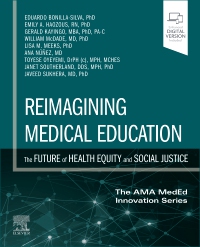
Reimagining Medical Education: The Future of Health Equity and Social Justice - Reimagining Medical Education: The Future of Health Equity and Social Justice, 1st Edition
by Eduardo Bonilla-Silva, PhD, Emily A. Haozous, RN, PhD, Gerald Kayingo, PhD, MMSc, PA-C, William McDade, MD, PhD, Lisa Meeks, PhD, Ana Núñez, MD, Toyese Oyeyemi, MPH, MCHES, Janet Southerland, DDS, MPH, PhD and Javeed Sukhera, MD, PhD
Elsevier eBook on VitalSource
ISBN:
9780443286742
Copyright:
2025
Publication Date:
10-11-2024
Page Count:
210
Imprint:
Elsevier
List Price:
$55.99
Was
$55.99
Now $50.39
Or $0.00 with a valid access code
Inequities in health care and medical education have a long and complex history involving racism, sexism, ableism, exclusivity, and other forms of social injustice. Reimagining Medical Education: The Future of Health Equity and Social Justice, externally commissioned by the American Medical Association and part of the AMA MedEd Innovation Series, explores and addresses these ongoing issues. Using both theoretical and practical approaches, medical educators share a vision of medical education through a social justice lens. The resulting volume focuses on equity throughout medical education: improving the diversity of the student, faculty, and health workforce and ameliorating inequitable outcomes among minoritized and marginalized patient populations. This unique, change-oriented text.
-
- Shares knowledge and insight from a diverse team of authors who outline what an equitable future for medical education and health care can be
- Provides a thought-provoking account of the negative impact of centuries of asymmetry of power
- Offers an aspirational vision of a just system for recruiting, training, and empowering the next generation of care providers and how to impact change at the individual, institutional, and population levels
- Covers both medical school (UME) and residency program (GME) implementation strategies
- Contains practical, visionary guidance for faculty, staff, students, administrators, and leaders in medical education
- An eBook version is included with purchase. The eBook allows you to access all of the text, figures and references, with the ability to search, customize your content, make notes and highlights, and have content read aloud
-
PART I Understanding and Conceptualizing Transformative Ideas
1. Medicine and Medical Education Otherwise: Speculative Futures of the Healing Professions
2. A Precision Medical Education Approach to Achieving Justice, Equity, Diversity, and Inclusion
PART II From Surface to Structures
3. Creating a More Equitable Medical School Experience: Fostering Well-Being and Inclusivity in Medical Education Through Varied Curricular Timelines
4. From Empathy to Epistemic Justice: Reconceptualizing Disability in Medical Education Using the 4R Model
PART III Case Studies: Curriculum and Pedagogy
5. Healing-Centered Pedagogy: Understanding and Addressing Minoritized and Marginalized Trauma, Stress, and Healing in Medical Education
6. Dismantling Ableism in Interprofessional Medical Education to Promote Health Equity for People With Disabilities
7. The “Add-A-Slide” Approach: A Practical Solution for Integrating LGBTQ+ Health Topics into Undergraduate Medical Education
8. Engaging Pediatric Providers in Racial Equity Education: Process, Reflections, and Next Steps
9. Training the 21st-Century Physician: Health Equity Cutting-Edge Technology and Pedagogy, and a Global Perspective
10. Building a Diverse and Equitable Future: The Role of Geographic Information Systems, Spatial Analysis, and Social Justice in Medical Education
PART IV Case Studies: Admission, Selection, Pathways, and Pipelines
11. The Mission-Based Program Model: A Programmatic Framework to Drive Diversity and Health Equity in Medical Education
12. Re-imagining Clinical Interviewing: Bridging the Gap Between Theory and Practice for Equitable Care
PART V Case Studies: Community Partnerships
13. Community-Directed Graduate Medical Education as a Pathway to Improved Health Equity and Social Justice
14. Social Responsibility as the North Star to Transform Medical Education
PART VI Case Studies: Leadership, Culture, and Climate Change
15. Leveraging the Underrepresented in Medicine Minority Faculty Experience: A Platform for Addressing Health Equity and Racial Justice in Medical Education
16. Dismantling the Complex Systems of Power and Privilege in Medical Education Through Change Management
17. Reimagining Health Care Professional Education to Embrace Socioeconomically Diverse Learners -
-
Ways of Reading
- The appearance of the text and page layout can be modified according to the capabilities of the reading system (font family and font size, spaces between paragraphs, sentences, words, and letters, as well as color of background and text)
- This e-publication is accessible to the full extent that the file format and types of content allow, on a specific reading device, by default, without necessarily including any additions such as textual descriptions of images or enhanced navigation
- No information about nonvisual reading is available
-
Conformance
- No information is available
-
Navigation
- Table of contents to all chapters of the text via links
- Page list to go to pages from the print source version
-
Rich Content
- No information is available
-
Hazards
- No information is available
-
Product Content
- No information is available
-
Legal Considerations
- No information is available
-
Additional Accessibility Information
- Content is enhanced with ARIA roles to optimize organization and facilitate navigation
- Page breaks included from the original print source
- For readers with color vision deficiency, use of color (e.g., in diagrams, graphics and charts, in prompts, or on buttons inviting a response) is not the sole means of graphical distinction or of conveying information
- E-publication includes basic navigation (usually less detailed than TOC-based navigation)
- Where links, controls or buttons are included in the content, the purpose or functionality of each link, control or button is apparent from the associated text alone - or where it is unclear, separate link, control or button descriptions are provided
- All (or substantially all) textual matter is arranged in a single logical reading order (including text that is visually presented as separate from the main text flow, e.g., in boxouts, captions, tables, footnotes, endnotes, citations, etc.). Non-textual content is also linked from within this logical reading order. (Purely decorative non-text content can be ignored).
- The language of the text has been specified (e.g., via the HTML or XML lang attribute) to optimise text-to-speech (and other alternative renderings), both at the whole document level and, where appropriate, for individual words, phrases or passages in a different language.
-
Ways of Reading

Was
$55.99
Now $50.39
Or $0.00 with a valid access code

 as described in our