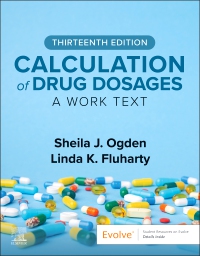

Calculation of Drug Dosages - Elsevier eBook on VitalSource, 13th Edition
Elsevier eBook on VitalSource
Drug dosage calculation is non-negotiable in clinical practice — and this work text helps ensure students are fully prepared.
Calculation of Drug Dosages: A Work Text, 13th Edition, covers all three major methods of drug dosage calculation — ratio and proportion, formula, and dimensional analysis — in a clear, structured format designed to build confidence and competence. A streamlined mathematics review brings together all five key areas in one place, helping students strengthen foundational skills and identify areas for improvement. Practice problems, worksheets, and chapter post-tests provide ample opportunity to apply learning, while a comprehensive, end-of-book post-test offers a final measure of overall understanding.
Next Generation NCLEX® (NGN) exam-style practice problems help students develop the critical thinking skills needed for drug calculation and administration on the NGN exam. Written by respected nursing experts Sheila J. Ogden and Linda K. Fluharty, this worktext is the ideal resource for nursing students and nurses returning to practice.
-
- NEW! Streamlined math review chapter brings together all five key areas in one place, with ample practice problems to reinforce learning
- NEW! Drug labels and clinical information reflect current practice, with particular attention to critical care, insulin, and diabetes medications
- NEW! Photos throughout the text showcase greater cultural diversity
- Extensive math review covers the basic math skills essential for accurate drug dosage calculation to help students identify their strengths and areas for improvement
- Chapter material organized from simple to complex, with worksheets and post-tests, allows students to practice realistic problems and assess their understanding along the way
- Alert boxes highlight information critical to math calculation and patient safety
- Comprehensive, end-of-book post-test offers additional practice and an accurate gauge of overall understanding
- Learning objectives help keep students focused and clarify what they should accomplish upon completing each chapter
- Next Generation NCLEX® exam-style practice problems promote critical thinking in drug calculation and administration
- This title is also available in Sherpath! Sold separately, this innovative teaching and learning technology offers interactive course content and resources that streamline class preparation and assessment and give students personalized help to reach their learning goals. Sherpath fully includes the eBook of this title for all-in-one digital course delivery.
-
-

-
 Calculation of Drug DosagesPaperback
-
-
Part I: Review of Mathematics
Review of Mathematics Pre-Test
1. Fractions
2. Decimals
3. Percents
4. Ratios
5. Proportions
Review of Mathematics Post-Test
Part II: Units and Measurements for the Calculation of Drug Dosages
6. Metric and Household Measurements
7. Calculations Used in Patient Assessments
Part III: Preparation for Calculation of Drug Dosages
8. Safety in Medication Administration
9. Interpretation of the Physician's Orders
10. Reading Medication Labels
Part IV: Calculation of Drug Dosages
11. Oral Dosages
12. Parenteral Dosages
13. Dosages Measured in Units
14. Reconstitution of Medications
15. Intravenous Flow Rates
16. Intravenous Flow Rates for Dosages Measured in Units
17. Critical Care Intravenous Flow Rates
18. Pediatric Dosages
19. Obstetric Dosages
Comprehensive Post-Test
Glossary
Appendix A: Apothecary Systems of Measure -
-
Ways of Reading
- The appearance of the text and page layout can be modified according to the capabilities of the reading system (font family and font size, spaces between paragraphs, sentences, words, and letters, as well as color of background and text)
- This e-publication is accessible to the full extent that the file format and types of content allow, on a specific reading device, by default, without necessarily including any additions such as textual descriptions of images or enhanced navigation
- All content can be read as read aloud speech or dynamic braille
-
Conformance
- The certifier's credential is https://bornaccessible.benetech.org/certified-publishers/
- For detailed accessibility information, see Elsevier's website at https://www.elsevier.com/about/accessibility
- For queries regarding accessibility information, contact [email protected]
- The publication was certified on 03-09-2025
-
Navigation
- Table of contents to all chapters of the text via links
- Page list to go to pages from the print source version
-
Rich Content
- No information is available
-
Hazards
- No information is available
-
Product Content
- No information is available
-
Legal Considerations
- No information is available
-
Additional Accessibility Information
- Content is enhanced with ARIA roles to optimize organization and facilitate navigation
- Page breaks included from the original print source
- For readers with color vision deficiency, use of color (e.g., in diagrams, graphics and charts, in prompts, or on buttons inviting a response) is not the sole means of graphical distinction or of conveying information
- The body text is presented with a contrast ratio of at least 4.5:1 (or 3:1 for large/heading text)
- Ultra-high contrast between text and background
- E-publication includes basic navigation (usually less detailed than TOC-based navigation)
- Where links, controls or buttons are included in the content, the purpose or functionality of each link, control or button is apparent from the associated text alone - or where it is unclear, separate link, control or button descriptions are provided
- All (or substantially all) textual matter is arranged in a single logical reading order (including text that is visually presented as separate from the main text flow, e.g., in boxouts, captions, tables, footnotes, endnotes, citations, etc.). Non-textual content is also linked from within this logical reading order. (Purely decorative non-text content can be ignored).
- Where interactive content is included in the product, controls are provided (e.g., for speed, pause and resume, reset) and labelled to make their use clear.
- The language of the text has been specified (e.g., via the HTML or XML lang attribute) to optimise text-to-speech (and other alternative renderings), both at the whole document level and, where appropriate, for individual words, phrases or passages in a different language.
-
Ways of Reading

 as described in our
