ISBN:
9780443351044
Copyright:
2028
Page Count:
224
Imprint:
Elsevier
List Price:
$94.99

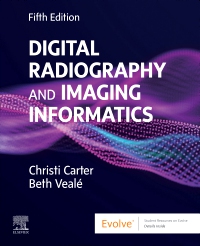
Digital Radiography and Imaging Informatics - Elsevier eBook on VitalSource, 5th Edition
by Christi Carter, MSRS, RT(R) and Beth Veale, BSRS, MEd, RT(R)(QM)
Elsevier eBook on VitalSource
ISBN:
9780443351044
Copyright:
2028
Page Count:
224
Imprint:
Elsevier
List Price:
$94.99
$94.99
Or $0.00 with a valid access code
Not Yet Available
Coming Soon!
Expected availability date: 02-01-2027
Master the techniques and principles of digital imaging! Using an easy-to-understand format and style, Digital Radiography and Imaging Informatics, 5th Edition, provides the latest information on digital imaging systems. It offers tips on producing clear radiographic images and helps you build skills in computed radiography (CR) and digital radiography (DR), as well as Medical Image Management and Processing Systems (MIMPS). Coverage also includes the management of medical images from acquisition to the storage and sharing of data. Written by noted educators Christi Carter and Beth Vealé, this book provides excellent preparation for the ARRT credentialing exam and for success as a practicing technologist.
-
- NEW! Updates include new content on evolving technologies, including cloud computing, display technology, DICOM (Digital Imaging and Communications in Medicine), HL7 (Health Level 7), and CIIP (Certified Imaging Informatics Professional) qualifications
- NEW! Content from the latest ARRT content specifications and ASRT curriculum guidelines is incorporated into the text
-
- Authoritative, trusted information on digital imaging systems includes computed radiography (CR), digital radiography (DR), and Medical Image Management and Processing Systems (MIMPS, formerly PACS)
- Practical information addresses topics such as working with CR/DR workstations, including advanced image processing and manipulation functions; MIMPS workstations, archiving solutions, and system architectures; plus effective techniques for digitizing film, printing images, and preparing image files
- In-depth coverage of imaging informatics includes hardware, infrastructure, standards, project management, and more
- More than 200 photographs and illustrations show digital imaging concepts and systems
- Learning objectives, outlines, and key terms at the beginning of each chapter introduce the chapter content, and help you organize, study, and boost your comprehension
- Bulleted summaries recap the main points of each chapter, ensuring that you focus on the most important concepts
- Review questions reflect the chapter objectives and help you assess your understanding of the material
-
Part I: Introduction
1. Introduction to Digital Radiology and Imaging Informatics
Part II: Basic Principles of Digital Radiography
2. Digital Imaging Characteristics
3. Digital Radiographic Image Processing Manipulation
Part III: Digital Image Acquisition
4. Digital Imaging Basics
5. Thin-Film Transistor Flat Panel Array Image Acquisition
6. Charged-Coupled Device/Complementary Metal Oxide Semiconductor Image Capture
7. Quality Acceptance Testing Within Digital Projection Imaging
Part IV: Imaging Informatics
8. Informatics: Infrastructure
9. Informatics: Systems
10. Informatics: Standards in Medical Imaging
11. Informatics: Governance, Risk and Innovation
12. Informatics: Project Management
Glossary
Abbreviations -
-
Ways of Reading
- The appearance of the text and page layout can be modified according to the capabilities of the reading system (font family and font size, spaces between paragraphs, sentences, words, and letters, as well as color of background and text)
- This e-publication is accessible to the full extent that the file format and types of content allow, on a specific reading device, by default, without necessarily including any additions such as textual descriptions of images or enhanced navigation
- All content can be read as read aloud speech or dynamic braille
-
Conformance
- The certifier's credential is https://bornaccessible.benetech.org/certified-publishers/
- For detailed accessibility information, see Elsevier's website at https://www.elsevier.com/about/accessibility
- For queries regarding accessibility information, contact [email protected]
- The publication was certified on 03-09-2025
-
Navigation
- Table of contents to all chapters of the text via links
- Page list to go to pages from the print source version
-
Rich Content
- No information is available
-
Hazards
- No information is available
-
Product Content
- No information is available
-
Legal Considerations
- No information is available
-
Additional Accessibility Information
- Content is enhanced with ARIA roles to optimize organization and facilitate navigation
- Page breaks included from the original print source
- For readers with color vision deficiency, use of color (e.g., in diagrams, graphics and charts, in prompts, or on buttons inviting a response) is not the sole means of graphical distinction or of conveying information
- The body text is presented with a contrast ratio of at least 4.5:1 (or 3:1 for large/heading text)
- Ultra-high contrast between text and background
- E-publication includes basic navigation (usually less detailed than TOC-based navigation)
- Where links, controls or buttons are included in the content, the purpose or functionality of each link, control or button is apparent from the associated text alone - or where it is unclear, separate link, control or button descriptions are provided
- All (or substantially all) textual matter is arranged in a single logical reading order (including text that is visually presented as separate from the main text flow, e.g., in boxouts, captions, tables, footnotes, endnotes, citations, etc.). Non-textual content is also linked from within this logical reading order. (Purely decorative non-text content can be ignored).
- Where interactive content is included in the product, controls are provided (e.g., for speed, pause and resume, reset) and labelled to make their use clear.
- The language of the text has been specified (e.g., via the HTML or XML lang attribute) to optimise text-to-speech (and other alternative renderings), both at the whole document level and, where appropriate, for individual words, phrases or passages in a different language.
-
Ways of Reading


$94.99
Or $0.00 with a valid access code
Not Yet Available
Coming Soon!
Expected availability date: 02-01-2027

 as described in our