
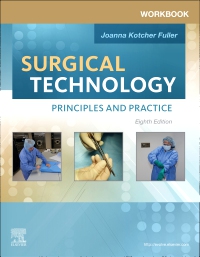

Workbook for Surgical Technology - Elsevier eBook on VitalSource, 8th Edition
Elsevier eBook on VitalSource
Now $43.11
Get the review and practice you need to succeed on classroom and certification exams! Corresponding chapter by chapter to Fuller’s Surgical Technology: Principles and Practice, 8th Edition textbook, this practical workbook helps you master the role and the essential skills of the surgical technologist. Each chapter contains a variety of activities, including key terms, labeling, practice questions, and realistic case studies with critical thinking exercises. Making it easy to apply your knowledge to practice, this study tool ensures that you have everything you need for success in a surgical technology career.
Newer Edition Available

Workbook for Surgical Technology - Elsevier E-Book on VitalSource
-
-
 Surgical Technology - Elsevier eBook on VitalSourceElsevier eBook on VitalSource
-
-
- Case studies encourage you to think strategically and apply your knowledge to realistic situations in the operating room environment
- More than 80 Skills Checklists provide clear guidelines for performing each skill, and help you evaluate your performance of core functions by practicing skills until you have mastered them
- Variety of exercises includes a review of key terms, practice questions, labeling exercises, and case studies with critical thinking questions, reinforcing your understanding and preparing you for in-class testing and for the certification exam
- Reader-friendly writing style and organization makes the content easier to understand
-
- NEW Robotic Surgery chapter includes exercises for the most frequently performed minimally invasive procedures involving surgical robots
- NEW! Updated and expanded Skills Checklists add coverage of patient preparation, transporting, positioning, and draping
- NEW! Updated exercises are provided for the updated and expanded content in the surgical technology textbook
- NEW! Additional multiple-choice questions mirror the types of questions found on the Certified Surgical Technologist exam
-
1. The Surgical Technologist
2. Communication, Teamwork and Professionalism
3. Law, Documentation and Professional Ethics
4. The Health Care Facility
5. The Patient in Surgery
6. Diagnostic and Assessment Procedure
7. Hazards in the Perioperative Environment
8. Microbes and the Process of Infection
9. Aseptic Technique
10. Decontamination, Sterilization, and Disinfection
11. Surgical Instruments
12. Perioperative Pharmacology
13. Anesthesia and Physiological Monitoring
14. Post Anesthesia Recovery
15. Death and Dying
16. Energy Sources in Surgery
17. Moving, Handling and Positioning the Surgical
18. Surgical Skin Preparation and Draping
19. Case Planning and Basic Intraoperative Skills
20. Management of the Surgical Wound
21. Minimally Invasive Surgery
22. Robotic Surgery
23. General Surgery
24. Gynecological and Obstetrical Surgery
25. Genitourinary Surgery
26. Ophthalmic Surgery
27. Surgery of the Ear Nose Pharynx and Larynx
28. Oral and Maxillofacial Surgery
29. Plastic and Reconstructive Surgery
30. Orthopedic Surgery
31. Peripheral Vascular Surgery
32. Thoracic and Pulmonary Surgery
33. Cardiac Surgery
34. Pediatric Surgery
35. Neurosurgery
36. Emergency Trauma Surgery
37. Disaster Preparedness and Response
-
-
Ways of Reading
- The appearance of the text and page layout can be modified according to the capabilities of the reading system (font family and font size, spaces between paragraphs, sentences, words, and letters, as well as color of background and text)
- This e-publication is accessible to the full extent that the file format and types of content allow, on a specific reading device, by default, without necessarily including any additions such as textual descriptions of images or enhanced navigation
- No information about nonvisual reading is available
-
Conformance
- No information is available
-
Navigation
- Table of contents to all chapters of the text via links
- Page list to go to pages from the print source version
-
Rich Content
- No information is available
-
Hazards
- No information is available
-
Product Content
- No information is available
-
Legal Considerations
- No information is available
-
Additional Accessibility Information
- Content is enhanced with ARIA roles to optimize organization and facilitate navigation
- Page breaks included from the original print source
- For readers with color vision deficiency, use of color (e.g., in diagrams, graphics and charts, in prompts, or on buttons inviting a response) is not the sole means of graphical distinction or of conveying information
- E-publication includes basic navigation (usually less detailed than TOC-based navigation)
- Where links, controls or buttons are included in the content, the purpose or functionality of each link, control or button is apparent from the associated text alone - or where it is unclear, separate link, control or button descriptions are provided
- All (or substantially all) textual matter is arranged in a single logical reading order (including text that is visually presented as separate from the main text flow, e.g., in boxouts, captions, tables, footnotes, endnotes, citations, etc.). Non-textual content is also linked from within this logical reading order. (Purely decorative non-text content can be ignored).
- The language of the text has been specified (e.g., via the HTML or XML lang attribute) to optimise text-to-speech (and other alternative renderings), both at the whole document level and, where appropriate, for individual words, phrases or passages in a different language.
-
Ways of Reading

 as described in our