
ISBN:
9780443352713
Copyright:
2027
Publication Date:
02-28-2026
Page Count:
1520
Imprint:
Saunders
List Price:
$37.99

Saunders Nursing Drug Handbook 2027 - Elsevier eBook on VitalSource, 1st Edition
by Robert Kizior, BS, RPh and Keith Hodgson, RN, BSN, CCRN
Elsevier eBook on VitalSource
ISBN:
9780443352713
Copyright:
2027
Publication Date:
02-28-2026
Page Count:
1520
Imprint:
Saunders
List Price:
$37.99
$37.99
Or $0.00 with a valid access code
Not Yet Available
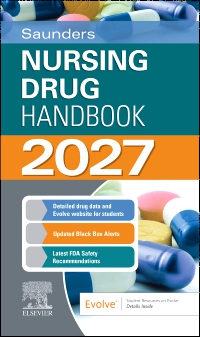
Ensure safe and effective drug therapy with this easy-to-use handbook! Saunders Nursing Drug Handbook 2027 provides you with current, detailed information on more than 1,000 generic and 4,000 trade name drugs. This handy, user-friendly guide includes updated uses, dosage forms, interactions, alerts, side effects and adverse reactions, IV drugs, nursing implications, and much more. Organized alphabetically by generic drug name for quick reference, this book stands out from the others in guiding the nurse through the steps essential to quality patient care. New drug monographs cover the latest FDA-approved medications!
-
- More than 1,000 generic name drugs, encompassing over 4,000 trade-name drugs, are organized alphabetically with A-to-Z tabs for quick and easy access
- List of newly approved medications in the front of the book makes it easy to locate the latest drugs
- Detailed information for each drug includes side effects listed by frequency, plus adverse effects, herbal interactions, and reactions requiring prompt intervention
- High Alert drugs are highlighted to promote safe administration of drugs that pose the greatest risk for patient harm, and Do Not Confuse With warnings call out drug names that sound alike or look alike
- Herbal information is included in the A-to-Z portion of the book, covering the interactions and effects of frequently used herbs, with additional herb information in the appendix
- Nursing Implications are organized in a functional nursing process framework and include baseline assessment, intervention/evaluation, and patient/family teaching
- Top 100 Drugs list helps you easily identify the most frequently administered drugs
- Cross-references to the 400 top U.S. brand-name drugs are located throughout the book for easy access
- Drugs by Disorder are listed in the front of the book for easy reference, showing common disorders and the drugs most often used for treatment
- Drug Classifications section features an overview of actions and uses for drug families
- Information on lifespan and disorder-related dosage variations covers special considerations for pediatric, geriatric, hepatic, and immune- or renal-compromised patients
- Extensive IV content includes IV compatibilities and breaks down key information on rates of infusion, reconstitutions, drip rates, test doses, flushing, and incompatibilities.
- IV Compatibility chart is provided as a foldout, featuring comprehensive compatibility information for 65 intravenous drugs
- Therapeutic and toxic blood level information is included in the Interactions section and under Nursing Implications
- Fixed combinations included in dosages of each combined drug are shown in the individual monographs
- Customizable and printable monographs for 100 of the most commonly used drugs are located on the companion Evolve website, along with other valuable drug-related information and drugs not found in the book
-
- NEW! Drug monographs for approximately 25 new FDA-approved medications equip you with the most current drug information
- NEW! Drug updates include uses, dosage forms, interactions, precautions, alerts, patient teaching instructions, and other need-to-know information to help prevent medication dispensing errors
-
DRUGS BY DISORDER
DRUG CLASSIFICATION CONTENTS
A–Z DRUG ENTRIES
APPENDICES
A. Correct Use of Oral Inhalers for Asthma and COPD
B. Wound Care
C. Drugs of Abuse
D. Herbals: Common Natural Medicines
E. Lifespan, Cultural Aspects, and Pharmacogenomics of Drug Therapy
F. Laboratory Test Reference Ranges
G. Drug Interactions
H. Antidote/Reversal Agents
I. Preventing Medication Errors and Improving Medication Safety
J. Parenteral Fluid Administration
K. Common Terminology Criteria for Adverse Events (CTCAE)
L. Contraception Choices
M. Hormones
N. Nutrition: Enteral
O. Nutrition: Parenteral
INDEX -
-
Ways of Reading
- The appearance of the text and page layout can be modified according to the capabilities of the reading system (font family and font size, spaces between paragraphs, sentences, words, and letters, as well as color of background and text)
- This e-publication is accessible to the full extent that the file format and types of content allow, on a specific reading device, by default, without necessarily including any additions such as textual descriptions of images or enhanced navigation
- No information about nonvisual reading is available
-
Conformance
- No information is available
-
Navigation
- Table of contents to all chapters of the text via links
- Page list to go to pages from the print source version
-
Rich Content
- No information is available
-
Hazards
- No information is available
-
Product Content
- No information is available
-
Legal Considerations
- No information is available
-
Additional Accessibility Information
- Content is enhanced with ARIA roles to optimize organization and facilitate navigation
- Page breaks included from the original print source
- For readers with color vision deficiency, use of color (e.g., in diagrams, graphics and charts, in prompts, or on buttons inviting a response) is not the sole means of graphical distinction or of conveying information
- E-publication includes basic navigation (usually less detailed than TOC-based navigation)
- Where links, controls or buttons are included in the content, the purpose or functionality of each link, control or button is apparent from the associated text alone - or where it is unclear, separate link, control or button descriptions are provided
- All (or substantially all) textual matter is arranged in a single logical reading order (including text that is visually presented as separate from the main text flow, e.g., in boxouts, captions, tables, footnotes, endnotes, citations, etc.). Non-textual content is also linked from within this logical reading order. (Purely decorative non-text content can be ignored).
- The language of the text has been specified (e.g., via the HTML or XML lang attribute) to optimise text-to-speech (and other alternative renderings), both at the whole document level and, where appropriate, for individual words, phrases or passages in a different language.
-
Ways of Reading

$37.99
Or $0.00 with a valid access code
Not Yet Available

 as described in our