ISBN:
9780443378300
Copyright:
2027
Publication Date:
09-04-2026
Page Count:
412
Imprint:
Elsevier
List Price:
$68.99

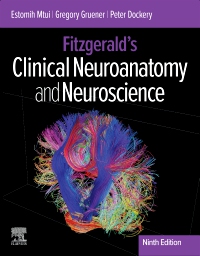
Fitzgerald's Clinical Neuroanatomy and Neuroscience - Elsevier E-Book on VitalSource, 9th Edition
by Estomih Mtui, MD, Gregory Gruener, MD, MBA and Peter Dockery, BSc, PhD
Elsevier eBook on VitalSource
ISBN:
9780443378300
Copyright:
2027
Publication Date:
09-04-2026
Page Count:
412
Imprint:
Elsevier
List Price:
$68.99
Was
$68.99
Now $48.29
Or $0.00 with a valid access code
Using outstanding artwork and a clear, understandable approach to make a complex subject easily accessible, Fitzgerald's Clinical Neuroanatomy and Neuroscience, 9th Edition, is an ideal text for both medical students and those in non-medical courses. Expertly designed to help you learn basic and clinical neuroscience, this award-winning title breaks complicated concepts and topics into easily digestible lessons using clear visual images and concise, straightforward explanations. Now thoroughly reviewed and updated, the ninth edition of this popular text skillfully integrates clinical neuroanatomy with the clinical application of neuroscience for today’s students.
-
- Organizes chapters by anatomical area, with integrated analyses of sensory, motor, and cognitive systems
- Features explanatory illustrations drawn by the same meticulous artists who illustrated Gray’s Anatomy
- Includes Basic Science Panels that highlight an emerging or relevant basic science concept to expand your learning in specific content areas
- Provides online access to 30 case studies and multiple-choice questions testing your recall and recognition
- Contains learning aids in every chapter, including bulleted points, clinical boxes, opening summaries, and concluding core information boxes
-
1. Embryology
2. Cerebral Topography
3. Midbrain, Hindbrain, Spinal Cord
4. Blood Supply of the Brain
5. Meninges
6. Neurons and Neuroglia
7. Electrical Events
8. Transmitters and Receptors
9. Peripheral Nerves
10. Innervation of Muscles and Joints
11. Innervation of Skin
12. Electrodiagnostic Examination
13. Autonomic Nervous System
14. Nerve Roots
15. Spinal Cord: Ascending Pathways
16. Spinal Cord: Descending Pathways
17. Brainstem
18. The Lowest Four Cranial Nerves
19. Vestibular Nerve
20. Cochlear Nerve
21. Trigeminal Nerve
22. Facial Nerve
23. Ocular Motor Nerves
24. Reticular Formation and the Neuromodulatory System
25. Thalamus, Epithalamus
26. Basal Ganglia
27. Cerebellum
28. Cerebral Cortex
29. Electroencephalography
30. Evoked Potentials
31. Visual Pathways
32. Hemispheric Asymmetries
33. Olfactory and Limbic Systems
34. Pituitary and Hypothalamus
35. Cerebrovascular Disease -
-
Ways of Reading
- The appearance of the text and page layout can be modified according to the capabilities of the reading system (font family and font size, spaces between paragraphs, sentences, words, and letters, as well as color of background and text)
- This e-publication is accessible to the full extent that the file format and types of content allow, on a specific reading device, by default, without necessarily including any additions such as textual descriptions of images or enhanced navigation
- All content can be read as read aloud speech or dynamic braille
- Has alternative text descriptions for images
-
Conformance
- The certifier's credential is https://bornaccessible.benetech.org/certified-publishers/
- For detailed accessibility information, see Elsevier's website at https://www.elsevier.com/about/accessibility
- For queries regarding accessibility information, contact [email protected]
- The publication was certified on 07-07-2026
-
Navigation
- Table of contents to all chapters of the text via links
- Index with links to referenced entries
- Elements such as headings, tables, etc. for structured navigation
- Page list to go to pages from the print source version
-
Rich Content
- Math formulas in accessible format (MathML)
- Information-rich images are described by extended descriptions
-
Hazards
- The publication contains no hazards
-
Product Content
- Content includes any type of illustrations.
- The primary content is text.
- Content includes maps and/or other cartographic content.
- Content includes a significant number of actionable (clickable) web links to external content, downloadable resources, supplementary material, etc.
- Content includes a significant number of actionable (clickable) cross-references, hyperlinked notes and annotations, or with other actionable links between largely textual elements (e.g., quiz/test questions, 'choose your own ending', etc.).
- Content includes photographs, whether in a plate section / insert or not.
- Content includes figures, diagrams, charts and/or graphs, including other 'mechanical' (i.e. non-photographic) illustrations.
- Content includes assessment material, e.g., Questions or student exercises, problems, quizzes or tests (as an integral part of the work).
- Content includes text within images, including text-as-text embedded in diagrams, charts, or within images containing speech balloons, thought bubbles, captions, etc.
- Content includes visual content that is purely decorative and is not necessary to understanding of the content.
- Content includes mathematical notations, formulae.
- At least some text - including text within other images - is 'text as an image' (i.e., a picture of text).
-
Legal Considerations
- No information is available
-
Additional Accessibility Information
- Content is enhanced with ARIA roles to optimize organization and facilitate navigation
- Page breaks included from the original print source
- For readers with color vision deficiency, use of color (e.g., in diagrams, graphics and charts, in prompts, or on buttons inviting a response) is not the sole means of graphical distinction or of conveying information
- The body text is presented with a contrast ratio of at least 4.5:1 (or 3:1 for large/heading text)
- Ultra-high contrast between text and background
- E-publication includes basic navigation (usually less detailed than TOC-based navigation)
- Where links, controls or buttons are included in the content, the purpose or functionality of each link, control or button is apparent from the associated text alone - or where it is unclear, separate link, control or button descriptions are provided
- All (or substantially all) textual matter is arranged in a single logical reading order (including text that is visually presented as separate from the main text flow, e.g., in boxouts, captions, tables, footnotes, endnotes, citations, etc.). Non-textual content is also linked from within this logical reading order. (Purely decorative non-text content can be ignored).
- Content provides explanations for unusual words, abbreviations, acronyms, idioms, jargon in an accessible form, such as glossaries, scripted pop-ups.
- Where interactive content is included in the product, controls are provided (e.g., for speed, pause and resume, reset) and labelled to make their use clear.
- The language of the text has been specified (e.g., via the HTML or XML lang attribute) to optimise text-to-speech (and other alternative renderings), both at the whole document level and, where appropriate, for individual words, phrases or passages in a different language.
-
Ways of Reading

Was
$68.99
Now $48.29
Or $0.00 with a valid access code

 as described in our