ISBN:
9780443378447
Copyright:
2027
Page Count:
427
Imprint:
Elsevier
List Price:
$44.99
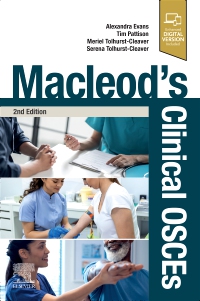
Macleod's Clinical OSCEs, 2nd Edition
by Alexandra Evans, MBChB, MRCGP, DRCOG, DFRSH, Tim Pattison, BSc, MBChB, MRCP, MSc, PGCert (Med Ed), Meriel Tolhurst-Cleaver, MA (Cantab), MB BChir, MRCPCH and Serena Tolhurst-Cleaver, MBChB, MRCP(Lon), FFICM, PGCert(MMC)
Paperback
ISBN:
9780443378447
Copyright:
2027
Page Count:
427
Imprint:
Elsevier
List Price:
$44.99
Not Yet Available
Most review copies are eBooks – how fast!
A review copy request is most likely to be fulfilled as an eBook on VitalSource rather than a print product, unless no eBook is available. eBooks become available in as little as a few hours. Print products will take between 7 and 10 days to arrive. To request a print copy, please contact us through the Evolve Support Center for further assistance or contact your Elsevier Sales Rep.
Coming Soon!
Expected availability date: 12-11-2026
With up-to-date coverage of more than 60 of the most commonly encountered OSCE stations in medicine and surgery, Macleod's Clinical OSCEs, 2nd Edition, is an accessible revision tool for students who are preparing for a clinical OSCE (Objective Structured Clinical Examination). Fully aligned and mapped to the updated 2026 MLA curriculum, this resource logically arranges OSCEs by type of skill, such as history-taking, ethics and communication, and physical examination. Both in print and online, it provides easy-to-understand content, tips on exam preparation, sample OSCE station questions, supporting videos, and simulated patient scripts (with answers) for self-study or with fellow students.
-
- Includes new chapters that cover a greater breadth of conditions and presentations, as well as a new quick-reference MLA mapping guide/page index that references the MLA-required ‘Presentations’ and ‘Conditions’ in the 2026 curriculum—aiding in exam preparation and providing assurance that all topics are covered
- Provides hints and tips from experienced educators to help students perform at their best in the OSCE station, and highlights ‘red flag’ situations and the importance of these topics
- Includes advice both on how to excel and on common errors at each OSCE station
- Gives details in selected OSCE stations on how the topic could be made more basic or more advanced, suitable for different year end examinations and finals
- Features online access to a complete set of mark sheets to help prepare for each OSCE station with friends and colleagues; and high-quality supplementary videos covering core patient examinations
- An ideal revision tool for OSCE preparation as well as a useful day-to-day guide in future clinical practice
- Closely connected and complementary to the bestselling Macleod’s Clinical Examination, 15th Edition, and the wider Macleod’s ‘family’ of texts
- An eBook version is included with purchase. The eBook allows access to all of the text, figures, and references, with the ability to search, make notes and highlights, and have content read aloud
-
-
 Macleod's Clinical OSCEs - Elsevier E-Book on VitalSourceElsevier eBook on VitalSource
-
-
1 INTRODUCTION TO THE OSCE
2 HISTORY TAKING
3 PHYSICAL EXAMINATION
4 PRACTICAL SKILLS
5 ETHICS, COMMUNICATION AND EXPLANATION
6 PRESCRIBING AND HANDOVER
7 RECOGNISING AND MANAGING ACUTELY UNWELL PATIENTS -
No accessibility information is available for this product.
Not Yet Available
Most review copies are eBooks – how fast!
A review copy request is most likely to be fulfilled as an eBook on VitalSource rather than a print product, unless no eBook is available. eBooks become available in as little as a few hours. Print products will take between 7 and 10 days to arrive. To request a print copy, please contact us through the Evolve Support Center for further assistance or contact your Elsevier Sales Rep.
Coming Soon!
Expected availability date: 12-11-2026

 as described in our