ISBN:
9780443380457
Copyright:
2027
Publication Date:
08-10-2026
Page Count:
300
Imprint:
Elsevier
List Price:
$47.99

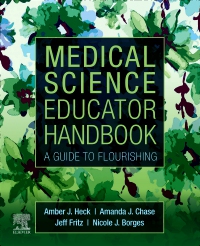
Medical Science Educator Handbook - Elsevier E-Book on VitalSource, 1st Edition
by Amber J. Heck, Amanda J. Chase, PhD, Jeff Fritz, PhD and Nicole J. Borges, PhD
Elsevier eBook on VitalSource
ISBN:
9780443380457
Copyright:
2027
Publication Date:
08-10-2026
Page Count:
300
Imprint:
Elsevier
List Price:
$47.99
Not Yet Available
Most review copies are eBooks – how fast!
A review copy request is most likely to be fulfilled as an eBook on VitalSource rather than a print product, unless no eBook is available. eBooks become available in as little as a few hours. Print products will take between 7 and 10 days to arrive. To request a print copy, please contact us through the Evolve Support Center for further assistance or contact your Elsevier Sales Rep.
This unique Medical Science Educator Handbook provides a comprehensive, focused, and supportive resource to help guide professional identity formation and success. It covers the entire spectrum of medical science educator development, dividing content into three practical sections: personal development, curriculum development, and professional development —the key components that help students develop strategies to navigate the academic waters and flourish as medical science educators.
-
- Defines and describes the roles of a medical science educator and identifies best practices for building an educator portfolio for promotion
- Outlines strategies for success on a personal and professional level
- Includes the journeys and reflections of a wide variety of medical educators in their own professional identity development
- Discusses personal development topics such as the medical science educator as a role model; engaging with others in intellectual, personal, and professional activities; and discovering your “why” as a medical science educator
- Discusses curriculum development topics such as the role of the medical science educator in the development and implementation of curricula; the role of the educator as a facilitator, instructional designer, and navigator; the medical educator’s role in contrast with artificial intelligence; and more
- Discusses professional development topics such as leader attributes; the functions of scholarship; research; navigating promotion criteria; training others; and more
- A unique and practical resource for assistant, associate, adjunct, and full professors of anatomy, physiology, biochemistry, microbiology, genetics, cell biology, neuroscience and any basic sciences at medical, dental, PA, nursing, and other allied health programs—and for students who are preparing for careers in these areas
- An eBook version is included with purchase. The eBook allows access to all of the text, figures, and references, with the ability to search, make notes and highlights, and have content read aloud
-
-
 Medical Science Educator HandbookPaperback
-
-
1. Flourishing
Section I PERSONAL DEVELOPMENT
2. Professional Identity Formation
3. Role Model
4. Community
Section II CURRICULUM DEVELOPMENT
5. Curriculum Developer
6. Facilitator of Learning
7. Assessor
8. Navigator
Section III PROFESSIONAL DEVELOPMENT
9. Leader
10. Scholar
11. Researcher
12. Promotion
13. Faculty Developer -
-
Ways of Reading
- The appearance of the text and page layout can be modified according to the capabilities of the reading system (font family and font size, spaces between paragraphs, sentences, words, and letters, as well as color of background and text)
- This e-publication is accessible to the full extent that the file format and types of content allow, on a specific reading device, by default, without necessarily including any additions such as textual descriptions of images or enhanced navigation
- No information about nonvisual reading is available
-
Conformance
- No information is available
-
Navigation
- Table of contents to all chapters of the text via links
- Page list to go to pages from the print source version
-
Rich Content
- No information is available
-
Hazards
- No information is available
-
Product Content
- No information is available
-
Legal Considerations
- No information is available
-
Additional Accessibility Information
- Content is enhanced with ARIA roles to optimize organization and facilitate navigation
- Page breaks included from the original print source
- For readers with color vision deficiency, use of color (e.g., in diagrams, graphics and charts, in prompts, or on buttons inviting a response) is not the sole means of graphical distinction or of conveying information
- E-publication includes basic navigation (usually less detailed than TOC-based navigation)
- Where links, controls or buttons are included in the content, the purpose or functionality of each link, control or button is apparent from the associated text alone - or where it is unclear, separate link, control or button descriptions are provided
- All (or substantially all) textual matter is arranged in a single logical reading order (including text that is visually presented as separate from the main text flow, e.g., in boxouts, captions, tables, footnotes, endnotes, citations, etc.). Non-textual content is also linked from within this logical reading order. (Purely decorative non-text content can be ignored).
- The language of the text has been specified (e.g., via the HTML or XML lang attribute) to optimise text-to-speech (and other alternative renderings), both at the whole document level and, where appropriate, for individual words, phrases or passages in a different language.
-
Ways of Reading
Not Yet Available
Most review copies are eBooks – how fast!
A review copy request is most likely to be fulfilled as an eBook on VitalSource rather than a print product, unless no eBook is available. eBooks become available in as little as a few hours. Print products will take between 7 and 10 days to arrive. To request a print copy, please contact us through the Evolve Support Center for further assistance or contact your Elsevier Sales Rep.

 as described in our