
ISBN:
9780443380716
Copyright:
2026
Publication Date:
06-06-2025
Page Count:
1232
Imprint:
Elsevier
List Price:
$41.99

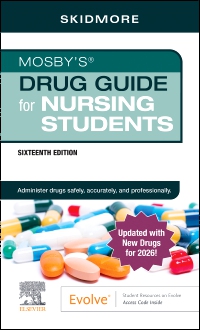
Mosby’s Drug Guide for Nursing Students with 2026 Update - Elsevier E-Book on VitalSource, 16th Edition
by Linda Skidmore-Roth, RN, MSN, NP
Elsevier eBook on VitalSource
ISBN:
9780443380716
Copyright:
2026
Publication Date:
06-06-2025
Page Count:
1232
Imprint:
Elsevier
List Price:
$41.99
Was
$41.99
Now $36.95
Or $0.00 with a valid access code
**Selected for 2025 Doody’s Core Titles® in Pharmacology**
Find the information you need to administer drugs safely, accurately, and professionally! Mosby's Drug Guide for Nursing Students, 16th Edition with 2026 Update, provides concise profiles of more than 4,000 generic and trade name drugs, including the drugs most recently approved by the FDA. Each drug monograph includes clear guidelines to dosing, administration, and the nursing process, so you’ll always be sure that you’re practicing medication safety. What sets this handbook apart is its detailed coverage of rationales and explanations, IV drugs, and the similarities and differences in common classes of drugs. From well-known pharmacology expert Linda Skidmore-Roth, this drug guide has been trusted by nursing students for more than 25 years.
Find the information you need to administer drugs safely, accurately, and professionally! Mosby's Drug Guide for Nursing Students, 16th Edition with 2026 Update, provides concise profiles of more than 4,000 generic and trade name drugs, including the drugs most recently approved by the FDA. Each drug monograph includes clear guidelines to dosing, administration, and the nursing process, so you’ll always be sure that you’re practicing medication safety. What sets this handbook apart is its detailed coverage of rationales and explanations, IV drugs, and the similarities and differences in common classes of drugs. From well-known pharmacology expert Linda Skidmore-Roth, this drug guide has been trusted by nursing students for more than 25 years.
-
- NEW! Information on new drugs for 2026 is included in the appendix
- NEW! Updated Drug Categories sections include the new 2026 drugs
- More than 4,000 generic and trade-name drugs are profiled, covering almost every drug you will administer in practice or in clinicals
- Alphabetical organization by generic name provides quick and easy access to specific drugs, and a full-color design highlights important information
- Nursing Process steps are used as the framework for organizing all nursing care information
- Black Box Warnings provide alerts to FDA warnings of dangerous or life-threatening drug reactions
- High Alert headings indicate drugs that pose the great risk if administered improperly
- Additional drug monographs on the Evolve companion website provide information on the most recently approved drugs
- Individual drug monographs include generic name, pronunciation, functional and chemical classification, do-not-confuse drug names, action, therapeutic outcome, uses, unlabeled uses, pharmacokinetics/pharmacodynamics, contraindications, precautions, dosages and routes, adverse effects, interactions (including drug/herb, drug/food and lab test), nursing considerations, black box warnings, patient/family education, and treatment of overdose
- Drug Categories sections promote the safe administration of common classes of drugs, explaining the similarities and differences among drugs in the same functional class including their common side effects and interactions
- Common and life-threatening side effects are organized by body system, showing signs to watch for during assessments
- Coverage of IV drug administration highlights dosage and IV administration instructions, including safety considerations and Y-site, syringe, and additive compatibilities
- Complete pharmacokinetic information includes the mechanism and absorption of the drug, as well as its action, duration, and excretion
- Photo atlas of drug administration includes full-color illustrations showing physical landmarks and administration techniques used for IV and other drugs
- Cross-references indicate drug information that may be found in the appendixes
- Flexible, water-resistant cover provides durability in the clinical setting
-
INDIVIDUAL DRUG MONOGRAPHS
DRUG CATEGORIES
APPENDICES
- A. Selected New Drugs
- B. Ophthalmic, Nasal, Topical, and Otic Products
- C. Vaccines and Toxoids
- D. Abbreviations
- E. Immunization Schedules
- F. Standard Precautions
INDEX
NEW DRUGS FOR 2026
EVOLVE WEBSITE CONTENTS
- Content Changes
- Drug Monographs—Additional Monographs
- Drug Monographs—Recently Approved
- Drug Categories
Additional Appendices
- Appendix G: Illustrated Mechanisms and Sites of Action
- Appendix H: Photo Atlas of Drug Administration
- Appendix I: Common Herbs -
-
Ways of Reading
- The appearance of the text and page layout can be modified according to the capabilities of the reading system (font family and font size, spaces between paragraphs, sentences, words, and letters, as well as color of background and text)
- This e-publication is accessible to the full extent that the file format and types of content allow, on a specific reading device, by default, without necessarily including any additions such as textual descriptions of images or enhanced navigation
- No information about nonvisual reading is available
-
Conformance
- For detailed accessibility information, see Elsevier's website at https://www.elsevier.com/about/accessibility
- For queries regarding accessibility information, contact [email protected]
- The publication was certified on 18-11-2025
-
Navigation
- Table of contents to all chapters of the text via links
-
Rich Content
- No information is available
-
Hazards
- No information is available
-
Product Content
- No information is available
-
Legal Considerations
- No information is available
-
Additional Accessibility Information
- For readers with color vision deficiency, use of color (e.g., in diagrams, graphics and charts, in prompts, or on buttons inviting a response) is not the sole means of graphical distinction or of conveying information
- E-publication includes basic navigation (usually less detailed than TOC-based navigation)
- Where links, controls or buttons are included in the content, the purpose or functionality of each link, control or button is apparent from the associated text alone - or where it is unclear, separate link, control or button descriptions are provided
- All (or substantially all) textual matter is arranged in a single logical reading order (including text that is visually presented as separate from the main text flow, e.g., in boxouts, captions, tables, footnotes, endnotes, citations, etc.). Non-textual content is also linked from within this logical reading order. (Purely decorative non-text content can be ignored).
- The language of the text has been specified (e.g., via the HTML or XML lang attribute) to optimise text-to-speech (and other alternative renderings), both at the whole document level and, where appropriate, for individual words, phrases or passages in a different language.
-
Ways of Reading
Was
$41.99
Now $36.95
Or $0.00 with a valid access code

 as described in our