ISBN:
9780443380761
Copyright:
2026
Publication Date:
12-17-2025
Page Count:
832
Imprint:
Elsevier
List Price:
$107.99

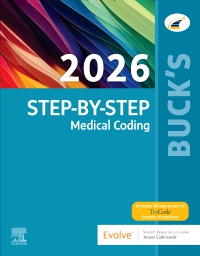
Buck's Step-by-Step Medical Coding, 2026 Edition - Elsevier E-Book on VitalSource, 1st Edition
by Elsevier
Elsevier eBook on VitalSource
ISBN:
9780443380761
Copyright:
2026
Publication Date:
12-17-2025
Page Count:
832
Imprint:
Elsevier
List Price:
$107.99
Most review copies are eBooks – how fast!
A review copy request is most likely to be fulfilled as an eBook on VitalSource rather than a print product, unless no eBook is available. eBooks become available in as little as a few hours. Print products will take between 7 and 10 days to arrive. To request a print copy, please contact us through the Evolve Support Center for further assistance or contact your Elsevier Sales Rep.
**Selected for 2026 Doody's Core Titles in Health Information Management**
Help your students take the first step toward a successful career in medical coding with guidance from the most trusted name in coding education! The bestselling Buck’s Step-by-Step Medical Coding is a practical, easy-to-use resource that shows you exactly how to code using all current coding sets. To reinforce your understanding, practice exercises follow the explanations of each coding concept. In addition to coverage of reimbursement, ICD-10-CM, CPT, HCPCS, and inpatient coding, an Evolve website includes 30-day access to TruCode® Encoder Essentials. No other text so thoroughly covers all coding sets!
Help your students take the first step toward a successful career in medical coding with guidance from the most trusted name in coding education! The bestselling Buck’s Step-by-Step Medical Coding is a practical, easy-to-use resource that shows you exactly how to code using all current coding sets. To reinforce your understanding, practice exercises follow the explanations of each coding concept. In addition to coverage of reimbursement, ICD-10-CM, CPT, HCPCS, and inpatient coding, an Evolve website includes 30-day access to TruCode® Encoder Essentials. No other text so thoroughly covers all coding sets!
New Edition Expected Availability: 12-15-2026

Buck's Step-by-Step Medical Coding, 2027 Edition - Elsevier E-Book on VitalSource
Elsevier eBook on VitalSource
ISBN: 9780443386619
-
- NEW! Updated content includes the latest coding information available, promoting accurate coding and success on the job
-
- NEW! Coding updates include the latest information available, promoting accurate coding and success on the job
- Theory and practical review questions (located at the end of each chapter) focus on recalling important chapter information and application of codes
- A step-by-step approach makes it easier for students to build coding skills and remember the material
- Learning objective and glossary review questions reinforce student understanding of key chapter concepts and terms
- Coverage reflects the latest changes to the CPT E/M guidelines for office and other outpatient codes
- 30-day trial to TruCode® Encoder Essentials gives students experience with using an encoder (plus access to additional encoder practice exercises on the Evolve website)
- UNIQUE! "Real-life" coding reports (cleared of any confidential information) simulate the reports students will encounter as coders to help them apply coding principles to actual cases
- Online activities on Evolve provide extra practice with assignments, including coding reports
- More than 450 illustrations help in understanding the types of medical conditions and procedures being coded, and include examples taken directly from Elsevier's professional ICD-10 and HCPCS manuals
- UNIQUE! Four coding-question variations — covering both single-code questions and multiple-code questions and scenarios — develop students’ coding ability and critical thinking skills
- UNIQUE! Coders’ Index in the back of the book makes it easy to quickly locate specific codes
- Official Guidelines for Coding and Reporting boxes show the official guidelines wording for inpatient and outpatient coding alongside in-text explanations
- Exercises, Quick Checks, and Toolbox features reinforce coding rules and concepts, and emphasize key information
- Valuable tips and advice are offered in features such as From the Trenches, Coding Shots, Stop!, Caution!, Check This Out, and CMS Rules
- Sample EHR screenshots (in Appendix D) show examples similar to the electronic health records students will encounter in the workplace
-
-

-
 Buck's Workbook for Step-by-Step Medical Coding, 2026 Edition - Elsevier eBook on VitalSourceElsevier eBook on VitalSource
 -

-

-

-
-
UNIT 1 Reimbursement
1. Reimbursement, HIPAA, and Compliance
UNIT 2 ICD-10-CM
2. An Overview of ICD-10-CM
3. ICD-10-CM Outpatient Coding and Reporting Guidelines
4. Using ICD-10-CM
5. Chapter-Specific Guidelines (ICD-10-CM Chapters 1-10)
6. Chapter-Specific Guidelines (ICD-10-CM Chapters 11-14)
7. Chapter-Specific Guidelines (ICD-10-CM Chapters 15-22)
UNIT 3 CPT and HCPCS
8. Introduction to CPT
9. Introduction to the Level II National Codes (HCPCS)
10. Modifiers
11. Evaluation and Management (E/M) Services
12. Anesthesia
13. Surgery Guidelines and General Surgery
14. Integumentary System
15. Musculoskeletal System
16. Respiratory System
17. Cardiovascular System
18. Hemic, Lymphatic, Mediastinum, and Diaphragm
19. Digestive System
20. Urinary and Male Genital Systems
21. Reproductive, Intersex Surgery, Female Genital System, and Maternity Care and Delivery
22. Endocrine and Nervous Systems
23. Eye, Ocular Adnexa, Auditory, and Operating Microscope
24. Radiology
25. Pathology/Laboratory
26. Medicine
UNIT 4 Inpatient Coding
27. Inpatient Coding -
-
Ways of Reading
- The appearance of the text and page layout can be modified according to the capabilities of the reading system (font family and font size, spaces between paragraphs, sentences, words, and letters, as well as color of background and text)
- This e-publication is accessible to the full extent that the file format and types of content allow, on a specific reading device, by default, without necessarily including any additions such as textual descriptions of images or enhanced navigation
- No information about nonvisual reading is available
-
Conformance
- No information is available
-
Navigation
- Table of contents to all chapters of the text via links
- Page list to go to pages from the print source version
-
Rich Content
- No information is available
-
Hazards
- No information is available
-
Product Content
- No information is available
-
Legal Considerations
- No information is available
-
Additional Accessibility Information
- Content is enhanced with ARIA roles to optimize organization and facilitate navigation
- Page breaks included from the original print source
- For readers with color vision deficiency, use of color (e.g., in diagrams, graphics and charts, in prompts, or on buttons inviting a response) is not the sole means of graphical distinction or of conveying information
- E-publication includes basic navigation (usually less detailed than TOC-based navigation)
- Where links, controls or buttons are included in the content, the purpose or functionality of each link, control or button is apparent from the associated text alone - or where it is unclear, separate link, control or button descriptions are provided
- All (or substantially all) textual matter is arranged in a single logical reading order (including text that is visually presented as separate from the main text flow, e.g., in boxouts, captions, tables, footnotes, endnotes, citations, etc.). Non-textual content is also linked from within this logical reading order. (Purely decorative non-text content can be ignored).
- The language of the text has been specified (e.g., via the HTML or XML lang attribute) to optimise text-to-speech (and other alternative renderings), both at the whole document level and, where appropriate, for individual words, phrases or passages in a different language.
-
Ways of Reading
Most review copies are eBooks – how fast!
A review copy request is most likely to be fulfilled as an eBook on VitalSource rather than a print product, unless no eBook is available. eBooks become available in as little as a few hours. Print products will take between 7 and 10 days to arrive. To request a print copy, please contact us through the Evolve Support Center for further assistance or contact your Elsevier Sales Rep.

 as described in our