ISBN:
9780443380822
Copyright:
2028
Page Count:
336
Imprint:
Elsevier
List Price:
$99.99
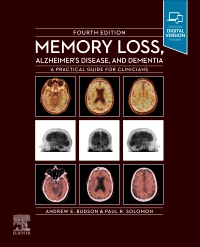
Memory Loss, Alzheimer's Disease and Dementia: A Practical Guide for Clinicians, 4th Edition
by Andrew E. Budson, MD and Paul R. Solomon, PhD
Paperback
ISBN:
9780443380822
Copyright:
2028
Page Count:
336
Imprint:
Elsevier
List Price:
$99.99
Not Yet Available
Most review copies are eBooks – how fast!
A review copy request is most likely to be fulfilled as an eBook on VitalSource rather than a print product, unless no eBook is available. eBooks become available in as little as a few hours. Print products will take between 7 and 10 days to arrive. To request a print copy, please contact us through the Evolve Support Center for further assistance or contact your Elsevier Sales Rep.
Coming Soon!
Expected availability date: 01-01-2027
An essential, practical guide for neurologists, psychiatrists, geriatricians, and others who work with the elderly, Memory Loss, Alzheimer's Disease, and Dementia: A Practical Guide for Clinicians, 4th Edition, provides up-to-date information on detection, diagnosis, and treatment—including recent, significant medical advancements, drug therapies, and research. Drs. Andrew E. Budson and Paul R. Solomon focus on the day-to-day tools clinicians need, thoroughly covering the essentials of physical and cognitive examinations plus laboratory and imaging studies for dementia and related illnesses. This fully revised edition is particularly timely in a field that is experiencing tremendous progress and change in numerous areas, and contains authoritative, real-world guidance to help you make accurate diagnosis and treatment decisions with confidence.
-
- Contains fully updated content from cover to cover, with a new chapter on Amyloid-Targeting Therapies, information on newly FDA-approved drugs for treatment (donanemab, benzgalantamine, and lecanemab) as well as discontinued drugs that must be phased out, and newly revised criteria for diagnosis and staging of Alzheimer's disease
- Covers recent advances in the understanding of blood, plasma, and imaging biomarkers for the diagnosis of AD and related disorders; advances in understanding genetic causes; new developments in lifestyle interventions and technology, such as wearable devices; and recent progress in blood testing for accurate diagnosis
- Provides comprehensive coverage of hot topics such as chronic traumatic encephalopathy (CTE), primary age-related tauopathy (PART), and limbic-predominant, age-related TDP-43 encephalopathy (LATE)
- Incorporates real-world case studies that facilitate the management of both common and uncommon conditions
- Reflects current National Institute on Aging–Alzheimer's Association and DSM-5-TR criteria for Alzheimer’s disease, mild cognitive impairment, and related disorders
- Provides access to dozens of videos that illustrate common tests, clinical signs, and diagnostic features
- Features Quick Start boxes at the top of every chapter to inform your clinical approach, as well as diagrams, charts, patient brain imaging studies, pathology images, and anatomical illustrations to visually support the text
- An eBook version is included with purchase. The eBook allows you to access all of the text, figures, and references, with the ability to search, make notes and highlights, and have content read
-
[NOT FINAL - DO NOT POST ON PUBLIC-FACING SITE]
Section I
1. Why Diagnose and Treat Memory Loss, Alzheimer’s Disease, and Dementia
2. Evaluating the Patient With Memory Loss or Dementia
3. Subjective Cognitive Decline, Mild Cognitive Impairment, and Dementia
Section II
4. Alzheimer’s Disease
5. Primary Age-Related Tauopathy
6. Limbic-predominant Age-related TDP-43 Encephalopathy
7. Vascular Cognitive Impairment and Vascular Dementia
8. Dementia With Lewy Bodies
9. Primary Progressive Aphasia and Apraxia of Speech
10. Behavioral Variant Frontotemporal Dementia
11. Posterior Cortical Atrophy
12. Progressive Supranuclear Palsy
13. Corticobasal Degeneration and Corticobasal Syndrome
14. Normal Pressure Hydrocephalus
Section III
15. Chronic Traumatic Encephalopathy
16. Creutzfeldt–Jakob Disease
17. Other Disorders That Cause Memory Loss or Dementia
18. Goals for the Treatment of Memory Loss, Alzheimer’s Disease, and Dementia
19. Cholinesterase Inhibitors
20. Memantine
Section IV
21. Vitamins, Herbs, Supplements, and Antiinflammatories
22. Nonpharmacological Treatment of Memory Loss, Alzheimer’s Disease, and Dementia
23. [FUTURE THERAPIES CHAPTER REPLACED WITH NEW CHAPTER]
24. Evaluating the Behavioral and Psychological Symptoms of Dementia
Section V
25. Caring for and Educating the Caregiver
26. Nonpharmacological Treatment of the Behavioral and Psychological Symptoms of Dementia
27. Pharmacological Treatment of the Behavioral and Psychological Symptoms of Dementia
28. Life Adjustments for Memory Loss, Alzheimer’s Disease, and Dementia
29. Legal and Financial Issues in Memory Loss, Alzheimer’s Disease, and Dementia
30. Special Issues in Memory Loss, Alzheimer’s Disease, and Dementia -
No accessibility information is available for this product.
Not Yet Available
Most review copies are eBooks – how fast!
A review copy request is most likely to be fulfilled as an eBook on VitalSource rather than a print product, unless no eBook is available. eBooks become available in as little as a few hours. Print products will take between 7 and 10 days to arrive. To request a print copy, please contact us through the Evolve Support Center for further assistance or contact your Elsevier Sales Rep.
Coming Soon!
Expected availability date: 01-01-2027

 as described in our