ISBN:
9780443381461
Copyright:
2025
Publication Date:
03-01-2024
Page Count:
384
Imprint:
Elsevier
List Price:
$65.99

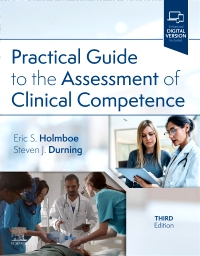
Practical Guide to the Assessment of Clinical Competence - Elsevier E-Book on VitalSource, 3rd Edition
by Eric S. Holmboe, MD, MACP, FRCP and Steven James Durning, MD, PhD, MACP
Elsevier eBook on VitalSource
ISBN:
9780443381461
Copyright:
2025
Publication Date:
03-01-2024
Page Count:
384
Imprint:
Elsevier
List Price:
$65.99
Most review copies are eBooks – how fast!
A review copy request is most likely to be fulfilled as an eBook on VitalSource rather than a print product, unless no eBook is available. eBooks become available in as little as a few hours. Print products will take between 7 and 10 days to arrive. To request a print copy, please contact us through the Evolve Support Center for further assistance or contact your Elsevier Sales Rep.
Offering a multifaceted, practical approach to the complex topic of clinical assessment, Practical Guide to the Assessment of Clinical Competence, 3rd Edition, is designed to help medical educators employ better assessment methods, tools, and models directly into their training programs. World-renowned editors and expert contributing authors provide hands-on, authoritative guidance on outcomes-based assessment in clinical education, presenting a well-organized, diverse combination of methods you can implement right away. This thoroughly revised edition is a valuable resource for developing, implementing, and sustaining effective systems for assessing clinical competence in medical school, residency, and fellowship programs.
-
- Helps medical educators and administrators answer complex, ongoing, and critical questions in today’s changing medical education system: Is this undergraduate or postgraduate medical student prepared and able to move to the next level of training? To be a competent and trusted physician?
- Provides practical suggestions and assessment approaches that can be implemented immediately in your training program, tools that can be used to assess and measure clinical performance, overviews of key educational theories, and strengths and weaknesses of every method
- Covers assessment techniques, frameworks, high-quality assessment of clinical reasoning and procedural competence, psychometrics, and practical approaches to feedback
- Includes expanded coverage of fast-moving areas where concepts now have solid research and data that support practical ways to connect judgments of ability to outcomes—including work-based assessments, clinical competency committees, milestones and entrustable professional assessments (EPAs), and direct observation
- Offers examples of assessment instruments along with suggestions on how you can apply these methods and instruments in your own setting, as well as guidelines that apply across the medical education spectrum
- Includes online access to videos of medical interviewing scenarios and more, downloadable assessment tools, and detailed faculty guidelines
- An eBook version is included with purchase. The eBook allows you to access all of the text, figures, and references, with the ability to search, make notes and highlights, and have content read aloud
-
1. Assessment in the Era of Outcomes-Based Education
2. Issues of Validity and Reliability for Assessments in Medical Education
3. Programmatic Assessment Using Systems Thinking
4. Evaluation Frameworks, Assessment Forms, and Rating Scales
5. Direct Observation
6. Standardized Patients
7. Assessing Clinical Reasoning In Vitro (NonWorkplace Assessment)
8. Assessing Clinical Reasoning in the Workplace
9. Workplace-Based Assessment of Procedural Skills
10. Evaluating Evidence-Based Practice
11. Clinical Performance Measures and Practice Review
12. Multisource Feedback
13. Simulation Overview
14. Feedback and Coaching
15. Portfolios
16. Group Process in Assessment
17. A Programmatic Approach to Identifying and Supporting the Struggling Learner
18. Program Evaluation -
-
Ways of Reading
- The appearance of the text and page layout can be modified according to the capabilities of the reading system (font family and font size, spaces between paragraphs, sentences, words, and letters, as well as color of background and text)
- This e-publication is accessible to the full extent that the file format and types of content allow, on a specific reading device, by default, without necessarily including any additions such as textual descriptions of images or enhanced navigation
- No information about nonvisual reading is available
-
Conformance
- No information is available
-
Navigation
- Table of contents to all chapters of the text via links
- Page list to go to pages from the print source version
-
Rich Content
- No information is available
-
Hazards
- No information is available
-
Product Content
- No information is available
-
Legal Considerations
- No information is available
-
Additional Accessibility Information
- Content is enhanced with ARIA roles to optimize organization and facilitate navigation
- Page breaks included from the original print source
- For readers with color vision deficiency, use of color (e.g., in diagrams, graphics and charts, in prompts, or on buttons inviting a response) is not the sole means of graphical distinction or of conveying information
- E-publication includes basic navigation (usually less detailed than TOC-based navigation)
- Where links, controls or buttons are included in the content, the purpose or functionality of each link, control or button is apparent from the associated text alone - or where it is unclear, separate link, control or button descriptions are provided
- All (or substantially all) textual matter is arranged in a single logical reading order (including text that is visually presented as separate from the main text flow, e.g., in boxouts, captions, tables, footnotes, endnotes, citations, etc.). Non-textual content is also linked from within this logical reading order. (Purely decorative non-text content can be ignored).
- The language of the text has been specified (e.g., via the HTML or XML lang attribute) to optimise text-to-speech (and other alternative renderings), both at the whole document level and, where appropriate, for individual words, phrases or passages in a different language.
-
Ways of Reading

Most review copies are eBooks – how fast!
A review copy request is most likely to be fulfilled as an eBook on VitalSource rather than a print product, unless no eBook is available. eBooks become available in as little as a few hours. Print products will take between 7 and 10 days to arrive. To request a print copy, please contact us through the Evolve Support Center for further assistance or contact your Elsevier Sales Rep.

 as described in our