ISBN:
9780443384110
Copyright:
2028
Page Count:
402
Imprint:
Elsevier
List Price:
$62.99

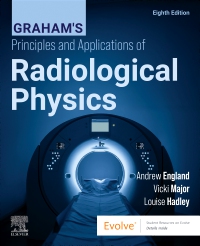
Graham's Principles and Applications of Radiological Physics - Elsevier E-Book on VitalSource, 8th Edition
by Andrew England, BSc (Hons), PgCert, MSc, PhD, FHEA, Vicki Major and Louise Hadley
Elsevier eBook on VitalSource
ISBN:
9780443384110
Copyright:
2028
Page Count:
402
Imprint:
Elsevier
List Price:
$62.99
$62.99
Or $0.00 with a valid access code
Not Yet Available
Coming Soon!
Expected availability date: 03-01-2027
Offering a balanced, accessible approach to the science behind radiographic technology, Graham's Principles and Applications of Radiological Physics, 8th Edition, links theoretical concepts to practical applications, ensuring students gain both understanding and confidence in diagnostic imaging. Designed for radiography and radiology students at all levels, this core textbook uses vibrant illustrations and easy-to-understand analogies to explain the fundamentals, while retaining more complex concepts for those with a more advanced knowledge of radiological physics. New and updated content, new diagrams and images, and coverage of the latest technological advancements and safety protocols ensure that students are well-prepared with the knowledge and skills required to excel in their studies and in future practice.
-
- Provides strong links between theory and practice throughout, with updated clinical scenarios and practical examples
- Reflects current medical imaging practices, such as increased use of digital and sectional imaging, and includes enhanced coverage of radiation safety, including non-ionising radiation safety in MRI and ultrasound
- Includes more than 80 new diagrams and images, along with video and slideshow narrations that make complex concepts more accessible and easier to understand
- Uses a logical organisation that mirrors the order of delivery used in current teaching programmes, along with clear and concise text , insight boxes, and summary points
- Features multiple-choice questions for convenient self-assessment online
-
SECTION 1 Fundamentals
1. Principles of medical imaging
Andrew England, Louise Hadley and Victoria Major
2. Atoms and matter
Andrew England, Louise Hadley and Victoria Major
3. Classical physics principles – energy, force, matter and heat
Andrew England, Louise Hadley and Victoria Major
4. Units of measurement
Andrew England, Louise Hadley and Victoria Major
5. Electricity
Andrew England, Louise Hadley and Victoria Major
6. Magnetism and electromagnetism
Andrew England, Louise Hadley and Victoria Major
7. X-ray circuit components
Andrew England, Louise Hadley and Victoria Major
8. The laws of modern physics
Andrew England, Louise Hadley and Victoria Major
9. Electromagnetic radiations
Andrew England, Louise Hadley and Victoria Major
10. Radioactivity
Andrew England, Louise Hadley and Victoria Major
SECTION 2 Applications
11. X-ray production
Andrew England, Louise Hadley and Victoria Major
12. The diagnostic X-ray tube
Andrew England, Louise Hadley and Victoria Major
13. X-ray attenuation
Andrew England, Louise Hadley and Victoria Major
14. Properties of X-ray beams
Andrew England, Louise Hadley and Victoria Major
15. Digital radiography: computed radiography and digital radiography systems
Andrew England, Louise Hadley and Victoria Major
16. Exposure factors and the digital radiographic image
Andrew England, Louise Hadley and Victoria Major
17. Mobile, portable and dental X-ray systems
Andrew England, Louise Hadley and Victoria Major
18. Mammography
Andrew England, Louise Hadley and Victoria Major
19. Fluoroscopy
Andrew England, Louise Hadley and Victoria Major
20. Computed tomography scanning
Andrew England, Louise Hadley and Victoria Major
21. Radiation dosimetry and protection
Andrew England, Louise Hadley and Victoria Major
22. The gamma camera
Andrew England, Louise Hadley and Victoria Major
23. Positron emission tomography and single photon emission computed tomography
Andrew England, Louise Hadley and Victoria Major
24. Ultrasound imaging
Andrew England, Louise Hadley and Victoria Major
25. Magnetic resonance imaging
Andrew England, Louise Hadley and Victoria Major
26. Hybrid scanners
Andrew England, Louise Hadley and Victoria Major
27. Medical Informatics and radiology
Andrew England, Louise Hadley and Victoria Major
28. Artificial Intelligence
Andrew England, Louise Hadley and Victoria Major
29. Safety and protection for non-ionising radiations
Andrew England, Louise Hadley and Victoria Major
30. Putting it all together – showing tissues with science
Andrew England, Louise Hadley and Victoria Major
SECTION 3 Appendices and tables
Appendix A: Mathematics for radiography
Andrew England, Louise Hadley and Victoria Major
Appendix B: Modulation transfer function
Andrew England, Louise Hadley and Victoria Major
Appendix C: Signal-to-noise ratio
Andrew England, Louise Hadley and Victoria Major
Appendix D: International System of base units
Andrew England, Louise Hadley and Victoria Major
Table A: Powers of 10
Andrew England, Louise Hadley and Victoria Major
Table B: Physical constants
Andrew England, Louise Hadley and Victoria Major
Table C: Important conversion factors
Andrew England, Louise Hadley and Victoria Major
Table D: Greek symbols and their common usage
Andrew England, Louise Hadley and Victoria Major
Table E: The periodic table of elements
Andrew England, Louise Hadley and Victoria Major
Table F: Electron configuration of the elements
Andrew England, Louise Hadley and Victoria Major
Self-Test Questions
Andrew England, Louise Hadley and Victoria Major
Self-Test Answers
Andrew England, Louise Hadley and Victoria Major -
-
Ways of Reading
- The appearance of the text and page layout can be modified according to the capabilities of the reading system (font family and font size, spaces between paragraphs, sentences, words, and letters, as well as color of background and text)
- This e-publication is accessible to the full extent that the file format and types of content allow, on a specific reading device, by default, without necessarily including any additions such as textual descriptions of images or enhanced navigation
- All content can be read as read aloud speech or dynamic braille
-
Conformance
- The certifier's credential is https://bornaccessible.benetech.org/certified-publishers/
- For detailed accessibility information, see Elsevier's website at https://www.elsevier.com/about/accessibility
- For queries regarding accessibility information, contact [email protected]
- The publication was certified on 03-09-2025
-
Navigation
- Table of contents to all chapters of the text via links
- Page list to go to pages from the print source version
-
Rich Content
- No information is available
-
Hazards
- No information is available
-
Product Content
- No information is available
-
Legal Considerations
- No information is available
-
Additional Accessibility Information
- Content is enhanced with ARIA roles to optimize organization and facilitate navigation
- Page breaks included from the original print source
- For readers with color vision deficiency, use of color (e.g., in diagrams, graphics and charts, in prompts, or on buttons inviting a response) is not the sole means of graphical distinction or of conveying information
- The body text is presented with a contrast ratio of at least 4.5:1 (or 3:1 for large/heading text)
- Ultra-high contrast between text and background
- E-publication includes basic navigation (usually less detailed than TOC-based navigation)
- Where links, controls or buttons are included in the content, the purpose or functionality of each link, control or button is apparent from the associated text alone - or where it is unclear, separate link, control or button descriptions are provided
- All (or substantially all) textual matter is arranged in a single logical reading order (including text that is visually presented as separate from the main text flow, e.g., in boxouts, captions, tables, footnotes, endnotes, citations, etc.). Non-textual content is also linked from within this logical reading order. (Purely decorative non-text content can be ignored).
- Where interactive content is included in the product, controls are provided (e.g., for speed, pause and resume, reset) and labelled to make their use clear.
- The language of the text has been specified (e.g., via the HTML or XML lang attribute) to optimise text-to-speech (and other alternative renderings), both at the whole document level and, where appropriate, for individual words, phrases or passages in a different language.
-
Ways of Reading


$62.99
Or $0.00 with a valid access code
Not Yet Available
Coming Soon!
Expected availability date: 03-01-2027

 as described in our