ISBN:
9780443407062
Copyright:
2028
Page Count:
1664
Imprint:
Elsevier
List Price:
$159.99

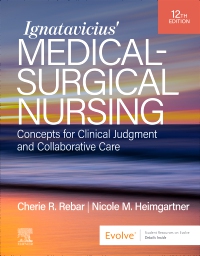
Ignatavicius' Medical-Surgical Nursing - Elsevier eBook on VitalSource, 12th Edition
by Cherie R. Rebar, PhD, MBA, RN, CNE, CNEcl, COI, FAADN and Nicole M. Heimgartner, DNP, RN, CNE, CNEcl, COI, FAADN
Elsevier eBook on VitalSource
ISBN:
9780443407062
Copyright:
2028
Page Count:
1664
Imprint:
Elsevier
List Price:
$159.99
$159.99
Or $0.00 with a valid access code
Not Yet Available
Coming Soon!
Expected availability date: 01-18-2027
Develop the clinical judgment skills you need to succeed on the NCLEX-RN® Examination and in medical-surgical nursing practice with Iggy’s innovative, conceptual and traditional approach that seamlessly supports every curricular structure! Ignatavicius' Medical-Surgical Nursing: Concepts for Clinical Judgment and Collaborative Care, 12th Edition, provides a comprehensive foundation in patient-centered, evidence-based medical-surgical nursing practice while emphasizing clinical judgment, collaborative care, and inclusive nursing practice. Each major body system begins with a dedicated assessment chapter that equips you with the foundational knowledge and skills nurses need to collect and interpret patient data through health histories, physical assessments, diagnostic testing, and analysis of assessment findings. Care chapters are organized by priority and interrelated nursing concepts, followed by commonly occurring exemplars that reinforce clinical reasoning and application. From a team of nursing experts led by Cherie Rebar and Nicole Heimgartner, this trusted bestseller helps you think like a nurse and confidently apply your knowledge in the classroom, simulation laboratory, and clinical settings.
-
- NEW! Current guidelines and curricular emphases include the NCLEX® Exam (NGN), the 2026 version of the AACN Essentials, Healthy People 2030, and the 2020-2030 Future of Nursing Report
- NEW! Evidence‑based practice updates reflect the latest clinical guidelines, safety standards, and national quality initiatives
- NEW and updated case studies strengthen clinical judgment, priority setting, and safe patient care
- NEW! AI Impact boxes explore the growing role of artificial intelligence in healthcare and its implications for nursing practice
- NEW! Leadership at the Bedside boxes highlight how all registered nurses demonstrate leadership through patient advocacy, clinical decision-making, communication, and care coordination
- NEW! Critical Nursing Care boxes at the end of every exemplar distill important elements of the nursing role, helping you quickly identify key priorities for safe, patient-centered care
- NEW! Expanded coverage of emerging health conditions and updated pathophysiology explanations help you connect disease processes to patient assessment, clinical reasoning, and nursing care
- NEW! Enhanced emphasis on collaboration and team‑based care reflects today’s healthcare environment and prepares you to thrive as an effective member of the interprofessional team
- NEW! Comprehensive pharmacology updates include newly approved medications, current drug safety alerts, and the latest evidence-based recommendations to help you deliver safe, high-quality drug therapy
-
- UNIQUE! Unmatched focus on clinical judgment and systems thinking aligns with the NCSBN Clinical Judgment Measurement Model and emphasizes the six cognitive skills that you’ll need to develop effective clinical judgment
- UNIQUE! Data-driven Concept and Exemplar selections build a strong foundation in professional nursing concepts and health and illness concepts, with application throughout each chapter
- UNIQUE! Strong NCLEX® Exam preparation includes Learning Outcomes and Get Ready for the NCLEX® Examination! sections, with an answer key including rationales on the Evolve website
- Faculty-developed instructor resources are available on the Evolve companion website
-
-

-

-
 Clinical Companion for Ignatavicius' Medical-Surgical Nursing - Elsevier E-Book on VitalSourceElsevier eBook on VitalSource
 -
 Study Guide for Medical-Surgical Nursing - Elsevier eBook on VitalSourceElsevier eBook on VitalSource
 -

-
 Ignatavicius' Medical-Surgical NursingHardcover
-
-
UNIT I: Essential Concepts of Medical-Surgical Nursing
1. Overview of Professional Nursing Concepts for Medical-Surgical Nursing
2. Clinical Judgment and Systems Thinking
3. Overview of Health Concepts for Medical-Surgical Nursing
4. Concepts of Care for Older Adults
5. Concepts of Care for Transgender and Non-Binary Patients
6. Assessment and Concepts of Care for Patients with Pain
7. Concepts of Rehabilitation for Chronic and Disabling Health Conditions
8. Concepts of Care for Patients at End-of-Life
9. Concepts of Care for Perioperative Patients
UNIT II: Concepts of Emergency Care and Disaster Preparedness
10. Concepts of Emergency and Trauma Nursing
11. Concepts of Care for Patients with Common Environmental Emergencies
12. Concepts of Disaster Preparedness
UNIT III: Concepts of Fluid, Electrolyte, and Acid-Base Balance and Imbalance
13. Concepts of Fluid and Electrolyte Balance and Imbalance
14. Concepts of Acid-Base Balance and Imbalance
15. Concepts of Infusion Therapy
UNIT IV: Interprofessional Collaboration for Patients with Immunity Conditions
16. Concepts of Inflammation and Immunity
17. Concepts of Care for Patients with Allergy and Immunity Conditions
18. Concepts of Care for Patients with Cancer
19. Concepts of Care for Patients with Infection
UNIT V: Interprofessional Collaboration for Patients with Integumentary System Conditions
20. Assessment of the Skin, Hair, and Nails
21. Concepts of Care for Patients with Conditions of the Skin, Hair, and Nails
UNIT VI: Interprofessional Collaboration for Patients with Respiratory System Conditions
22. Assessment of the Respiratory System
23. Concepts of Care for Patients with Noninfectious Upper Respiratory Conditions
24. Concepts of Care for Patients with Noninfectious Lower Respiratory Conditions
25. Concepts of Care for Patients with Infectious Respiratory Conditions
26. Critical Care of Patients with Respiratory Emergencies
UNIT VII: Interprofessional Collaboration for Patients with Cardiovascular System Conditions
27. Assessment of the Cardiovascular System
28. Concepts of Care for Patients with Dysrhythmias
29. Concepts of Care for Patients with Cardiac Conditions
30. Concepts of Care for Patients with Vascular Conditions
31. Critical Care of Patients with Shock
32. Critical Care of Patients with Acute Coronary Syndromes
UNIT VIII: Interprofessional Collaboration for Patients with Hematologic System Conditions
33. Assessment of the Hematologic System
34. Concepts of Care for Patients with Hematologic Conditions
UNIT IX: Interprofessional Collaboration for Patients with Nervous System Conditions
35. Assessment of the Nervous System
36. Concepts of Care for Patients with Conditions of the Central Nervous System: The Brain
37. Concepts of Care for Patients with Conditions of the Central Nervous System: The Spinal Cord
38. Critical Care of Patients with Neurologic Emergencies
UNIT X: Interprofessional Collaboration for Patients with Sensory System Conditions
39. Assessment and Concepts of Care for Patients with Eye and Vision Conditions
40. Assessment and Concepts of Care for Patients with Ear and Hearing Conditions
UNIT XI: Interprofessional Collaboration for Patients with Musculoskeletal System Conditions
41. Assessment of the Musculoskeletal System
42. Concepts of Care for Patients with Musculoskeletal Conditions
43. Concepts of Care for Patients with Arthritis and Total Joint Arthroplasty
44. Concepts of Care for Patients with Musculoskeletal Trauma
UNIT XII: Interprofessional Collaboration for Patients with Gastrointestinal System Conditions
45. Assessment of the Gastrointestinal System
46. Concepts of Care for Patients with Oral Cavity and Esophageal Conditions
47. Concepts of Care for Patients with Stomach Conditions
48. Concepts of Care for Patients with Noninflammatory Intestinal Conditions
49. Concepts of Care for Patients with Inflammatory Intestinal Conditions
50. Concepts of Care for Patients with Liver Conditions
51. Concepts of Care for Patients with Conditions of the Biliary System and Pancreas
52. Concepts of Care for Patients with Malnutrition: Undernutrition and Obesity
UNIT XIII: Interprofessional Collaboration for Patients with Endocrine System Conditions
53. Assessment of the Endocrine System
54. Concepts of Care for Patients with Pituitary and Adrenal Gland Conditions
55. Concepts of Care for Patients with Conditions of the Thyroid and Parathyroid Glands
56. Concepts of Care for Patients with Diabetes Mellitus
UNIT XIV: Interprofessional Collaboration for Patients with Renal/Urinary System Conditions
57. Assessment of the Renal/Urinary System
58. Concepts of Care for Patients with Urinary Conditions
59. Concepts of Care for Patients with Kidney Conditions
60. Concepts of Care for Patients with Acute Kidney Injury and Chronic Kidney Disease
UNIT XV: Interprofessional Collaboration for Patients with Reproductive System Conditions
61. Assessment of the Reproductive System
62. Concepts of Care for Patients with Breast Conditions
63. Concepts of Care for Patients with Gynecologic Conditions
64. Concepts of Care for Patients with Male Reproductive Conditions
65. Concepts of Care for Patients with Sexually Transmitted Infections -
-
Ways of Reading
- The appearance of the text and page layout can be modified according to the capabilities of the reading system (font family and font size, spaces between paragraphs, sentences, words, and letters, as well as color of background and text)
- This e-publication is accessible to the full extent that the file format and types of content allow, on a specific reading device, by default, without necessarily including any additions such as textual descriptions of images or enhanced navigation
- All content can be read as read aloud speech or dynamic braille
-
Conformance
- The certifier's credential is https://bornaccessible.benetech.org/certified-publishers/
- For detailed accessibility information, see Elsevier's website at https://www.elsevier.com/about/accessibility
- For queries regarding accessibility information, contact [email protected]
- The publication was certified on 03-09-2025
-
Navigation
- Table of contents to all chapters of the text via links
- Page list to go to pages from the print source version
-
Rich Content
- No information is available
-
Hazards
- No information is available
-
Product Content
- No information is available
-
Legal Considerations
- No information is available
-
Additional Accessibility Information
- Content is enhanced with ARIA roles to optimize organization and facilitate navigation
- Page breaks included from the original print source
- For readers with color vision deficiency, use of color (e.g., in diagrams, graphics and charts, in prompts, or on buttons inviting a response) is not the sole means of graphical distinction or of conveying information
- The body text is presented with a contrast ratio of at least 4.5:1 (or 3:1 for large/heading text)
- Ultra-high contrast between text and background
- E-publication includes basic navigation (usually less detailed than TOC-based navigation)
- Where links, controls or buttons are included in the content, the purpose or functionality of each link, control or button is apparent from the associated text alone - or where it is unclear, separate link, control or button descriptions are provided
- All (or substantially all) textual matter is arranged in a single logical reading order (including text that is visually presented as separate from the main text flow, e.g., in boxouts, captions, tables, footnotes, endnotes, citations, etc.). Non-textual content is also linked from within this logical reading order. (Purely decorative non-text content can be ignored).
- Where interactive content is included in the product, controls are provided (e.g., for speed, pause and resume, reset) and labelled to make their use clear.
- The language of the text has been specified (e.g., via the HTML or XML lang attribute) to optimise text-to-speech (and other alternative renderings), both at the whole document level and, where appropriate, for individual words, phrases or passages in a different language.
-
Ways of Reading
$159.99
Or $0.00 with a valid access code
Not Yet Available
Coming Soon!
Expected availability date: 01-18-2027

 as described in our