ISBN:
9780443407147
Copyright:
2028
Page Count:
528
Imprint:
Elsevier
List Price:
$58.99

Learning Radiology - Elsevier E-Book on VitalSource, 6th Edition
by William Herring, MD, FACR
Elsevier eBook on VitalSource
ISBN:
9780443407147
Copyright:
2028
Page Count:
528
Imprint:
Elsevier
List Price:
$58.99
Not Yet Available
Most review copies are eBooks – how fast!
A review copy request is most likely to be fulfilled as an eBook on VitalSource rather than a print product, unless no eBook is available. eBooks become available in as little as a few hours. Print products will take between 7 and 10 days to arrive. To request a print copy, please contact us through the Evolve Support Center for further assistance or contact your Elsevier Sales Rep.
Coming Soon!
Expected availability date: 03-15-2027
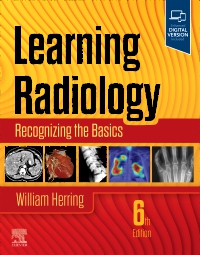
For twenty years, Dr. William Herring’s Learning Radiology: Recognizing the Basics has been the preferred text for medical students and others who are required to read and interpret common radiologic images. This fully revised 6th Edition remains an ideal resource for learning how to differentiate normal and abnormal images of all modalities, offering complete, introductory coverage of everything from the basics of patient safety, dose reduction, and radiation protection to the latest information on artificial intelligence, ultrasound, MRI, and CT. It retains all of the features that readers appreciate most: an easy-to-follow, pattern recognition approach, numerous illustrations, bulleted format, useful tables and teaching boxes, and Dr. Herring’s clear, conversational writing style—with a touch of humor—that explains exactly what today’s students need to know.
-
- Teaches how to arrive at a diagnosis by following a pattern recognition approach, and logically overcome difficult diagnostic challenges with the aid of decision trees
- Employs an easy-to-read, bullet-point format, including bolded key points and icons designating special content: Diagnostic Pitfalls, Really Important Points, Take-Home Points, and newly added Artificial Intelligence
- Features more than 950 figures, useful tables, case study questions, and teaching boxes throughout
- Contains an updated chapter on artificial intelligence in radiology
- Shares the extensive knowledge and experience of esteemed author Dr. William Herring, a skilled radiology teacher and the host of his own specialty website, www.learningradiology.com
- Offers quick review and instruction for medical students, residents, and fellows, as well as those in related fields such as nurse practitioners and physician assistants
- Provides access to exclusive bonus content online, including appendices covering the Discovery of X-rays, Diagnostic Radiology Signs, and What to Order When; USMLE-style questions and answers; videos; and more
- An eBook version is included with purchase. The eBook allows access to all of the text, figures, and references, with the ability to search, make notes and highlights, and have content read aloud
-
-
 Learning RadiologyPaperback
-
-
1. Recognizing Anything: Past, Present, and Future
2. Recognizing Normal Pulmonary Anatomy
3. Recognizing Normal Cardiac Anatomy
4. Recognizing Airspace Versus Interstitial Lung Disease
5. Recognizing the Causes of an Opacified Hemithorax
6. Recognizing Atelectasis
7. Recognizing a Pleural Effusion
8. Recognizing Pneumonia
9. Recognizing the Correct Placement of Lines and Tubes and Their Potential Complications: Critical Care Radiology
10. Recognizing Other Diseases of the Chest
11. Recognizing Adult Heart Disease
12. Recognizing the Normal Abdomen and Pelvis: Conventional Radiographs
13. Recognizing the Normal Abdomen and Pelvis: Computed Tomography
14. Recognizing Bowel Obstruction and Ileus
15. Recognizing Extraluminal Air in the Abdomen
16. Recognizing Abnormal Calcifications and Their Causes
17. Recognizing Gastrointestinal, Hepatobiliary, and Urinary Tract Abnormalities
18. Ultrasonography: Understanding the Principles and Its Uses in Abdominal and Pelvic Imaging
19. Vascular, Pediatric, and Point-of-Care Ultrasound
20. Magnetic Resonance Imaging: Understanding the Principles and Recognizing the Basics
21. Recognizing Nontraumatic Abnormalities of the Appendicular Skeleton and Arthritis
22. Recognizing Nontraumatic Abnormalities of the Spine
23. Recognizing Trauma to the Bony Skeleton
24. Recognizing the Imaging Findings of Trauma to the Chest
25. Recognizing the Imaging Findings of Trauma to the Abdomen and Pelvis
26. Recognizing Some Common Causes of Intracranial Pathology
27. Recognizing Pediatric Diseases
28. Using Image-Guided Interventions in Diagnosis and Treatment (Interventional Radiology)
29. Recognizing the Findings in Breast Imaging Bibliography Index Online-Only
Appendixes
A. Nuclear Medicine: Understanding the Principles and Recognizing the Basics
A. The ABCs of Heart Disease (DELETING)
B. Radiation Dose and Safety
C. Key Terminology and Glossaries
D. Early History and Public Exuberance of the Discovery of X-rays
E. Diagnostic Radiology Signs
F. Artificial Intelligence and Radiology (MOVING TO PRINT)
G. What to Order When -
-
Ways of Reading
- The appearance of the text and page layout can be modified according to the capabilities of the reading system (font family and font size, spaces between paragraphs, sentences, words, and letters, as well as color of background and text)
- This e-publication is accessible to the full extent that the file format and types of content allow, on a specific reading device, by default, without necessarily including any additions such as textual descriptions of images or enhanced navigation
- All content can be read as read aloud speech or dynamic braille
-
Conformance
- The certifier's credential is https://bornaccessible.benetech.org/certified-publishers/
- For detailed accessibility information, see Elsevier's website at https://www.elsevier.com/about/accessibility
- For queries regarding accessibility information, contact [email protected]
- The publication was certified on 03-09-2025
-
Navigation
- Table of contents to all chapters of the text via links
- Page list to go to pages from the print source version
-
Rich Content
- No information is available
-
Hazards
- No information is available
-
Product Content
- No information is available
-
Legal Considerations
- No information is available
-
Additional Accessibility Information
- Content is enhanced with ARIA roles to optimize organization and facilitate navigation
- Page breaks included from the original print source
- For readers with color vision deficiency, use of color (e.g., in diagrams, graphics and charts, in prompts, or on buttons inviting a response) is not the sole means of graphical distinction or of conveying information
- The body text is presented with a contrast ratio of at least 4.5:1 (or 3:1 for large/heading text)
- Ultra-high contrast between text and background
- E-publication includes basic navigation (usually less detailed than TOC-based navigation)
- Where links, controls or buttons are included in the content, the purpose or functionality of each link, control or button is apparent from the associated text alone - or where it is unclear, separate link, control or button descriptions are provided
- All (or substantially all) textual matter is arranged in a single logical reading order (including text that is visually presented as separate from the main text flow, e.g., in boxouts, captions, tables, footnotes, endnotes, citations, etc.). Non-textual content is also linked from within this logical reading order. (Purely decorative non-text content can be ignored).
- Where interactive content is included in the product, controls are provided (e.g., for speed, pause and resume, reset) and labelled to make their use clear.
- The language of the text has been specified (e.g., via the HTML or XML lang attribute) to optimise text-to-speech (and other alternative renderings), both at the whole document level and, where appropriate, for individual words, phrases or passages in a different language.
-
Ways of Reading
Not Yet Available
Most review copies are eBooks – how fast!
A review copy request is most likely to be fulfilled as an eBook on VitalSource rather than a print product, unless no eBook is available. eBooks become available in as little as a few hours. Print products will take between 7 and 10 days to arrive. To request a print copy, please contact us through the Evolve Support Center for further assistance or contact your Elsevier Sales Rep.
Coming Soon!
Expected availability date: 03-15-2027

 as described in our