
ISBN:
9780443408243
Copyright:
2028
Page Count:
624
Imprint:
Elsevier
List Price:
$99.99

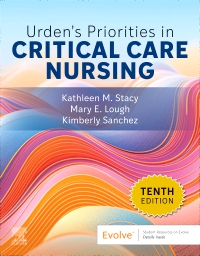
Urden's Priories in Crical Care Nusing - Elsevier E-Book on VitalSource, 10th Edition
by Linda D. Urden, DNSc, RN, CNS, FAAN, Kathleen M. Stacy, PhD, RN, APRN-CNS, CCNS, FCNS, Mary E. Lough, PhD, RN, CNS, FCCM, FAHA, FCNS, FAAN and Kimberly Sanchez, PhD, RN, CCRN, ACCNS- AG
Elsevier eBook on VitalSource
ISBN:
9780443408243
Copyright:
2028
Page Count:
624
Imprint:
Elsevier
List Price:
$99.99
$99.99
Or $0.00 with a valid access code
Not Yet Available
Coming Soon!
Expected availability date: 01-15-2027
Focus on the most important concepts in progressive and critical care nursing with Priorities in Critical Care Nursing, 10th Edition. Ideal for students, practicing nurses undergoing in-service training for progressive and critical care, and progressive or critical care nurses reviewing for PCCN® or CCRN® certification, this trusted, evidence-based textbook uses the latest, most authoritative research to help you identify patient priorities in order to safely and expertly manage patient care. Succinct coverage of all essential progressive and critical care nursing topics includes medications, patient safety, patient education, problem identification, and interprofessional collaborative management. With this award-winning resource, you'll learn how to integrate the technology of progressive and critical care nursing with the physiological needs and psychosocial concerns of patients and families to provide the highest-quality care.
-
- Updated content throughout reflects the latest changes in concepts, techniques, and technology of progressive and critical care nursing
- Updates reflect the curricular emphases specified in the 2021 AACN Essentials and the 2020-2030 Future of Nursing Report, with particular emphasis on diversity, equity, and inclusion and overcoming health disparities
- Updated and expanded resources for the Next-Generation NCLEX(R) Examination (NGN) for prelicensure students
- NOTE: Additional features to be identified in a summer 2024 planning meeting
-
- Need-to-know content reflects the essentials of high-quality care in today’s progressive and critical care environments
- UNIQUE! Balanced coverage of technology and psychosocial concerns includes an emphasis on patient care priorities to help students learn to provide the highest-quality nursing care
- Consistent format features a Clinical Assessment and Diagnostic Procedures chapter followed by one or more Disorders and Therapeutic Management chapters for each content area
- Strong AACN Essentials focus throughout includes Evidence-Based Practice boxes that highlight evidence specific to the discussion; Patient-Centered Care boxes that provide recommendations to address patient uniqueness; Quality Improvement boxes describing quality initiatives and implications for practice; Teamwork and Collaboration boxes that provide guidelines for effective handoffs, assessments, and communication between nurses and other hospital staff; Safety boxes that highlight important guidelines and tips to ensure patient safety in critical care settings; and Informatics boxes that provide guidance in using key information technology
- Patient Care Management Plans provide a complete care plan for every priority patient problem, including outcome criteria, nursing interventions, and rationales
- UNIQUE! Trending Priorities in Healthcare boxes highlight societal trends and issues that affect health care as it is delivered throughout various sites and geographical settings, such as limited English proficiency, unhoused status, and external disaster preparedness
- Winner of the Silver American Journal of Nursing Book of the Year award in emergency/critical care nursing in its 9th edition!
-
UNIT ONE: FOUNDATIONS IN CRITICAL CARE NURSING
1. Caring for the Critically Ill Patient
2. Ethical and Legal Issues
3. Facilitating Care Transitions
UNIT TWO: COMMON PROBLEMS IN CRITICAL CARE
4. Psychosocial and Spiritual Considerations
5. Nutritional Alterations and Management
6. The Older Adult
7. Pain and Pain Management
8. Sedation and Delirium Management
9. Palliative and End-of-Life Care
UNIT THREE: CARDIOVASCULAR ALTERATIONS
10. Cardiovascular Clinical Assessment and Diagnostic Procedures
11. Cardiovascular Disorders
12. Cardiovascular Therapeutic Management
UNIT FOUR: PULMONARY ALTERATIONS
13. Pulmonary Clinical Assessment and Diagnostic Procedures
14. Pulmonary Disorders
15. Pulmonary Therapeutic Management
UNIT FIVE: NEUROLOGICAL ALTERATIONS
16. Neurological Clinical Assessment and Diagnostic Procedures
17. Neurologic Disorders and Therapeutic Management
UNIT SIX: KIDNEY ALTERATIONS
18. Kidney Clinical Assessment and Diagnostic Procedures
19. Kidney Disorders and Therapeutic Management
UNIT SEVEN: GASTROINTESTINAL ALTERATIONS
20. Gastrointestinal Clinical Assessment and Diagnostic Procedures
21. Gastrointestinal Disorders and Therapeutic Management
UNIT EIGHT: ENDOCRINE ALTERATIONS
22. Endocrine Clinical Assessment and Diagnostic Procedures
23. Endocrine Disorders and Therapeutic Management
UNIT NINE: MULTISYSTEM ALTERATIONS
24. Trauma
25. Burns
26. Shock, Sepsis, and Multiple Organ Dysfunction Syndrome
27. Hematological and Oncological Emergencies Appendix: Patient Care Management Plans Index -
-
Ways of Reading
- The appearance of the text and page layout can be modified according to the capabilities of the reading system (font family and font size, spaces between paragraphs, sentences, words, and letters, as well as color of background and text)
- This e-publication is accessible to the full extent that the file format and types of content allow, on a specific reading device, by default, without necessarily including any additions such as textual descriptions of images or enhanced navigation
- No information about nonvisual reading is available
-
Conformance
- No information is available
-
Navigation
- Table of contents to all chapters of the text via links
- Page list to go to pages from the print source version
-
Rich Content
- No information is available
-
Hazards
- No information is available
-
Product Content
- No information is available
-
Legal Considerations
- No information is available
-
Additional Accessibility Information
- Content is enhanced with ARIA roles to optimize organization and facilitate navigation
- Page breaks included from the original print source
- For readers with color vision deficiency, use of color (e.g., in diagrams, graphics and charts, in prompts, or on buttons inviting a response) is not the sole means of graphical distinction or of conveying information
- E-publication includes basic navigation (usually less detailed than TOC-based navigation)
- Where links, controls or buttons are included in the content, the purpose or functionality of each link, control or button is apparent from the associated text alone - or where it is unclear, separate link, control or button descriptions are provided
- All (or substantially all) textual matter is arranged in a single logical reading order (including text that is visually presented as separate from the main text flow, e.g., in boxouts, captions, tables, footnotes, endnotes, citations, etc.). Non-textual content is also linked from within this logical reading order. (Purely decorative non-text content can be ignored).
- The language of the text has been specified (e.g., via the HTML or XML lang attribute) to optimise text-to-speech (and other alternative renderings), both at the whole document level and, where appropriate, for individual words, phrases or passages in a different language.
-
Ways of Reading
$99.99
Or $0.00 with a valid access code
Not Yet Available
Coming Soon!
Expected availability date: 01-15-2027

 as described in our