ISBN:
9780443408632
Copyright:
2028
Page Count:
360
Imprint:
Elsevier
List Price:
$89.99

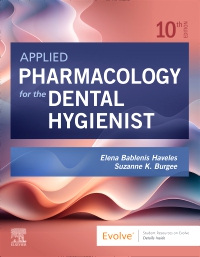
Applied Pharmacology for the Dental Hygienist - Elsevier E-Book on VitalSource, 10th Edition
by Elena Bablenis Haveles, BS Pharm, Pharm D (Retired) and Suzanne Burgee, MSDH, RDH, QDA
Elsevier eBook on VitalSource
ISBN:
9780443408632
Copyright:
2028
Page Count:
360
Imprint:
Elsevier
List Price:
$89.99
Not Yet Available
Most review copies are eBooks – how fast!
A review copy request is most likely to be fulfilled as an eBook on VitalSource rather than a print product, unless no eBook is available. eBooks become available in as little as a few hours. Print products will take between 7 and 10 days to arrive. To request a print copy, please contact us through the Evolve Support Center for further assistance or contact your Elsevier Sales Rep.
Coming Soon!
Expected availability date: 03-15-2027
With a focus on the most commonly used drugs in dentistry, Applied Pharmacology for the Dental Hygienist, 10th Edition, is the only pharmacology resource tailored specifically to dental hygiene practice, equipping students with the complete pharmacologic foundation needed to assess patients, identify drug interactions and adverse reactions, and support safe, effective oral health care delivery across an expanding scope of practice. This new edition adds timely coverage of drugs treating weight loss, ADHD, and addiction, as well as online patient questionnaires to help students develop confident, condition-specific patient assessment skills.
-
- NEW! Coverage of drugs used to treat weight loss, ADHD, and addiction prepares you to treat patients managing those conditions
- NEW! Patient questionnaires on the Evolve companion website help you learn what to ask patients who have certain conditions, such as diabetes or hypertension
-
- NEW! Coverage of drugs used to treat weight loss, ADHD, and addiction prepares students to treat patients managing those conditions
- NEW! Patient questionnaires on the Evolve companion website help students learn what to ask patients who have certain conditions, such as diabetes or hypertension
- Comprehensive coverage with a dental hygiene focus provides an in-depth understanding of the most commonly used drugs, how they work, and how they affect patients’ oral health and dental treatment options
- Practice opportunities for classroom and board exam prep include chapter review questions at the end of each chapter and practice quizzes on the Evolve companion website
- Learning features include clinical case studies in the text and on the Evolve companion website, Dental Hygiene Considerations, summary boxes and tables, and Note boxes to highlight key concepts
- Vocabulary practice includes key terms called out in each chapter and defined in the glossary
- Engaging art program features illustrations showing basic principles and internal processes, along with photographs of oral conditions and side effects
- Consistent presentation of each drug allows for quick identification of key information
- Separate drug index makes it easy to look up specific drugs and types of drugs
- Quick-reference appendices offer valuable information on topics such as medical terminology, medical acronyms, and dose calculations for children
-
Part I: General Principles
1. Information, Sources, Regulatory Agencies, Drug Legislation, and Prescription Writing
2. Drug Action and Handling
3. Adverse Reactions
Part II: Drugs Used in Dentistry
4. Autonomic Drugs
5. Nonopioid (Nonnarcotic) Analgesics
6. Opioid (Narcotic) Analgesics and Antagonists
7. Antiinfective Agents
8. Antifungal and Antiviral Agents
9. Antianxiety Agents
10. Local Anesthetics
11. General Anesthetics
Part III: Drugs That May Alter Dental Treatment
12. Drugs for the Treatment of Cardiovascular Diseases
13. Drugs for the Treatment of Gastrointestinal Disorders
14. Drugs for the Treatment of Seizure Disorders
15. Drugs for the Treatment of Central Nervous System Disorders
16. Adrenocorticosteroids
17. Drugs for the Treatment of Respiratory Disorders and Allergic Rhinitis
18. Drugs for the Treatment of Diabetes Mellitus
19. Drugs for the Treatment of Other Endocrine Disorders
20. Antineoplastic Drugs
Part IV: Special Situations
21. Emergency Drugs
22. Pregnancy and Breast Feeding
23. Substance Abuse Disorders
24. Natural/Herbal Products and Dietary Supplements
25. Prevention and Treatment of Common Oral Conditions
Appendix A: Medical Acronyms
Appendix B: Medical Terminology
Appendix C: Drug-Related Oral Manifestations: Xerostomia and Taste Alterations
Appendix D: Children’s Dose Calculations
Glossary -
-
Ways of Reading
- The appearance of the text and page layout can be modified according to the capabilities of the reading system (font family and font size, spaces between paragraphs, sentences, words, and letters, as well as color of background and text)
- This e-publication is accessible to the full extent that the file format and types of content allow, on a specific reading device, by default, without necessarily including any additions such as textual descriptions of images or enhanced navigation
- All content can be read as read aloud speech or dynamic braille
-
Conformance
- The certifier's credential is https://bornaccessible.benetech.org/certified-publishers/
- For detailed accessibility information, see Elsevier's website at https://www.elsevier.com/about/accessibility
- For queries regarding accessibility information, contact [email protected]
- The publication was certified on 03-09-2025
-
Navigation
- Table of contents to all chapters of the text via links
- Page list to go to pages from the print source version
-
Rich Content
- No information is available
-
Hazards
- No information is available
-
Product Content
- No information is available
-
Legal Considerations
- No information is available
-
Additional Accessibility Information
- Content is enhanced with ARIA roles to optimize organization and facilitate navigation
- Page breaks included from the original print source
- For readers with color vision deficiency, use of color (e.g., in diagrams, graphics and charts, in prompts, or on buttons inviting a response) is not the sole means of graphical distinction or of conveying information
- The body text is presented with a contrast ratio of at least 4.5:1 (or 3:1 for large/heading text)
- Ultra-high contrast between text and background
- E-publication includes basic navigation (usually less detailed than TOC-based navigation)
- Where links, controls or buttons are included in the content, the purpose or functionality of each link, control or button is apparent from the associated text alone - or where it is unclear, separate link, control or button descriptions are provided
- All (or substantially all) textual matter is arranged in a single logical reading order (including text that is visually presented as separate from the main text flow, e.g., in boxouts, captions, tables, footnotes, endnotes, citations, etc.). Non-textual content is also linked from within this logical reading order. (Purely decorative non-text content can be ignored).
- Where interactive content is included in the product, controls are provided (e.g., for speed, pause and resume, reset) and labelled to make their use clear.
- The language of the text has been specified (e.g., via the HTML or XML lang attribute) to optimise text-to-speech (and other alternative renderings), both at the whole document level and, where appropriate, for individual words, phrases or passages in a different language.
-
Ways of Reading


Not Yet Available
Most review copies are eBooks – how fast!
A review copy request is most likely to be fulfilled as an eBook on VitalSource rather than a print product, unless no eBook is available. eBooks become available in as little as a few hours. Print products will take between 7 and 10 days to arrive. To request a print copy, please contact us through the Evolve Support Center for further assistance or contact your Elsevier Sales Rep.
Coming Soon!
Expected availability date: 03-15-2027

 as described in our