ISBN:
9780443408977
Copyright:
2028
Page Count:
512
Imprint:
Elsevier
List Price:
$108.99

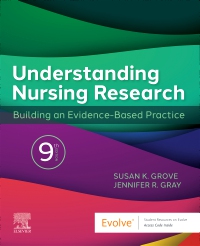
Understanding Nursing Research - Elsevier E-Book on VitalSource, 9th Edition
by Susan K. Grove, PhD, RN, ANP-BC, GNP-BC and Jennifer R. Gray, PhD, RN, FAAN
Elsevier eBook on VitalSource
ISBN:
9780443408977
Copyright:
2028
Page Count:
512
Imprint:
Elsevier
List Price:
$108.99
Not Yet Available
Most review copies are eBooks – how fast!
A review copy request is most likely to be fulfilled as an eBook on VitalSource rather than a print product, unless no eBook is available. eBooks become available in as little as a few hours. Print products will take between 7 and 10 days to arrive. To request a print copy, please contact us through the Evolve Support Center for further assistance or contact your Elsevier Sales Rep.
Coming Soon!
Expected availability date: 02-05-2027
Edition after edition, Understanding Nursing Research: Building an Evidence-Based Practice has provided a time-tested, step-by-step approach to the research process and the critical appraisal skills identified as a competency in the 2026 AACN Essentials and emphasized on the Next Generation NCLEX® Examination. To promote complete understanding, the book unpacks the principles of quantitative and qualitative research, examines ethics, and clarifies research designs, methods of measurement, and statistical analysis. Including all the content necessary for a one-semester introductory course in nursing research, this leading text helps students learn to critique research studies and implement research evidence in clinical settings.
-
- NEW! Updated content focuses on the most relevant, need-to-know information to help you understand the research and evidence-based practice (EBP) processes
- NEW! Updated research examples feature current, high-quality, and clinically relevant nursing research and quality improvement studies that illustrate how to understand and critically appraise the nursing literature
-
- NEW! Updated content throughout the book focuses on the most relevant, need-to-know information give students a foundational understanding of research and evidence-based practice (EBP) processes
- NEW! Updated research examples feature current, high-quality, and clinically relevant nursing research and quality improvement studies that illustrate how to understand and critically appraise the nursing literature
- Clear, step-by-step organization introduces the research process and critical appraisal skills, identified as a competency in the 2026 AACN Essentials and a key emphasis of the Next Generation NCLEX® Examination (NGN)
- Balanced coverage of qualitative and quantitative research methods prepares students to approach published studies with an unbiased view of the researcher's methodology
- Introduction to mixed-methods and outcomes research familiarizes students with three design categories of these increasingly popular methodologies in nursing research
- Research Examples feature current, high-quality, and clinically relevant nursing research and quality improvement studies showing how to understand and critically appraise nursing literature
- Strong focus on evidence-based practice helps students develop skills in critically appraising and applying published studies to clinical practice
- Research/EBP Tips provide expert advice clarifying the process of research and critical appraisal
- Critical Appraisal Guidelines boxes provide step-by-step guidance in critically appraising published research studies
- Summary tables, illustrations, and boxes promote in-depth learning of processes and approaches for today’s increasingly evidence-based clinical practice
- Authoritative content is written by pioneers and practitioners of nursing research who offer unique, firsthand insights into the field
- This title is also available in Sherpath! Sold separately, this innovative teaching and learning technology offers interactive course content and resources that streamline class preparation and assessment and give students personalized help to reach their learning goals. Sherpath fully includes the eBook of this title for all-in-one digital course delivery.
-
-

-
 Understanding Nursing ResearchPaperback
-
-
1. Introduction to Nursing Research and Its Importance in Building an Evidence-Based Practice
2. Introduction to Quantitative Research
3. Introduction to Qualitative Research
4. Examining Ethics in Nursing Research
5. Examining Research Problems, Purposes, and Hypotheses
6. Understanding and Critically Appraising the Literature Review
7. Understanding Theory and Research Frameworks
8. Clarifying Quantitative Research Designs
9. Examining Populations and Samples in Research
10. Clarifying Measurement and Data Collection in Quantitative Research
11. Understanding Statistics in Research
12. Critical Appraisal of Quantitative and Qualitative Research for Nursing Practice
13. Building an Evidence-Based Nursing Practice
14. Introduction to Additional Research Methodologies in Nursing: Mixed Methods and Outcomes Research Glossary -
-
Ways of Reading
- The appearance of the text and page layout can be modified according to the capabilities of the reading system (font family and font size, spaces between paragraphs, sentences, words, and letters, as well as color of background and text)
- This e-publication is accessible to the full extent that the file format and types of content allow, on a specific reading device, by default, without necessarily including any additions such as textual descriptions of images or enhanced navigation
- All content can be read as read aloud speech or dynamic braille
-
Conformance
- The certifier's credential is https://bornaccessible.benetech.org/certified-publishers/
- For detailed accessibility information, see Elsevier's website at https://www.elsevier.com/about/accessibility
- For queries regarding accessibility information, contact [email protected]
- The publication was certified on 03-09-2025
-
Navigation
- Table of contents to all chapters of the text via links
- Page list to go to pages from the print source version
-
Rich Content
- No information is available
-
Hazards
- No information is available
-
Product Content
- No information is available
-
Legal Considerations
- No information is available
-
Additional Accessibility Information
- Content is enhanced with ARIA roles to optimize organization and facilitate navigation
- Page breaks included from the original print source
- For readers with color vision deficiency, use of color (e.g., in diagrams, graphics and charts, in prompts, or on buttons inviting a response) is not the sole means of graphical distinction or of conveying information
- The body text is presented with a contrast ratio of at least 4.5:1 (or 3:1 for large/heading text)
- Ultra-high contrast between text and background
- E-publication includes basic navigation (usually less detailed than TOC-based navigation)
- Where links, controls or buttons are included in the content, the purpose or functionality of each link, control or button is apparent from the associated text alone - or where it is unclear, separate link, control or button descriptions are provided
- All (or substantially all) textual matter is arranged in a single logical reading order (including text that is visually presented as separate from the main text flow, e.g., in boxouts, captions, tables, footnotes, endnotes, citations, etc.). Non-textual content is also linked from within this logical reading order. (Purely decorative non-text content can be ignored).
- Where interactive content is included in the product, controls are provided (e.g., for speed, pause and resume, reset) and labelled to make their use clear.
- The language of the text has been specified (e.g., via the HTML or XML lang attribute) to optimise text-to-speech (and other alternative renderings), both at the whole document level and, where appropriate, for individual words, phrases or passages in a different language.
-
Ways of Reading
Not Yet Available
Most review copies are eBooks – how fast!
A review copy request is most likely to be fulfilled as an eBook on VitalSource rather than a print product, unless no eBook is available. eBooks become available in as little as a few hours. Print products will take between 7 and 10 days to arrive. To request a print copy, please contact us through the Evolve Support Center for further assistance or contact your Elsevier Sales Rep.
Coming Soon!
Expected availability date: 02-05-2027

 as described in our
