ISBN:
9780443409080
Copyright:
2028
Page Count:
992
Imprint:
Elsevier
List Price:
$99.99

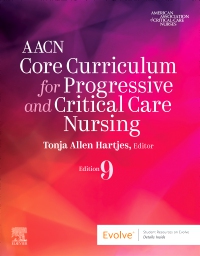
AACN Core Curriculum for Progressive and Critical Care Nursing - Elsevier E-Book on VitalSource, 9th Edition
by AACN
Elsevier eBook on VitalSource
ISBN:
9780443409080
Copyright:
2028
Page Count:
992
Imprint:
Elsevier
List Price:
$99.99
Not Yet Available
Most review copies are eBooks – how fast!
A review copy request is most likely to be fulfilled as an eBook on VitalSource rather than a print product, unless no eBook is available. eBooks become available in as little as a few hours. Print products will take between 7 and 10 days to arrive. To request a print copy, please contact us through the Evolve Support Center for further assistance or contact your Elsevier Sales Rep.
Coming Soon!
Expected availability date: 06-25-2027
-
- Updated throughout to reflect the latest research, best practices, national and international guidelines, and AACN initiatives
- Updated to reflect the latest CCRN(R) Test Plan
- Updated to reflect the 2021 AACN Essentials
- Additional new features to be determined in a Summer 2024 planning call
-
- Experts at the American Association of Critical-Care Nurses (AACN) provide the definitive reference for progressive and critical care nursing care of adults
- Concise outline format makes information easy to find and easy to digest
- Novice-to-expert levels of coverage emphasize clinical nursing practice, preparing you with the full range of knowledge needed for optimal patient care in progressive and critical care settings
- Key content in each body systems chapter includes an anatomy and physiology review along with coverage of assessment, patient care, and specific patient health problems
- Expert Tips and Key Concepts boxes highlight important content and serve as a quick reference
-
PART I. Foundations of Progressive and Critical Care Nursing
1. Professional Caring and Ethical Practice
2. Psychosocial Aspects of Critical Care
PART II. Critical Care of Patients with Issues Affecting Specific Body Systems
3. Pulmonary System
4. Cardiovascular System
5. Neurologic System
6. Renal System
7. Endocrine System
8. Hematologic and Immunologic Systems
9. Gastrointestinal System
PART III. Critical Care of Patients with Multisystem Issues
10. Sepsis and Septic Shock
11. Multisystem Trauma
12. Burns
13. Hypothermia
14. Toxin Exposure
PART IV. Critical Care of Patients With Special Needs
15. Bariatric Patients
16. Older Adult Patients
17. High-Risk Obstetric Patients
18. Patient Transport
19. Sedation
20. Pain Chapter
21. Palliative and End-of-Life Care
22. Perioperative Care Index -
-
Ways of Reading
- The appearance of the text and page layout can be modified according to the capabilities of the reading system (font family and font size, spaces between paragraphs, sentences, words, and letters, as well as color of background and text)
- This e-publication is accessible to the full extent that the file format and types of content allow, on a specific reading device, by default, without necessarily including any additions such as textual descriptions of images or enhanced navigation
- All content can be read as read aloud speech or dynamic braille
-
Conformance
- The certifier's credential is https://bornaccessible.benetech.org/certified-publishers/
- For detailed accessibility information, see Elsevier's website at https://www.elsevier.com/about/accessibility
- For queries regarding accessibility information, contact [email protected]
- The publication was certified on 03-09-2025
-
Navigation
- Table of contents to all chapters of the text via links
- Page list to go to pages from the print source version
-
Rich Content
- No information is available
-
Hazards
- No information is available
-
Product Content
- No information is available
-
Legal Considerations
- No information is available
-
Additional Accessibility Information
- Content is enhanced with ARIA roles to optimize organization and facilitate navigation
- Page breaks included from the original print source
- For readers with color vision deficiency, use of color (e.g., in diagrams, graphics and charts, in prompts, or on buttons inviting a response) is not the sole means of graphical distinction or of conveying information
- The body text is presented with a contrast ratio of at least 4.5:1 (or 3:1 for large/heading text)
- Ultra-high contrast between text and background
- E-publication includes basic navigation (usually less detailed than TOC-based navigation)
- Where links, controls or buttons are included in the content, the purpose or functionality of each link, control or button is apparent from the associated text alone - or where it is unclear, separate link, control or button descriptions are provided
- All (or substantially all) textual matter is arranged in a single logical reading order (including text that is visually presented as separate from the main text flow, e.g., in boxouts, captions, tables, footnotes, endnotes, citations, etc.). Non-textual content is also linked from within this logical reading order. (Purely decorative non-text content can be ignored).
- Where interactive content is included in the product, controls are provided (e.g., for speed, pause and resume, reset) and labelled to make their use clear.
- The language of the text has been specified (e.g., via the HTML or XML lang attribute) to optimise text-to-speech (and other alternative renderings), both at the whole document level and, where appropriate, for individual words, phrases or passages in a different language.
-
Ways of Reading

Not Yet Available
Most review copies are eBooks – how fast!
A review copy request is most likely to be fulfilled as an eBook on VitalSource rather than a print product, unless no eBook is available. eBooks become available in as little as a few hours. Print products will take between 7 and 10 days to arrive. To request a print copy, please contact us through the Evolve Support Center for further assistance or contact your Elsevier Sales Rep.
Coming Soon!
Expected availability date: 06-25-2027

 as described in our
