
ISBN:
9780443409509
Copyright:
2026
Publication Date:
12-08-2025
Page Count:
1632
Imprint:
Elsevier
List Price:
$101.99

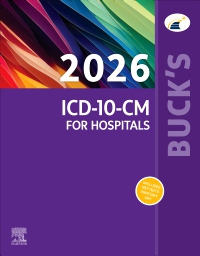
Buck's 2026 ICD-10-CM for Hospitals - Elsevier E-Book on VitalSource, 1st Edition
by Elsevier
Elsevier eBook on VitalSource
ISBN:
9780443409509
Copyright:
2026
Publication Date:
12-08-2025
Page Count:
1632
Imprint:
Elsevier
List Price:
$101.99
Was
$101.99
Now $91.79
Or $0.00 with a valid access code
Selecting diagnosis codes is faster and easier with Buck's 2026 ICD-10-CM for Hospitals. Designed by coders for coders, this full-color manual includes all the ICD-10 codes that you need for today’s inpatient coding. As coders need extensive knowledge to code with ICD-10-CM — and to choose from the thousands of possible codes — this edition makes it easier with colorful anatomy plates (including Netter’s Anatomy illustrations) to help you understand anatomy and how it can affect your code choices. In addition, it comes with durable spiral binding, and includes a companion website with the latest coding updates.
Newer Edition Available

Buck's 2027 ICD-10-CM for Physicians & Hospitals - Elsevier E-Book on VitalSource
Elsevier eBook on VitalSource
ISBN: 9780443386664
-
- At-a-glance Guide to the 2026 ICD-10-CM Updates in the front of the book lists all new, revised, and deleted codes, providing a quick lookup of the coding changes
- Official Guidelines for Coding and Reporting (OGCRs) are listed in full at the beginning of the book, with chapter-specific guidelines listed at the beginning of each chapter and integrated within the code set, providing easier reference to coding rules when they are needed most
- UNIQUE! Full-color anatomy plates (including Netter’s Anatomy art) are included in a separate section for easy reference and cross-referenced within the Tabular List of Diseases and Injuries, to help you understand anatomy and how it may affect choosing codes
- Full-color design includes consistent color-coded symbols and text, providing easier access to codes and coding information
- American Hospital Association's Coding Clinic® citations include official ICD-10-CM coding advice relating to specific codes and their usage
- More than 190 illustrations provide visual orientation and enhance understanding of specific coding situations
- Items are included throughout the Tabular List to ensure accurate coding, providing additional information on common diseases and conditions
- Additional elements within specific codes define terms and add coding instructions relating to difficult terminology, diseases and conditions, or coding in a specific category
- Symbols and highlights draw attention to codes that may require special consideration before coding, including:
- New, Revised, and Deleted
- Unacceptable Principal Diagnosis
- Codes that Call for the Use of Additional Character(s)
- Includes, Excludes1, and Excludes2
- Use Additional
- Code First and Code Also
- Placeholder X symbol reminds you to assign placeholder X for codes less than 6 characters that require a 7th character
- CC (Complications & Comorbidities) and MCC (Major CC) symbols identify codes associated with the presence of secondary diagnoses from MS-DRGs, and call attention to CC and MCC exceptions
- Exclusion and PDX symbols indicate exclusions to CC and MCC for both primary and secondary diagnoses, along with the corresponding PDX Collection number
- Hospital Acquired Condition symbol clearly identifies conditions that will always be coded as hospital acquired
- Manifestation code symbol identifies conditions for which it is important to record both the etiology and the symptom of the disease
- HCC symbol indicates diagnoses in the Tabular List associated with Hierarchical Condition Categories
- Age and Sex edits from the Definition of Medicare Code Edits help to ensure accuracy by denoting codes that are used only with patients of a specific age or sex
-
- NEW! Updated 2026 Official Code set reflects the latest ICD-10 codes needed for diagnosis coding
-
Guide to Using the 2026 ICD-10-CM for Hospitals
Symbols and Conventions
Guide to the 2026 ICD-10-CM Updates
Part I Introduction
ICD-10-CM Official Guidelines for Coding and Reporting FY2026
Anatomy Illustrations
Part II Alphabetic Index
Index to Diseases and Injuries
Table of Neoplasms
Table of Drugs and Chemicals
External Cause of Injuries Index
Part III Tabular List of Diseases and Injuries
1. Certain Infectious and Parasitic Diseases (A00-B99)
2. Neoplasms (C00-D49)
3. Diseases of the Blood and Blood-Forming Organs and Certain Disorders Involving the Immune Mechanism (D50-D89)
4. Endocrine, Nutritional and Metabolic Diseases (E00-E89)
5. Mental, Behavioral and Neurodevelopmental Disorders (F01-F99)
6. Diseases of the Nervous System (G00-G99)
7. Diseases of the Eye and Adnexa (H00-H59)
8. Diseases of the Ear and Mastoid Process (H60-H95)
9. Diseases of the Circulatory System (I00-I99)
10. Diseases of the Respiratory System (J00-J99)
11. Diseases of the Digestive System (K00-K95)
12. Diseases of the Skin and Subcutaneous Tissue (L00-L99)
13. Diseases of the Musculoskeletal System and Connective Tissue (M00-M99)
14. Diseases of the Genitourinary System (N00-N99)
15. Pregnancy, Childbirth, and the Puerperium (O00-O9A)
16. Certain Conditions Originating in the Perinatal Period (P00-P96)
17. Congenital Malformations, Deformations, and Chromosomal Abnormalities (Q00-Q99)
18. Symptoms, Signs, and Abnormal Clinical and Laboratory Findings, Not Elsewhere Classified (R00-R99)
19. Injury, Poisoning and Certain Other Consequences of External Causes (S00-T88)
20. External Causes of Morbidity (V00-Y99)
21. Factors Influencing Health Status and Contact with Health Services (Z00-Z99)
22. Codes for Special Purposes (U00-U85) -
-
Ways of Reading
- The appearance of the text and page layout can be modified according to the capabilities of the reading system (font family and font size, spaces between paragraphs, sentences, words, and letters, as well as color of background and text)
- This e-publication is accessible to the full extent that the file format and types of content allow, on a specific reading device, by default, without necessarily including any additions such as textual descriptions of images or enhanced navigation
- No information about nonvisual reading is available
-
Conformance
- No information is available
-
Navigation
- Table of contents to all chapters of the text via links
- Page list to go to pages from the print source version
-
Rich Content
- No information is available
-
Hazards
- No information is available
-
Product Content
- No information is available
-
Legal Considerations
- No information is available
-
Additional Accessibility Information
- Content is enhanced with ARIA roles to optimize organization and facilitate navigation
- Page breaks included from the original print source
- For readers with color vision deficiency, use of color (e.g., in diagrams, graphics and charts, in prompts, or on buttons inviting a response) is not the sole means of graphical distinction or of conveying information
- E-publication includes basic navigation (usually less detailed than TOC-based navigation)
- Where links, controls or buttons are included in the content, the purpose or functionality of each link, control or button is apparent from the associated text alone - or where it is unclear, separate link, control or button descriptions are provided
- All (or substantially all) textual matter is arranged in a single logical reading order (including text that is visually presented as separate from the main text flow, e.g., in boxouts, captions, tables, footnotes, endnotes, citations, etc.). Non-textual content is also linked from within this logical reading order. (Purely decorative non-text content can be ignored).
- The language of the text has been specified (e.g., via the HTML or XML lang attribute) to optimise text-to-speech (and other alternative renderings), both at the whole document level and, where appropriate, for individual words, phrases or passages in a different language.
-
Ways of Reading
Was
$101.99
Now $91.79
Or $0.00 with a valid access code

 as described in our