ISBN:
9780443409943
Copyright:
2027
Publication Date:
10-06-2026
Page Count:
288
Imprint:
Elsevier
List Price:
$79.99

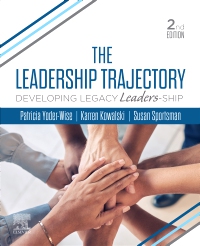
The Leadership Trajectory - Elsevier E-Book on VitalSource, 2nd Edition
by Patricia S. Yoder-Wise, RN, EdD, NEA-BC, ANEF, FAAN, Karren Kowalski, PhD, RN, NEA-BC, FAAN and Susan Sportsman, RN, PhD, ANEF, FAAN
Elsevier eBook on VitalSource
ISBN:
9780443409943
Copyright:
2027
Publication Date:
10-06-2026
Page Count:
288
Imprint:
Elsevier
List Price:
$79.99
Most review copies are eBooks – how fast!
A review copy request is most likely to be fulfilled as an eBook on VitalSource rather than a print product, unless no eBook is available. eBooks become available in as little as a few hours. Print products will take between 7 and 10 days to arrive. To request a print copy, please contact us through the Evolve Support Center for further assistance or contact your Elsevier Sales Rep.
Designed to help nurses excel at every stage of your leadership path, The Leadership Trajectory: Developing Legacy Leaders-Ship, 2nd Edition, follows a five-element framework that addresses the core attributes of a leader — character, commitment, connectedness, compassion and confidence. This unique and practical text offers strategic guidance on the actions you need to take to become more influential in any environment to move yourself and your team to greater contributions. Nurses will learn how to develop the skills, mindset, and aptitude to succeed regardless of where you are in your position, setting or education journey.
The authors are pleased to donate all royalty proceeds to the American Organization for Nursing Leadership (AONL) Foundation, a 501(c)(3) organization, to further its mission of providing resources that create opportunities to bridge science and practice to shape the future of nursing leadership.
The authors are pleased to donate all royalty proceeds to the American Organization for Nursing Leadership (AONL) Foundation, a 501(c)(3) organization, to further its mission of providing resources that create opportunities to bridge science and practice to shape the future of nursing leadership.
-
- NEW! What is Leadership? chapter explores what the future might be like for nurse leaders
- Updated virtual communication coverage addresses the effects of remote and hybrid work on the leadership profession, and how nurse managers can lead effectively in these environments
- Introduction to AI technology discusses how nurse leaders can collaborate with nurse informaticists, ethicists, engineers and other stakeholders when AI implementation is considered
- Peer-review comments in the opening chapters expand on the Trajectory Model and its use
- Coverage of the nursing bailout examines its ongoing effect on the nursing leadership profession
-
- NEW! What is Leadership? chapter explores what the future might be like for nurse leaders
- Updated virtual communication coverage addresses the effects of remote and hybrid work on the leadership profession, and how nurse managers can lead effectively in these environments
- Introduction to AI technology discusses how nurse leaders can collaborate with nurse informaticists, ethicists, engineers and other stakeholders when AI implementation is considered
- Peer-review comments in the opening chapters expand on the Trajectory Model and its use in nursing leadership
- Coverage of the nursing bailout examines its ongoing effect on the nursing leadership profession
- Five-element framework throughout the text explores the core attributes of an effective leader — character, commitment, connectedness, compassion, and confidence
- Success Tips boxes within most chapters offer practical strategies for successfully using key chapter concepts in practice
- Reflection Questions at the end of each chapter emphasize the importance of the topic covered as a strategy for growth
- Legacy Leadership (LL) Alert boxes cite examples of actions and statements to avoid
- Legacy Leadership (LL) Lineup summaries conclude each chapter to students you create an action plan related to the topic
-
-
 The Leadership TrajectoryPaperback
-
-
1. What is Leadership?
2. Leading to Legacies
3. Legacy Leaders-Ship: The Model
4. The Profession and Values
5. Lifelong Learning
6. Purpose
7. Self-Assessing
8. Reflecting
9. Framing
10. Inspiring
11. Advocating
12. Coaching
13. Mentoring
14. Visioning
15. Wisdom
Personal Overview
16. Accountability
17. Agility
18. Attitudes
19. Authenticity
20. Capacity
21. Courage
22. Creativity
23. Integrity
24. Intelligence
25. Presence
26. Risking
27. Spirituality
28. Timing
29. Trust
30. Truthfulness
31. Vulnerability
32. Wellbeing
Environment Overview
33. Alliances
34. Communication
35. Contribution
36. Culture
37. Engagement
38. Governance
39. Innovation
40. Negotiations
41. Politics
42. Processes
43. Relationships
44. Strategy
45. Structure
46. Exiting -
-
Ways of Reading
- The appearance of the text and page layout can be modified according to the capabilities of the reading system (font family and font size, spaces between paragraphs, sentences, words, and letters, as well as color of background and text)
- This e-publication is accessible to the full extent that the file format and types of content allow, on a specific reading device, by default, without necessarily including any additions such as textual descriptions of images or enhanced navigation
- All content can be read as read aloud speech or dynamic braille
- Has alternative text descriptions for images
-
Conformance
- The certifier's credential is https://bornaccessible.benetech.org/certified-publishers/
- For detailed accessibility information, see Elsevier's website at https://www.elsevier.com/about/accessibility
- For queries regarding accessibility information, contact [email protected]
- The publication was certified on 23-07-2026
-
Navigation
- Table of contents to all chapters of the text via links
- Index with links to referenced entries
- Elements such as headings, tables, etc. for structured navigation
- Page list to go to pages from the print source version
-
Rich Content
- Math formulas in accessible format (MathML)
- Information-rich images are described by extended descriptions
-
Hazards
- The publication contains no hazards
-
Product Content
- Content includes any type of illustrations.
- The primary content is text.
- Content includes a significant number of actionable (clickable) cross-references, hyperlinked notes and annotations, or with other actionable links between largely textual elements (e.g., quiz/test questions, 'choose your own ending', etc.).
- Content includes additional textual content such as an interview, feature article, essay, bibliography, quiz/test, other background material, or text that is not included in a primary or 'unenhanced' version.
- Content includes figures, diagrams, charts and/or graphs, including other 'mechanical' (i.e. non-photographic) illustrations.
- Content includes assessment material, e.g., Questions or student exercises, problems, quizzes or tests (as an integral part of the work).
- Content includes mathematical notations, formulae.
-
Legal Considerations
- No information is available
-
Additional Accessibility Information
- Content is enhanced with ARIA roles to optimize organization and facilitate navigation
- Page breaks included from the original print source
- For readers with color vision deficiency, use of color (e.g., in diagrams, graphics and charts, in prompts, or on buttons inviting a response) is not the sole means of graphical distinction or of conveying information
- The body text is presented with a contrast ratio of at least 4.5:1 (or 3:1 for large/heading text)
- Text-to-speech has been optimized through provision of PLS lexicons, SSML or CSS Speech synthesis hints or other speech synthesis markup languages or hinting
- Ultra-high contrast between text and background
- E-publication includes basic navigation (usually less detailed than TOC-based navigation)
- Where links, controls or buttons are included in the content, the purpose or functionality of each link, control or button is apparent from the associated text alone - or where it is unclear, separate link, control or button descriptions are provided
- All (or substantially all) textual matter is arranged in a single logical reading order (including text that is visually presented as separate from the main text flow, e.g., in boxouts, captions, tables, footnotes, endnotes, citations, etc.). Non-textual content is also linked from within this logical reading order. (Purely decorative non-text content can be ignored).
- Content provides explanations for unusual words, abbreviations, acronyms, idioms, jargon in an accessible form, such as glossaries, scripted pop-ups.
- Where interactive content is included in the product, controls are provided (e.g., for speed, pause and resume, reset) and labelled to make their use clear.
- The language of the text has been specified (e.g., via the HTML or XML lang attribute) to optimise text-to-speech (and other alternative renderings), both at the whole document level and, where appropriate, for individual words, phrases or passages in a different language.
-
Ways of Reading
Most review copies are eBooks – how fast!
A review copy request is most likely to be fulfilled as an eBook on VitalSource rather than a print product, unless no eBook is available. eBooks become available in as little as a few hours. Print products will take between 7 and 10 days to arrive. To request a print copy, please contact us through the Evolve Support Center for further assistance or contact your Elsevier Sales Rep.

 as described in our