ISBN:
9780443409943
Copyright:
2027
Publication Date:
10-06-2026
Page Count:
288
Imprint:
Elsevier
List Price:
$79.99

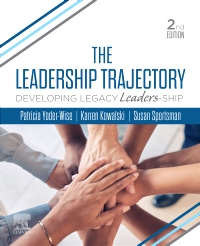
The Leadership Trajectory - Elsevier E-Book on VitalSource, 2nd Edition
by Patricia S. Yoder-Wise, RN, EdD, NEA-BC, ANEF, FAAN, Karren Kowalski, PhD, RN, NEA-BC, FAAN and Susan Sportsman, RN, PhD, ANEF, FAAN
Elsevier eBook on VitalSource
ISBN:
9780443409943
Copyright:
2027
Publication Date:
10-06-2026
Page Count:
288
Imprint:
Elsevier
List Price:
$79.99
$79.99
Or $0.00 with a valid access code
Designed to help nurses excel at every stage of your leadership path, The Leadership Trajectory: Developing Legacy Leaders-Ship, 2nd Edition, follows a five-element framework that addresses the core attributes of a leader — character, commitment, connectedness, compassion and confidence. This unique and practical text offers strategic guidance on the actions you need to take to become more influential in any environment to move yourself and your team to greater contributions. Nurses will learn how to develop the skills, mindset, and aptitude to succeed regardless of where you are in your position, setting or education journey.
The authors are pleased to donate all royalty proceeds to the American Organization for Nursing Leadership (AONL) Foundation, a 501(c)(3) organization, to further its mission of providing resources that create opportunities to bridge science and practice to shape the future of nursing leadership.
-
- NEW! What is Leadership? chapter explores what the future might be like for nurse leaders
- Updated virtual communication coverage addresses the effects of remote and hybrid work on the leadership profession, and how nurse managers can lead effectively in these environments
- Introduction to AI technology discusses how nurse leaders can collaborate with nurse informaticists, ethicists, engineers and other stakeholders when AI implementation is considered
- Peer-review comments in the opening chapters expand on the Trajectory Model and its use
- Coverage of the nursing bailout examines its ongoing effect on the nursing leadership profession
-
- NEW! Nora AI - an AI-powered learning assistant exclusive to Elsevier ebooks on VitalSource's Bookshelf® platform - offers built-in AI learning support that provides personalized answers based on content from the Elsevier ebook
- Five-element framework throughout the text explores the core attributes of an effective leader — character, commitment, connectedness, compassion, and confidence
- Success Tips boxes within most chapters offer practical strategies for successfully using key chapter concepts in practice
- Reflection Questions at the end of each chapter emphasize the importance of the topic covered as a strategy for growth
- Legacy Leadership (LL) Alert boxes cite examples of actions and statements to avoid
- Legacy Leadership (LL) Lineup summaries conclude each chapter to help you create an action plan related to the topic
-
-
 The Leadership TrajectoryPaperback
-
-
SECTION I Strategies Overview
1 What Is Leadership?
A Leadership Definition
Common Theories of Leadership in Nursing
2 Leading to Legacies
What Forms a Legacy?
Intentionality
Legacies
Leaders
3 Legacy Leaders-Ship: The Model
Why Have A Model?
What Is the Legacy Leaders-Ship Model?
How Was the LLT Model Devised?
The Legacy Leaders-Ship Trajectory Model
Importance of the Model for You
4 The Profession and Values
The Profession
Values
The 5 Cs
Compassion (Caring)
Confidence
Commitment
Connectedness
Character
The Integration/Interconnectedness of the 5 Cs
5 Lifelong Learning
Learning in an Organization
Innovation in Lifelong Learning
Learning by Failure
Learning With Artificial Intelligence
6 Purpose
What Is Purpose
Getting to Purpose
The Sense of Enough
Readily Naming Heroes
Singling Out Life's Sweet Moments
Identifying Our Greatest Pains
The Next Life-Chapter Theme
When No One Is Looking
Wanting to Get up in the Morning
What Matters
Communicating Your Interests to Others
Humanizing
Another Look at Purpose
7 Self-Assessing
Why Do Self-Assessments?
The Tools
Other Strategies
Others
Self
Using Self-Assessment Tools
8 Reflecting
The Evolution of Reflective Practice
What Makes Leaders Reject Reflection
Journaling
An Additional Approach to Reflection
9 Framing
The Handwashing Study
The Power of Yet
The Art of Persuasion
The Most Effective Conversion in Framing
10 Inspiring
What Is Influencing?
Getting From Influencing to Inspiring
The Science of Influencing
11 Advocating
Self-Advocacy
Patient Advocacy
Speaking Up
Why People Do Not Speak Up
Challenges When Nurses Advocate
Colleague Advocacy
12 Coaching
Types of Coaching
What Is Coaching?
Philosophical Approach for Coaching
The Importance of Listening
The Importance of Questions
The Importance of Feedback
Coaching for Performance
13 Mentoring
Aspects of Mentoring
Differentiating Between Mentoring and Coaching
Mentoring and Precepting
The Mentoring Role
The Use of Mentoring in Organizations
Establishing Successful Mentoring Relationships
14 Visioning
Creating a Vision
Enroll in the Vision
Visions That Work
15 Wisdom
What Is Wisdom?
Strategies for Retaining the Older Wisdom Worker
Collaboration
Becoming Wise
Leadership Maturity
SECTION II Personal Overview
16 Accountability
Nursing and Accountability
The Professional Accountability Mindset
Accountability Versus Responsibility
Positive Accountability
17 Agility
Personal Agility
On Being a Scrum Master
Balancing Agility With Consistency
Team Agility
Organizational Agility
Becoming More Agile
18 Attitudes
General Observations About Attitude
Stress and Negative Attitudes
Psychological Aspects of Attitude and Behaviors
Development of Attitudes
Mindset
Grit
Reframing Negative to Positive
What Prevents Us From Reflecting on Negativism?
19 Authenticity
What Does Authenticity in Leadership Look Like?
Embrace Your Story
Authenticity as a Journey
Vulnerability as a Part of Authenticity
Authenticity in Healthcare
20 Capacity
What Is Capacity?
Leadership Capacities
Developing Mental Toughness
Developing Leadership Capacity in Teams and Organizations
21 Courage
What Is Courage?
Characteristics of a Courageous Leader
Categories of Courage
Competently Courageous
Managing Risk
Application of Courageous Leadership
22 Creativity
A Creativity Perspective
Levels of Creativity
Additional Thoughts About Creativity and Innovation
Increasing Your Creativity and Innovation
Brainswarming
23 Integrity
Courage and Integrity
What does Integrity Look Like in Our Personal Lives?
How to Develop Integrity
What is Integrity in the Workplace?
When Integrity is Missing
How do We Recoup from Mistakes with Integrity?
24 Intelligence
General (Intellectual) Intelligence
Appreciative Intelligence
Emotional Intelligence
Visual Intelligence
25 Presence
What Is Presence?
The ABCs of Presence
Improving Our Abilities
26 Risking
Taking Risks
Characteristics of Risk-Takers
Gender Differences in Risk-Taking
Improving Your Risk-Taking Skills
Considered Risk-Taking
27 Spirituality
Spirituality and Religion: How They Differ
Spirituality Compared With Emotional Health
What Makes Spirituality Important?
Developing Spiritual Resources
Spirituality and Leadership
28 Timing
When Is the Right Time?
Deciding the Consequences of Timing
Timing Implications for Leadership
Recovery
29 Trust
The Definition of Trust
The Neuroscience of Trust
Trust in Organizations
Application of the "the Characteristics of Trustworthiness"
When Trust Has Been Lost
Choosing Whom to Trust
The Impact of Trust on Our Own Leadership Trajectory
30 Truthfulness
Why Do People Make Untruthful Statements?
Examples of Dishonesty in Organizations
Truthfulness: Its Impact on Relationships
Truthfulness in Individual Relationships
Scenario 1
Scenario 2
Truthfulness by an Organization
Limits to Transparency
31 Vulnerability
Connection
The Limits of Vulnerability
The Myths of Vulnerability
Myth #1: Vulnerability Is Weakness
Myth #2: You Can Opt Out of Vulnerability
Myth #3: Vulnerability Means Letting It All Hang Out
Myth #4: I Can Go It Alone
When Vulnerability Enters the Workplace
32 Well-Being
Atmosphere of Safety
What Is Mindfulness?
Practical Uses of Mindfulness
Resilience
How Resiliency Works
How to Become More Resilient
SECTION III Environment Overview
33 Alliances
What Is an Alliance?
Types of Alliances
The Individual Level of Alliances
Creating Alliances
34 Communication
Mental Filters
Compensation for the Filters
Effective Communication Skills
Guidelines for Creating a Positive Communication Environment
Communication Barriers
Communication Breakdown
Active Listening
"You, You, You"
35 Contribution
Framework for Nurses' Contributions
An Example of Being Present
Documentation of Nurses' Impact on Healthcare
Nurses' Impact on Healthcare Outcomes
Care Coordination
Nursing Contributions at the Organizational Level
36 Culture
Why Organizational Culture Is Important
How Organizational Culture Is Created and Communicated
How and Why Does Organizational Culture Change?
What Are Subcultures?
Nursing at Its Best
37 Engagement
What Is Engagement?
Change and Engagement
Disengagement
Inclusiveness
Examining Bias
Storytelling
Engagement and the Leader
Changing the Equation
Effects of Engagement Surveys
38 Governance
The Role of Governance
Components of a Governance Plan
Board of Directors
Nurses on Boards
Accountability Framework for Executives
Shared Governance
An Experience With Shared Governance
39 Innovation
The Hard Work of Having Fun
How to Become Innovative
40 Negotiation
What Is Negotiation?
Preplanning
Negotiation in Action
41 Politics
The Definition of Organizational Politics
Social Power and Political Capital
An Example of "Living" the Values and Mission of an Organization
Sources of Political Power or Capital
Strategies for Organizational Political Action
42 Processes
What Is a Process?
The Deming Cycle (PDSA Cycle)
Processes in Health Care
PDSA Cycle in Healthcare
Developing a New Initiative
Will Processes Reduce Missteps and Failures?
Preventing Problems Through the Use of Processes
Are Processes Fool-Proof?
43 Relationships
A Good Relationship Defined
Levels of Relationships
The Foundation for Developing Relationships
Common Beliefs and Values
Common Interests
Common Vision or Goals
What Happens When No Common Goals, Values, or Interests Can Be Identified?
Steps in Building Relationships
Obstacles to Building Good Relationships
How to Repair a Relationship
44 Strategy
What Advantages Does a Strategy Provide?
Key Questions to Prepare for a Strategic Plan
Struggling With Strategy
A Business Perspective
Developing Strategic Thinking
Aligned Decision-Making
Zoom in and Zoom out
45 Structure
Impact of Structure
Organizational Structure and Motivation
Assessing the Organizational Structure
46 Exiting
The Concept of Exiting
Leaving a Position We Love
Leaving Under Conflict
A Story of Being Downsized
Retirement
Steps for Retirement Planning
Preparation for Exiting
Evidence on Successful Leadership Transitions
Intergenerational Leadership
Conclusion
References -
-
Ways of Reading
- The appearance of the text and page layout can be modified according to the capabilities of the reading system (font family and font size, spaces between paragraphs, sentences, words, and letters, as well as color of background and text)
- This e-publication is accessible to the full extent that the file format and types of content allow, on a specific reading device, by default, without necessarily including any additions such as textual descriptions of images or enhanced navigation
- All content can be read as read aloud speech or dynamic braille
- Has alternative text descriptions for images
-
Conformance
- The certifier's credential is https://bornaccessible.benetech.org/certified-publishers/
- For detailed accessibility information, see Elsevier's website at https://www.elsevier.com/about/accessibility
- For queries regarding accessibility information, contact [email protected]
- The publication was certified on 23-07-2026
-
Navigation
- Table of contents to all chapters of the text via links
- Index with links to referenced entries
- Elements such as headings, tables, etc. for structured navigation
- Page list to go to pages from the print source version
-
Rich Content
- Math formulas in accessible format (MathML)
- Information-rich images are described by extended descriptions
-
Hazards
- The publication contains no hazards
-
Product Content
- Content includes any type of illustrations.
- The primary content is text.
- Content includes a significant number of actionable (clickable) cross-references, hyperlinked notes and annotations, or with other actionable links between largely textual elements (e.g., quiz/test questions, 'choose your own ending', etc.).
- Content includes additional textual content such as an interview, feature article, essay, bibliography, quiz/test, other background material, or text that is not included in a primary or 'unenhanced' version.
- Content includes figures, diagrams, charts and/or graphs, including other 'mechanical' (i.e. non-photographic) illustrations.
- Content includes assessment material, e.g., Questions or student exercises, problems, quizzes or tests (as an integral part of the work).
- Content includes mathematical notations, formulae.
-
Legal Considerations
- No information is available
-
Additional Accessibility Information
- Content is enhanced with ARIA roles to optimize organization and facilitate navigation
- Page breaks included from the original print source
- For readers with color vision deficiency, use of color (e.g., in diagrams, graphics and charts, in prompts, or on buttons inviting a response) is not the sole means of graphical distinction or of conveying information
- The body text is presented with a contrast ratio of at least 4.5:1 (or 3:1 for large/heading text)
- Text-to-speech has been optimized through provision of PLS lexicons, SSML or CSS Speech synthesis hints or other speech synthesis markup languages or hinting
- Ultra-high contrast between text and background
- E-publication includes basic navigation (usually less detailed than TOC-based navigation)
- Where links, controls or buttons are included in the content, the purpose or functionality of each link, control or button is apparent from the associated text alone - or where it is unclear, separate link, control or button descriptions are provided
- All (or substantially all) textual matter is arranged in a single logical reading order (including text that is visually presented as separate from the main text flow, e.g., in boxouts, captions, tables, footnotes, endnotes, citations, etc.). Non-textual content is also linked from within this logical reading order. (Purely decorative non-text content can be ignored).
- Content provides explanations for unusual words, abbreviations, acronyms, idioms, jargon in an accessible form, such as glossaries, scripted pop-ups.
- Where interactive content is included in the product, controls are provided (e.g., for speed, pause and resume, reset) and labelled to make their use clear.
- The language of the text has been specified (e.g., via the HTML or XML lang attribute) to optimise text-to-speech (and other alternative renderings), both at the whole document level and, where appropriate, for individual words, phrases or passages in a different language.
-
Ways of Reading
$79.99
Or $0.00 with a valid access code

 as described in our
