ISBN:
9780443410390
Copyright:
2025
Publication Date:
12-23-2025
Page Count:
3016
Imprint:
Elsevier
List Price:
$457.99

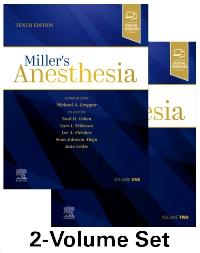
Miller's Anesthesia, 2-Volume Set - Elsevier E-Book on VitalSource, 10th Edition
by Michael A. Gropper, MD, PhD, Lars I. Eriksson, MD, Lee A. Fleisher, MD, Neal H. Cohen, MD, MPH, MS, Kate Leslie, MD and Oluwaseun Johnson-Akeju, MD
Elsevier eBook on VitalSource
ISBN:
9780443410390
Copyright:
2025
Publication Date:
12-23-2025
Page Count:
3016
Imprint:
Elsevier
List Price:
$457.99
Was
$457.99
Now $320.59
Or $0.00 with a valid access code
**Selected for 2026 Doody's Core Titles as an Essential Purchase in Anesthesiology & Pain Medicine**
Offering up-to-date coverage of everything from historical and international perspectives to basic science and today’s clinical practice, Miller's Anesthesia, 10th Edition, remains the #1 reference and trusted learning resource for practitioners and trainees in this complex field. Dr. Michael Gropper leads a team of expert editors and contributing authors who provide current information on the technical, scientific, and clinical issues you face each day—whether you’re managing a challenging patient care situation, preparing for the boards, or studying for recertification.
Offering up-to-date coverage of everything from historical and international perspectives to basic science and today’s clinical practice, Miller's Anesthesia, 10th Edition, remains the #1 reference and trusted learning resource for practitioners and trainees in this complex field. Dr. Michael Gropper leads a team of expert editors and contributing authors who provide current information on the technical, scientific, and clinical issues you face each day—whether you’re managing a challenging patient care situation, preparing for the boards, or studying for recertification.
-
- Addresses timely topics alongside foundational basic science for an in-depth and comprehensive understanding of the field
- Contains thoroughly up-to-date content, including two new chapters: The Immune System: Implications for Anesthetic Management and Emergency Preparedness in Healthcare
- Provides new content in key areas such as sustainability, global health equity, the effect of anesthetics on immune function, anesthesia for special populations, coverage of infectious diseases including COVID-19, and occupational exposure and safety
- Offers state-of-the-art coverage of anesthetic drugs, guidelines for anesthetic practice and patient safety, new techniques, step-by-step instructions for patient management, the unique needs of pediatric patients, and much more—all highlighted by more than 1,200 full-color illustrations (300 new to this edition) for enhanced visual clarity
- Includes 40+ video clips demonstrating patient positioning, ultrasound, echocardiograms, and other imaging, and anesthetic procedures in real time
-
SECTION I Introduction
1. The Scope of Modern Anesthetic Practice
2. Anesthesia and Global Health Equity
3. Perioperative Medicine
4. Informatics in Perioperative Medicine
5. Quality Improvement in Anesthesia Practice and Patient Safety
6. Human Behavior and Simulation in Anesthesia
7. Ethical Aspects of Anesthesia Care
SECTION II Anesthetic Physiology
8. Consciousness, Memory, and Anesthesia
9. Sleep Medicine
10. Cerebral Physiology and the Effects of Anesthetic Drugs
11. Neuromuscular Physiology and Pharmacology
12. Respiratory Physiology and Pathophysiology
13. Cardiac Physiology
14. Gastrointestinal and Hepatic Physiology, Pathophysiology, and Anesthetic Considerations
15. Renal Anatomy, Physiology, Pharmacology, and Evaluation of Function
16. Basic Principles of Pharmacology
17. Inhaled Anesthetics: Mechanisms of Action
18. Inhaled Anesthetic Uptake, Distribution, Metabolism, and Toxicity
19. Pulmonary Pharmacology of Inhaled Anesthetics
20. Inhaled Anesthetic Delivery Systems
21. Intravenous Anesthetics
22. Opioids
23. Intravenous Drug Delivery Systems
24. Pharmacology of Neuromuscular Blocking Drugs and Antagonists (Reversal Agents)
25. Local Anesthetics
26. Immune Implications of Anesthesia Care and Practice
SECTION III Anesthesia Management
27. Risk of Anesthesia
28. Preoperative Evaluation
29. Anesthetic Implications of Concurrent Diseases
30. Patient Positioning and Associated Risks
31. Neuromuscular Disorders and Other Genetic Disorders
32. Cardiovascular Monitoring
33. Perioperative Echocardiography and Point-of-Care Ultrasound (POCUS)
34. Implantable Cardiac Pulse Generators: Pacemakers and Cardioverter-Defibrillators
35. Neurophysiologic Monitoring
36. Monitoring the Brain’s Response to Anesthesia and Surgery
37. Respiratory Monitoring
38. Renal Pathophysiology and Treatment for Perioperative Ischemia and Nephrotoxic Injury
39. Neuromuscular Monitoring
40. Airway Management in the Adult
41. Spinal, Epidural, and Caudal Anesthesia
42. Peripheral Nerve Blocks and Ultrasound Guidance for Regional Anesthesia
43. Perioperative Fluid and Electrolyte Therapy
44. Perioperative Acid–Base Balance
45. Patient Blood Management: Transfusion Therapy
46. Patient Blood Management: Coagulation
VOLUME 2
SECTION IV Adult Subspecialty Management
47. Management of the Patient with Chronic Pain
48. Palliative Medicine
49. Anesthesia for Thoracic Surgery
50. Anesthesia for Cardiac Surgical Procedures
51. Anesthesia for Correction of Cardiac Arrhythmias
52. Anesthesia for Vascular Surgery
53. Anesthesia for Neurologic Surgery and Neurointerventions
54. Anesthesia for Bariatric Surgery
55. Anesthesia and the Renal and Genitourinary Systems
56. Anesthesia for Abdominal Organ Transplantation
57. Anesthesia for Organ Procurement
58. Anesthesia for Obstetrics
59. Anesthesia for Fetal Surgery and Other Fetal Therapies
60. Anesthesia for Orthopedic Surgery
61. Geriatric Anesthesia
62. Anesthesia for Trauma
63. Prehospital Care for Medical Emergencies and Trauma
64. Biologic, Natural, and Human-Induced Disasters: The Role of the Anesthesiologist
65. Anesthesia for Ophthalmic Surgery
66. Anesthesia for Otolaryngologic and Head–Neck Surgery
67. Anesthesia for Robotic Surgery
68. Ambulatory (Outpatient) Anesthesia
69. Non–Operating Room Anesthesia
70. Clinical Care in Extreme Environments: Physiology at High Altitude and in Space
71. Clinical Care in Extreme Environments: High Pressure, Immersion, Drowning, Hypo-, and Hyperthermia
SECTION V Pediatric Anesthesia
72. Pediatric Anesthesia
73. Anesthesia for Pediatric Cardiac Surgery
74. Regional Anesthesia in Children
75. Pediatric and Neonatal Critical Care
SECTION VI Postoperative Care
76. The Postanesthesia Care Unit
77. Acute Postoperative Pain
78. Perioperative Neurocognitive Disorders
SECTION VII Critical Care Medicine
79. Critical Care Anesthesiology
80. Neurocritical Care
81. Extracorporeal Membrane Oxygenation and Cardiac Devices
82. Cardiopulmonary Resuscitation and Advanced Cardiac Life Support
SECTION VIII Ancillary Responsibilities and Problems
83. Burn Management
84. Occupational Safety, Infection Control, and Substance Use Disorders
85. Emergency Preparedness in Health Care
86. Clinical Research
87. Interpreting the Medical Literature -
-
Ways of Reading
- The appearance of the text and page layout can be modified according to the capabilities of the reading system (font family and font size, spaces between paragraphs, sentences, words, and letters, as well as color of background and text)
- This e-publication is accessible to the full extent that the file format and types of content allow, on a specific reading device, by default, without necessarily including any additions such as textual descriptions of images or enhanced navigation
- All content can be read as read aloud speech or dynamic braille
- Has alternative text descriptions for images
-
Conformance
- The publication contains a conformance statement that it meets the EPUB Accessibility 1.1, WCAG 2.1, Level AA standard. Please see https://bornaccessible.benetech.org/certified-publishers/ for further details of our compatibility testing.
- The certifier's credential is https://bornaccessible.benetech.org/certified-publishers/
- For detailed accessibility information, see Elsevier's website at https://www.elsevier.com/about/accessibility
- For queries regarding accessibility information, contact [email protected]
- The publication was certified on 07-04-2026
-
Navigation
- Table of contents to all chapters of the text via links
- Index with links to referenced entries
- Elements such as headings, tables, etc. for structured navigation
- Page list to go to pages from the print source version
-
Rich Content
- Math formulas in accessible format (MathML)
- Information-rich images are described by extended descriptions
-
Hazards
- The publication contains no hazards
-
Product Content
- Content includes any type of illustrations.
- The primary content is text.
- Content includes a significant number of actionable (clickable) web links to external content, downloadable resources, supplementary material, etc.
- Content includes a significant number of actionable (clickable) cross-references, hyperlinked notes and annotations, or with other actionable links between largely textual elements (e.g., quiz/test questions, 'choose your own ending', etc.).
- Content includes additional textual content such as an interview, feature article, essay, bibliography, quiz/test, other background material, or text that is not included in a primary or 'unenhanced' version.
- Content includes figures, diagrams, charts and/or graphs, including other 'mechanical' (i.e. non-photographic) illustrations.
- Content includes narrative animation, e.g., cartoon, animatic or CGI animation (usually includes sound).
- Content includes images displayed in a specific order for the purpose of graphic storytelling or giving information (e.g. graphic novels, comics and manga). May include text integrated into the image (as speech and thought bubbles, textual 'sound' effects, captions etc.).
- Content includes mathematical notations, formulae.
- At least some text - including text within other images - is 'text as an image' (i.e., a picture of text).
- Product includes actionable (clickable) links to external interactive content.
-
Legal Considerations
- No information is available
-
Additional Accessibility Information
- Content is enhanced with ARIA roles to optimize organization and facilitate navigation
- Page breaks included from the original print source
- For readers with color vision deficiency, use of color (e.g., in diagrams, graphics and charts, in prompts, or on buttons inviting a response) is not the sole means of graphical distinction or of conveying information
- The body text is presented with a contrast ratio of at least 4.5:1 (or 3:1 for large/heading text)
- Text-to-speech has been optimized through provision of PLS lexicons, SSML or CSS Speech synthesis hints or other speech synthesis markup languages or hinting
- Ultra-high contrast between text and background
- E-publication includes basic navigation (usually less detailed than TOC-based navigation)
- Where links, controls or buttons are included in the content, the purpose or functionality of each link, control or button is apparent from the associated text alone - or where it is unclear, separate link, control or button descriptions are provided
- All (or substantially all) textual matter is arranged in a single logical reading order (including text that is visually presented as separate from the main text flow, e.g., in boxouts, captions, tables, footnotes, endnotes, citations, etc.). Non-textual content is also linked from within this logical reading order. (Purely decorative non-text content can be ignored).
- Content provides explanations for unusual words, abbreviations, acronyms, idioms, jargon in an accessible form, such as glossaries, scripted pop-ups.
- Where interactive content is included in the product, controls are provided (e.g., for speed, pause and resume, reset) and labelled to make their use clear.
- The language of the text has been specified (e.g., via the HTML or XML lang attribute) to optimise text-to-speech (and other alternative renderings), both at the whole document level and, where appropriate, for individual words, phrases or passages in a different language.
-
Ways of Reading
Was
$457.99
Now $320.59
Or $0.00 with a valid access code

 as described in our