ISBN:
9780443411472
Copyright:
2028
Page Count:
904
Imprint:
Elsevier
List Price:
$117.99

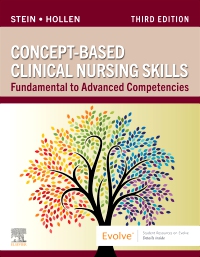
Concept-Based Clinical Nursing Skills: Fundamental to Advanced Competencies - Elsevier E-Book on VitalSource, 3rd Edition
by Loren Nell Melton Stein, MSN, RNC-NIC and Connie J. Hollen, PhD, MS, RN
Elsevier eBook on VitalSource
ISBN:
9780443411472
Copyright:
2028
Page Count:
904
Imprint:
Elsevier
List Price:
$117.99
Not Yet Available
Most review copies are eBooks – how fast!
A review copy request is most likely to be fulfilled as an eBook on VitalSource rather than a print product, unless no eBook is available. eBooks become available in as little as a few hours. Print products will take between 7 and 10 days to arrive. To request a print copy, please contact us through the Evolve Support Center for further assistance or contact your Elsevier Sales Rep.
Coming Soon!
Expected availability date: 02-15-2027
Teach students how to problem-solve and think conceptually when performing nursing skills and simulations! Concept-Based Clinical Nursing Skills: Fundamental to Advanced Competencies covers more than 250 nursing skills in an innovative concept-based format. Unlike any other text, Stein and Hollen incorporate an overarching framework of seven critical concepts — accuracy, person-centered care, infection control, safety, communication, evaluation, and health maintenance — to drive home the importance of these key themes in performing nursing skills and developing nursing competencies. This fully referenced and evidence-based text identifies and applies nursing decision-making models, including both the nursing process and the clinical judgment measurement model, to each chapter section. Every chapter includes a detailed case study to help students apply their knowledge to clinical situations and develop their decision-making process. Case-study-based Next-Generation NCLEX®–type questions help strengthen critical-thinking and clinical-judgment skills.
-
- NEW! AACN Essentials core competencies framework, language, domains, concepts, and competencies are easier to identify throughout
- NEW! Emphasis on clinical judgment elements encourages growth and development of fluid and dynamic decision-making
- NEW! Electronic resources include updated concept maps for each case study with detailed interpretations, answers to the critical-thinking questions, and additional NCLEX®-style practice questions
- NEW! Multimedia links direct you to videos related to key skills and assessment techniques
- NEW! Easy-to-navigate list of nursing skills helps you quickly find specific skills
- UPDATED! Concept maps for each case study help ensure alignment with current nursing practice
- EXPANDED! Coverage of cultural assessment and cultural considerations promotes culturally appropriate nursing care
- EXPANDED! Coverage of assessment of diverse populations includes an increased emphasis on social determinants of health
-
- NEW! AACN Essentials core competencies framework, language, domains, concepts, and competencies are easier to identify throughout
- NEW! Emphasis on clinical judgment elements encourages growth and development of fluid and dynamic decision-making
- NEW! Electronic resources include updated concept maps for each case study with detailed interpretations, answers to the critical-thinking questions, and additional NCLEX®-style practice questions
- NEW! Multimedia links direct students to videos related to key skills and assessment techniques
- NEW! Easy-to-navigate list of nursing skills helps students quickly find specific skills
- UPDATED! Concept maps for each case study help ensure alignment with current nursing practice
- EXPANDED! Coverage of cultural assessment and cultural considerations promotes culturally appropriate nursing care
- EXPANDED! Coverage of assessment of diverse populations includes an increased emphasis on social determinants of health
- More than 250 nursing skills are presented in a step-by-step format with concise rationales, current evidence, and over 900 outstanding photos and illustrations
- Emphasis on NCLEX® preparation is incorporated throughout with language and concepts that reflect those used on the exam
- Concept-based approach to skills education pairs well with the Giddens framework
- Critical concepts to skills performance — accuracy, person-centered care, infection control, safety, communication, evaluation, and health maintenance — are reinforced throughout the text with a strong emphasis on safety
- Detailed case studies in each skill chapter depict client scenarios with problems or issues that might be experienced in the clinical setting. Each case study is followed by a series of critical-thinking questions designed to help students learn to apply knowledge, synthesize nursing competencies, and use clinical judgment in nursing practice. Electronic resources include concept maps with detailed interpretation for each case study.
- Easy-to-understand, conversational writing style with a logical organization presents fundamental skills first, then intermediate acute care skills, and finally advanced skills often performed in critical care, with an emphasis on safety and person-centered care
- Application of the AACN Essentials competencies includes objectives and critical thinking questions that allow students to integrate nursing clinical skills into the broader role of the nurse within the four spheres of care
- Application of the NCSBN Clinical Judgment Measurement Model and Nursing Process sections in each chapter present an example of the steps in nursing decision-making, as a systematic, cyclic approach to problem solving
- Lifespan, cultural, and home care considerations assist students in understanding the diverse needs of their patients
- Lessons from the Evidence boxes highlight current research that can contribute to evidence-based clinical practice and identify gaps in knowledge
- Lessons from the Courtroom boxes summarize actual court cases related to the skills in the chapter to help students understand legal implications
- Storytelling-style "Lessons from" boxes include Lessons from Experience, sharing practical insights from more experienced nurses, and Expect the Unexpected boxes, preparing students to anticipate unexpected situations that could occur and explore appropriate responses
- Performing an Assessment chapter details essential physical assessment skills using a systematic and concept-based approach for diverse populations
- Updated Faculty Simulation Guides provide detailed simulations based on selected chapter case studies, allowing students to identify, anticipate, and apply the steps of the NCSBN Clinical Judgment Measurement Model and to focus on demonstrating key AACN Essentials competencies.
-
UNIT I: Fundamental Nursing Skills
1. Foundations of Safe Client Care
2. Personal Care and Hygiene
3. Vital Signs and Vital Measurements
4. Performing an Assessment
5. Nutritional and Gastrointestinal Tube Therapy
6. Supporting Mobility and Immobilization
7. Promoting Comfort
8. End-of-Life Care
UNIT II: Intermediate Nursing Skills
9. Gas Exchange and Airway Maintenance
10. Sterile Technique
11. Medication Administration
12. Venous Access
13. Central Venous Access
14. Bowel Elimination
15. Urine Elimination
16. Impaired Tissue Integrity and Wound Care
17. Perioperative Care
UNIT III: Advanced Nursing Skills
18. Advanced Respiratory Care
19. Cardiovascular Specialty Care
20. Neurologic Specialty Care -
-
Ways of Reading
- The appearance of the text and page layout can be modified according to the capabilities of the reading system (font family and font size, spaces between paragraphs, sentences, words, and letters, as well as color of background and text)
- This e-publication is accessible to the full extent that the file format and types of content allow, on a specific reading device, by default, without necessarily including any additions such as textual descriptions of images or enhanced navigation
- All content can be read as read aloud speech or dynamic braille
-
Conformance
- The certifier's credential is https://bornaccessible.benetech.org/certified-publishers/
- For detailed accessibility information, see Elsevier's website at https://www.elsevier.com/about/accessibility
- For queries regarding accessibility information, contact [email protected]
- The publication was certified on 07-04-2026
-
Navigation
- Table of contents to all chapters of the text via links
- Page list to go to pages from the print source version
-
Rich Content
- No information is available
-
Hazards
- No information is available
-
Product Content
- No information is available
-
Legal Considerations
- No information is available
-
Additional Accessibility Information
- Content is enhanced with ARIA roles to optimize organization and facilitate navigation
- Page breaks included from the original print source
- For readers with color vision deficiency, use of color (e.g., in diagrams, graphics and charts, in prompts, or on buttons inviting a response) is not the sole means of graphical distinction or of conveying information
- The body text is presented with a contrast ratio of at least 4.5:1 (or 3:1 for large/heading text)
- Ultra-high contrast between text and background
- E-publication includes basic navigation (usually less detailed than TOC-based navigation)
- Where links, controls or buttons are included in the content, the purpose or functionality of each link, control or button is apparent from the associated text alone - or where it is unclear, separate link, control or button descriptions are provided
- All (or substantially all) textual matter is arranged in a single logical reading order (including text that is visually presented as separate from the main text flow, e.g., in boxouts, captions, tables, footnotes, endnotes, citations, etc.). Non-textual content is also linked from within this logical reading order. (Purely decorative non-text content can be ignored).
- Where interactive content is included in the product, controls are provided (e.g., for speed, pause and resume, reset) and labelled to make their use clear.
- The language of the text has been specified (e.g., via the HTML or XML lang attribute) to optimise text-to-speech (and other alternative renderings), both at the whole document level and, where appropriate, for individual words, phrases or passages in a different language.
-
Ways of Reading


Not Yet Available
Most review copies are eBooks – how fast!
A review copy request is most likely to be fulfilled as an eBook on VitalSource rather than a print product, unless no eBook is available. eBooks become available in as little as a few hours. Print products will take between 7 and 10 days to arrive. To request a print copy, please contact us through the Evolve Support Center for further assistance or contact your Elsevier Sales Rep.
Coming Soon!
Expected availability date: 02-15-2027

 as described in our