ISBN:
9780443412400
Copyright:
2028
Page Count:
256
Imprint:
Elsevier
List Price:
$24.99

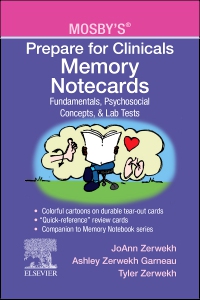
Mosby’s Prepare for Clinicals Memory Notecards: Fundamentals, Psychosocial Concepts, & Lab Tests - Elsevier E-Book on VitalSource, 1st Edition
by JoAnn Zerwekh, EdD, MSN, RN, Ashley Zerwekh Garneau, PhD, RN and Tyler Zerwekh, DrPH, MPH, REHS
Elsevier eBook on VitalSource
ISBN:
9780443412400
Copyright:
2028
Page Count:
256
Imprint:
Elsevier
List Price:
$24.99
$24.99
Or $0.00 with a valid access code
Not Yet Available
Coming Soon!
Expected availability date: 02-11-2027
Nearly 100 flashcards make it fun and easy to review clinical nursing! Mosby’s Prepare for Clinicals Memory Notecards use colorful cartoons, mnemonics, and clear explanations to help you remember important nursing concepts. Breaking down complex topics, notecards progress from the fundamentals of nursing practice to psychosocial concepts, nursing management, and lab test interpretation. A compact size allows convenient study anytime and anywhere, alone or with a group. Created by nursing educators JoAnn Zerwekh, Ashley Zerwekh Garneau, and Tyler Zerwekh, these durable notecards will help you prepare for class, clinicals, or the NCLEX® examination. There’s no other study tool like it!
-
- Use of mnemonics and cartoon figures to help you remember information about fundamentals in nursing, psychosocial nursing, nursing management, and laboratory/diagnostic tests
- Colorful visuals and diagrams that highlight clinical relevance and streamline your review of topics such as heart sounds, patient positioning, postoperative care, the 5 P’s of nursing rounds, and mental health disorders
- Mnemonics and other proven memory aids designed to boost retention and understanding through acronyms and fun, easy-to-recall associations
- Comprehensive lab and diagnostic content including blood tests and values, lab cultures, and procedures — explained clearly for real-world application
- Compact, durable, and portable cards for flexible study sessions
- Ideal for entry-level nursing courses
-
FUNDAMENTALS OF NURSING PRACTICE
1. 6 P’s of Dyspnea
2. Activities of Daily Living (ADL's)
3. Adventitious Breath Sounds
4. Assisting at the Table Locating Food
5. Auscultating Heart Sounds
6. Care of the Chronically Ill Child
7. Charting Body Fluids — COACH
8. Clinical Judgment
9. Day of Surgery Nursing Responsibilities
10. Dehiscence — Evisceration
11. Emergency Trauma Assessment
12. Epidural Analgesia vs. Anesthesia
13. Five Areas for Listening to the Heart
14. Hand Hygiene
15. Heart Sounds
16. Heat and Cold Applications
17. Instrumental Activities of Daily Living (IADL's)
18. Levels of Consciousness
19. Neurovascular Assessment — 6 P's
20. Maslow’s Hierarchy of Basic Human Needs
21. Pain
22. Patient Positioning
23. Postop Complications
24. Postop Nursing Care
25. Preop Checklist — Day of Surgery
26. Range of Motion
27. Shock
28. SIRES
29. Special Considerations for Older Adults
30. Steps in the Nursing Process
31. Tools of Physical Assessment
32. Trauma Survey
33. Types of Exudate
34. Wound Cleansing
PSYCHOSOCIAL NURSING CONCEPTS
35. 3R's in Working with Mental Disability
36. Alcohol Withdrawal Delirium (DTs)
37. Alterations of Body Image
38. Anorexia Nervosa
39. Assess Cognitive Changes in Dementia (JAMCO)
40. Basic Components of a Psych Assessment
41. Bipolar Disorder
42. Bulimia Nervosa
43. Child Abuse
44. Cocaine — Crack Users
45. Dementia
46. Depression Assessment
47. Depression
48. Eating Disorders
49. Five A's of Alzheimer Disease
50. Hallucinations, Illusions, and Delusions
51. Manic Episode Symptoms
52. Obsessive-Compulsive Disorder
53. Psychiatric Assessment
54. Psychobehavior Role of the Nurse
55. Schizophrenia
56. Suicide Precautions
57. Sundowning Syndrome
NURSING MANAGEMENT
58. 5 P’s Handoff
59. 5 P’s of Nursing Rounds
60. Four C's of Initial Direction
61. Informatics
62. I-SBAR-R
63. Prioritization and Delegation
64. The 10 Supervisory Commandments
65. Time Out Diagnostic Tests
66. Bone Densitometry (DEXA Scan)
67. Bronchoscopy
68. Chorionic Villus Sampling (CVS)
69. Occult Blood
70. Spinal Fluid Analysis
LABORATORY BLOOD TESTS
71. Ammonia Level
72. Blood Urea Nitrogen (BUN)
73. Correct Order of The Blood Draw
74. Creatinine and Creatinine Clearance
75. Digoxin Level
76. Fibrinogen
77. Gamma-Glutamyl Transferase (GGT)
78. Hematocrit (Hct)
79. Hemoglobin (Hgb)
80. Lead
81. Lipase and Amylase (Serum)
82. Lipoproteins (LDL-HDL)
83. Liver Biopsy
84. Prothrombin (PT) and International Normalized Ratio (INR)
85. PTT and aPTT
86. Sodium and Chloride (Serum)
87. Thyroid Function Tests
88. TORCH Screening
89. Type and Crossmatch Blood
90. Urinalysis
91. White Blood Cell (WBC) Count
LABORATORY CULTURES
92. Blood Cultures
93. Sputum Cultures
94. Stool Cultures
95. Throat Cultures
96. Urine Cultures
97. Wound Cultures -
-
Ways of Reading
- The appearance of the text and page layout can be modified according to the capabilities of the reading system (font family and font size, spaces between paragraphs, sentences, words, and letters, as well as color of background and text)
- This e-publication is accessible to the full extent that the file format and types of content allow, on a specific reading device, by default, without necessarily including any additions such as textual descriptions of images or enhanced navigation
- All content can be read as read aloud speech or dynamic braille
-
Conformance
- The certifier's credential is https://bornaccessible.benetech.org/certified-publishers/
- For detailed accessibility information, see Elsevier's website at https://www.elsevier.com/about/accessibility
- For queries regarding accessibility information, contact [email protected]
- The publication was certified on 07-04-2026
-
Navigation
- Table of contents to all chapters of the text via links
- Page list to go to pages from the print source version
-
Rich Content
- No information is available
-
Hazards
- No information is available
-
Product Content
- No information is available
-
Legal Considerations
- No information is available
-
Additional Accessibility Information
- Content is enhanced with ARIA roles to optimize organization and facilitate navigation
- Page breaks included from the original print source
- For readers with color vision deficiency, use of color (e.g., in diagrams, graphics and charts, in prompts, or on buttons inviting a response) is not the sole means of graphical distinction or of conveying information
- The body text is presented with a contrast ratio of at least 4.5:1 (or 3:1 for large/heading text)
- Ultra-high contrast between text and background
- E-publication includes basic navigation (usually less detailed than TOC-based navigation)
- Where links, controls or buttons are included in the content, the purpose or functionality of each link, control or button is apparent from the associated text alone - or where it is unclear, separate link, control or button descriptions are provided
- All (or substantially all) textual matter is arranged in a single logical reading order (including text that is visually presented as separate from the main text flow, e.g., in boxouts, captions, tables, footnotes, endnotes, citations, etc.). Non-textual content is also linked from within this logical reading order. (Purely decorative non-text content can be ignored).
- Where interactive content is included in the product, controls are provided (e.g., for speed, pause and resume, reset) and labelled to make their use clear.
- The language of the text has been specified (e.g., via the HTML or XML lang attribute) to optimise text-to-speech (and other alternative renderings), both at the whole document level and, where appropriate, for individual words, phrases or passages in a different language.
-
Ways of Reading

$24.99
Or $0.00 with a valid access code
Not Yet Available
Coming Soon!
Expected availability date: 02-11-2027

 as described in our