ISBN:
9780443433337
Copyright:
2028
Page Count:
530
Imprint:
Elsevier
List Price:
$38.99

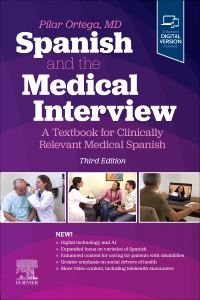
Spanish and the Medical Interview Elsevier eBook on VitalSource, 3rd Edition
by Pilar Ortega, MD
Elsevier eBook on VitalSource
ISBN:
9780443433337
Copyright:
2028
Page Count:
530
Imprint:
Elsevier
List Price:
$38.99
$38.99
Or $0.00 with a valid access code
Not Yet Available
Coming Soon!
Expected availability date: 03-25-2027
Designed to help clinicians and clinicians-in-training improve their Spanish communication skills and build trust and empathy with patients, Dr. Pilar Ortega’s Spanish and the Medical Interview: A Textbook for Clinically Relevant Medical Spanish, 3rd Edition, addresses today’s growing demand for Spanish-speaking physicians and healthcare professionals. Focusing on communication needs in real-world clinical situations, this versatile resource provides basic Spanish skills, sample interview questions, relevant cultural information, social drivers of health, and more, in addition to videos of patient-physician interactions, interactive self-assessment tools, and clinical vignettes. This unique text delivers exactly what you need to enhance patient-centered communication skills, increase your cultural competence, and make better clinical decisions in your practice.
-
- Helps you understand the nuts and bolts of better communication through Spanish grammar, vocabulary, pronunciation, sample interview questions, and helpful interview techniques.
- Goes beyond the basics to address specific clinical interactions, such as patient interviews, history taking, and physical exams.
- Reinforces learning in a logical sequence, with each chapter building on the previous one, aligned to the flow of a medical interview.
- Contains two new chapters on digital health and the sexual history as well as new content regarding caring for patients with disabilities, demonstrating empathy, and establishing trust; new telehealth scenarios; new vocabulary covering recent diseases; expanded coverage of cultural practices, gender-inclusive language, and social determinants of health.
- Covers how to best use interpreters in clinical practice, and includes new content on the appropriate integration of digital technologies and AI in multilingual healthcare settings.
- Includes interactive self-assessment tools and practice exercises that mimic real-life clinical situations to help you gauge and hone your health communication skills.
- Provides access to videos of real-time patient-physician exchanges, with and without Spanish subtitles, to help improve pronunciation and listening skills.
- Discusses cultural competence and humility as crucial elements of effective communication and building a rapport with patients to improve overall care.
-
1. User Guide
2. ¡Bienvenidos! Welcome and Introduction
3. Cultural Diversity (new)
4. Musculoskeletal/dermatologic cases
5. Cardiovascular cases
6. Pulmonary cases
7. Gastrointestinal cases
8. Endocrine cases Case
9. Genitourinary cases
10. Neurologic cases
11. Psychiatric cases
12. Eye/ear/nose/throat cases
13. Pediatric cases
14. Disability (new)
15. Y Ahora, ¿qué? (And now, what?) Learner self-assessment and Next steps -
-
Ways of Reading
- The appearance of the text and page layout can be modified according to the capabilities of the reading system (font family and font size, spaces between paragraphs, sentences, words, and letters, as well as color of background and text)
- This e-publication is accessible to the full extent that the file format and types of content allow, on a specific reading device, by default, without necessarily including any additions such as textual descriptions of images or enhanced navigation
- All content can be read as read aloud speech or dynamic braille
-
Conformance
- The certifier's credential is https://bornaccessible.benetech.org/certified-publishers/
- For detailed accessibility information, see Elsevier's website at https://www.elsevier.com/about/accessibility
- For queries regarding accessibility information, contact [email protected]
- The publication was certified on 03-09-2025
-
Navigation
- Table of contents to all chapters of the text via links
- Page list to go to pages from the print source version
-
Rich Content
- No information is available
-
Hazards
- No information is available
-
Product Content
- No information is available
-
Legal Considerations
- No information is available
-
Additional Accessibility Information
- Content is enhanced with ARIA roles to optimize organization and facilitate navigation
- Page breaks included from the original print source
- For readers with color vision deficiency, use of color (e.g., in diagrams, graphics and charts, in prompts, or on buttons inviting a response) is not the sole means of graphical distinction or of conveying information
- The body text is presented with a contrast ratio of at least 4.5:1 (or 3:1 for large/heading text)
- Ultra-high contrast between text and background
- E-publication includes basic navigation (usually less detailed than TOC-based navigation)
- Where links, controls or buttons are included in the content, the purpose or functionality of each link, control or button is apparent from the associated text alone - or where it is unclear, separate link, control or button descriptions are provided
- All (or substantially all) textual matter is arranged in a single logical reading order (including text that is visually presented as separate from the main text flow, e.g., in boxouts, captions, tables, footnotes, endnotes, citations, etc.). Non-textual content is also linked from within this logical reading order. (Purely decorative non-text content can be ignored).
- Where interactive content is included in the product, controls are provided (e.g., for speed, pause and resume, reset) and labelled to make their use clear.
- The language of the text has been specified (e.g., via the HTML or XML lang attribute) to optimise text-to-speech (and other alternative renderings), both at the whole document level and, where appropriate, for individual words, phrases or passages in a different language.
-
Ways of Reading


$38.99
Or $0.00 with a valid access code
Not Yet Available
Coming Soon!
Expected availability date: 03-25-2027

 as described in our