
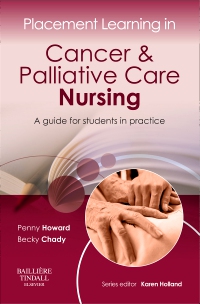

Placement Learning in Cancer & Palliative Care Nursing: A guide for students in practice - Elsevier E-Book on VitalSource, 1st Edition
Elsevier eBook on VitalSource
$13.99
Are you unsure about your cancer and palliative care placement? Do you need guidance on what to prepare to get the most out of your practice learning? Will you have the range of clinical skills to care for people with cancer? What learning opportunities will there be to meet your competencies? How can you maximise your learning during this placement?
This book will help you with all these concerns. It will advise you on what to expect from the placement, what you can learn, how to link theory and practice, and how to make the most of your learning opportunities and meet your competencies.
-
- Takes a logical, step-by-step approach to preparing for learning on a cancer and palliative care placement
- Provides the principles of care, treatment and management of someone with a cancer diagnosis, linking university-learned theory to clinical practice
- Gives helpful evidence-based practice examples and resources to support placement learning
- Identifies clinical skills that underpin care of an individual with cancer
- Highlights potential learning opportunities and experiences available on a cancer and palliative care placement
- Explains how to develop your clinical portfolio by completing specific exercises and activities
- Maps all activities and exercises to the NMC competencies
- Advises on approaches to a range of situations that may arise as a student nurse
- Adopts a case-study approach to consolidating learning and to explore the patient pathway from pre-diagnosis, through a range of treatment options to living beyond cancer or end-of-life care.
Series features:
- A unique guide to getting the most from clinical placements
- How to prepare for your placement
- What you can expect to learn during a placement
- Clear links to, and examples of, achieving NMC competencies
- Guidance on what to use as evidence for your portfolio
- Case studies that link theory with practice
- How to consolidate your experience and learn from the placement
- Tips, activities, further reading suggestions and useful websites.
-
Introduction
Section 1: Preparation for practice placement experience
Chapter 1 Personal and public perceptions of cancer
Chapter 2 What cancer is
Chapter 3 How the cancer situation can be improved
Chapter 4 How cancer is diagnosed and the impact of diagnosis
Chapter 5 Principles of palliative care nursing
Chapter 6 Beginning the learning experience
Chapter 7 Placement learning pathways
Section 2: Placement learning opportunities
Chapter 8 The rationale for selecting cancer treatment
Chapter 9 Caring for the patient undergoing surgical cancer treatment
Chapter 10 Caring for the patient undergoing cytotoxic therapy
Chapter 11 Caring for the patient undergoing haemopoietic stem cell transplant
Chapter 12 Caring for the patient undergoing of biological therapy
Chapter 13 Caring for the patient undergoing radiotherapy
Chapter 14 Caring for the patient undergoing endocrine therapy
Chapter 15 Managing symptoms: assess, plan, implement and evaluate
Chapter 16 –Caring for patients at the end of life
Chapter 17 Living with and beyond cancer
Section 3: Consolidating learning: the patient experience
Chapter 18 Introduction to consolidating learning
Chapter 19 Introducing the case study
Chapter 20 Receiving a cancer diagnosis
Chapter 21 Receiving treatment
Chapter 22 Advancing disease
Chapter 23 Last days of life
Chapter 24 Living with and beyond cancer
Chapter 25 Transferable skills for future placements
Appendix: Driscoll's model of reflection
Index
-
-
Ways of Reading
- The appearance of the text and page layout can be modified according to the capabilities of the reading system (font family and font size, spaces between paragraphs, sentences, words, and letters, as well as color of background and text)
- This e-publication is accessible to the full extent that the file format and types of content allow, on a specific reading device, by default, without necessarily including any additions such as textual descriptions of images or enhanced navigation
- All content can be read as read aloud speech or dynamic braille
-
Conformance
- The certifier's credential is https://bornaccessible.benetech.org/certified-publishers/
- For detailed accessibility information, see Elsevier's website at https://www.elsevier.com/about/accessibility
- For queries regarding accessibility information, contact [email protected]
- The publication was certified on 10-06-2026
-
Navigation
- Table of contents to all chapters of the text via links
- Page list to go to pages from the print source version
-
Rich Content
- No information is available
-
Hazards
- No information is available
-
Product Content
- No information is available
-
Legal Considerations
- No information is available
-
Additional Accessibility Information
- Content is enhanced with ARIA roles to optimize organization and facilitate navigation
- Page breaks included from the original print source
- For readers with color vision deficiency, use of color (e.g., in diagrams, graphics and charts, in prompts, or on buttons inviting a response) is not the sole means of graphical distinction or of conveying information
- The body text is presented with a contrast ratio of at least 4.5:1 (or 3:1 for large/heading text)
- Ultra-high contrast between text and background
- E-publication includes basic navigation (usually less detailed than TOC-based navigation)
- Where links, controls or buttons are included in the content, the purpose or functionality of each link, control or button is apparent from the associated text alone - or where it is unclear, separate link, control or button descriptions are provided
- All (or substantially all) textual matter is arranged in a single logical reading order (including text that is visually presented as separate from the main text flow, e.g., in boxouts, captions, tables, footnotes, endnotes, citations, etc.). Non-textual content is also linked from within this logical reading order. (Purely decorative non-text content can be ignored).
- Where interactive content is included in the product, controls are provided (e.g., for speed, pause and resume, reset) and labelled to make their use clear.
- The language of the text has been specified (e.g., via the HTML or XML lang attribute) to optimise text-to-speech (and other alternative renderings), both at the whole document level and, where appropriate, for individual words, phrases or passages in a different language.
-
Ways of Reading

 as described in our