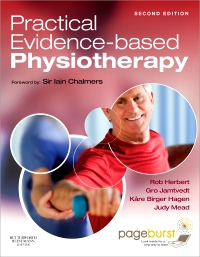

Practical Evidence-Based Physiotherapy - Elsevier eBook on VitalSource, 2nd Edition
Elsevier eBook on VitalSource
Now $47.59
Printed book plus Pageburst™ access – you will receive a printed book and access to the complete book content electronically. Pageburst™ enhances learning by not only bringing world class content to your fingertips but also letting you add to it, annotate it, and categorize it all in a way that suits you. Pageburst™ frees you to spend more time learning and less time searching.
Evidence-based practice has become a central part of physiotherapy today, but it is still an area which is constantly expanding and being updated. Written by an international team of experts, this second edition continues to outline the basic definitions of evidence-based practice and clinical reasoning, while detailing how to find and critically appraise evidence and clinical practice guidelines and the steps to follow in the implementation and evaluation of evidence.
For those struggling to understand both the concepts and how to implement them, this book will prove to be an invaluable and practical guide.
New Edition Expected Availability: 07-18-2022

Practical Evidence-Based Physiotherapy - Elsevier eBook on VitalSource
-
- Chapter asking the question: When and how should new therapies be introduced into clinical practice?
- Search strategies
- Evaluating quality of interventions
- Placebo effects
- Meta-regression
-
- Considers how both quantitative and qualitative research can be used to answer clinical questions
- Written for readers with different levels of expertise
- Highlighted critical points and text box summaries (basic)
- Detailed explanations in text (intermediate)
- Footnotes (advanced)
- Presents detailed strategies for searching physiotherapy-relevant databases
- Extensive consideration of clinical practice guidelines
-
Foreword by Sir Iain Chalmers
Preface to the first edition
Preface to the second editionChapter 1 Evidence-based physiotherapy: what, why and how?
What is ‘evidence-based physiotherapy?
Why is evidence-based physiotherapy important?
History of evidence-based health care
How will this book help you to practise evidence-based physiotherapy?Chapter 2 What do I need to know?
Relevant clinical questions
Refining your questionChapter 3 What constitutes evidence?
What constitutes evidence about effects of interventions?
What constitutes evidence about experiences?
What constitutes evidence about prognosis?
What constitutes evidence about the accuracy of diagnostic and screening tests?Chapter 4 Finding the evidence
Search strategies
Finding evidence of effects of interventions
Finding evidence of prognosis and diagnostic tests
Finding evidence of experiences
Getting full text
Finding evidence of advances in clinical practice (browsing)Chapter 5 Can I trust this evidence?
A process for critical appraisal of evidence
Critical appraisal of evidence about the effects of intervention
Critical appraisal of evidence about experiences
Critical appraisal of evidence about prognosis
Critical appraisal of evidence about diagnostic testsChapter 6 What does this evidence mean for my practice?
What does this randomized trial mean for my practice?
What does this systematic review of effects of intervention mean for my practice?
What does this study of experiences mean for my practice?
What does this study of prognosis mean for my practice?
What does this study of the accuracy of a diagnostic test mean for my practice?Chapter 7 Clinical guidelines as a resource for evidence-based physiotherapy
What are clinical guidelines?
History of clinical guidelines and why they are important
Where can I find clinical guidelines?
How do I know if I can trust the recommendations in a clinical guideline?Chapter 8 When and how should new therapies be introduced into clinical practice?
The life cycle of a medical innovation
A case study
Proposal for a protocol for introduction of new therapies
Anticipation of some objectionsChapter 9 Making it happen
What do we mean by ‘making it happen?
Changing is hard
Evidence-based implementation
Evidence-based physiotherapy in the context of continuous quality improvementChapter 10 Am I on the right track?
Assessing patient outcomes: clinical measurement
Assessing the process of care: audit
Concluding commentIndex
-
-
Ways of Reading
- The appearance of the text and page layout can be modified according to the capabilities of the reading system (font family and font size, spaces between paragraphs, sentences, words, and letters, as well as color of background and text)
- This e-publication is accessible to the full extent that the file format and types of content allow, on a specific reading device, by default, without necessarily including any additions such as textual descriptions of images or enhanced navigation
- No information about nonvisual reading is available
-
Conformance
- The publication was certified on 27-05-2026
-
Navigation
- Table of contents to all chapters of the text via links
- Page list to go to pages from the print source version
-
Rich Content
- No information is available
-
Hazards
- No information is available
-
Product Content
- No information is available
-
Legal Considerations
- The accessibility metadata for this title is unknown or has not been provided to Elsevier by the original publisher.
-
Additional Accessibility Information
- Page breaks included from the original print source
- For readers with color vision deficiency, use of color (e.g., in diagrams, graphics and charts, in prompts, or on buttons inviting a response) is not the sole means of graphical distinction or of conveying information
- E-publication includes basic navigation (usually less detailed than TOC-based navigation)
- Where links, controls or buttons are included in the content, the purpose or functionality of each link, control or button is apparent from the associated text alone - or where it is unclear, separate link, control or button descriptions are provided
- All (or substantially all) textual matter is arranged in a single logical reading order (including text that is visually presented as separate from the main text flow, e.g., in boxouts, captions, tables, footnotes, endnotes, citations, etc.). Non-textual content is also linked from within this logical reading order. (Purely decorative non-text content can be ignored).
- The language of the text has been specified (e.g., via the HTML or XML lang attribute) to optimise text-to-speech (and other alternative renderings), both at the whole document level and, where appropriate, for individual words, phrases or passages in a different language.
-
Ways of Reading

 as described in our