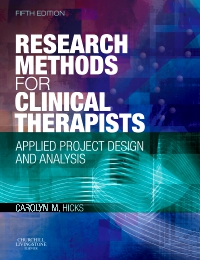

Research Methods for Clinical Therapists - Elsevier e-Book on VitalSource, 5th Edition
Elsevier eBook on VitalSource
Now $41.29
Struggling to do a project or dissertation, evaluate published research or conduct your own research? Help is at hand with this 5th edition of Research Methods for Clinical Therapists, which explains, in a clear and simple manner, how to evaluate existing research and how to conduct your own research.
Aimed at undergraduate and postgraduate students, as well as the practising health care professional, the focus of the text is the design and analysis of experimental studies. These are vital to the effectiveness studies that are central to the work of the healthcare professional. Specific examples from different areas of healthcare are used to explain the core research concepts and relate them to clinical situations. Statistical theory and jargon are kept to a minimum.
-
- Extended section on calculating sample sizes
- Guidelines on the preparation of posters
- Calculation of Inter-rater reliability measures, including Cohen’s Kappa, ICC (interclass correlation) and Bland-Altman graphs of inter-rater agreement
- Introduction to Receiver Operating Characteristics, for use in screening and diagnostic testing against gold-standards
- The Thurstone Paired Comparison Technique, valuable in capturing the user voice on a variety of service planning, design and development issues
- Undertaking Systematic Reviews
- Relevant further reading for each chapter to support readers in their work.
-
- 'Key concept' boxes to explain technical research terms
- Activities and exercises (with answers provided in an appendix) to reinforce learning
- Sample critique of a published research article
- Comprehensive coverage of the key components of a robust research study
- Explanation of basic mathematical concepts
-
SECTION 1 Basic principles of research
1. Introduction
2. Research design and statistics: some basic concepts
3. Questionnaires, surveys and sampling
4. The nature of the data
5. Techniques of descriptive statistics
6. Testing hypotheses
7. Designing your study
8. Sources of error in research
9. Matching the research design to the statistical test
10.Putting the theory into practice
11.Writing up the research for publication
12.Reading published research critically
SECTION 2 Statistical tests
13.Non-parametric tests for same- and matched-subject designs
14.Parametric tests for same- and matched-subject designs
15. Non-parametric tests for different- (unrelated-) subject designs
16.Parametric tests for different- (unrelated-) subject designs
17.Non-parametric and parametric tests for correlational designs
18.Estimation
SECTION 3 Research applications
19.Attitude scales
20.Repertory grid analysis
21.Using statistics in diagnostic and screening tests: receiver operating characteristics
22.Capturing expert opinion: the Delphi technique
23.Capturing the user voice: Thurstone’s paired comparison technique
24.Capturing the clinician’s view: reliability measures
25.Undertaking systematic reviews
Appendices
Appendix 1 Basic mathematical principles
Appendix 2 Statistical probability tables
Appendix 3 Answers to activities
Appendix 4 A sample critique of a published article
Glossary
References, further reading and information sources
Index -
-
Ways of Reading
- The appearance of the text and page layout can be modified according to the capabilities of the reading system (font family and font size, spaces between paragraphs, sentences, words, and letters, as well as color of background and text)
- This e-publication is accessible to the full extent that the file format and types of content allow, on a specific reading device, by default, without necessarily including any additions such as textual descriptions of images or enhanced navigation
- All content can be read as read aloud speech or dynamic braille
-
Conformance
- For detailed accessibility information, see Elsevier's website at https://www.elsevier.com/about/accessibility
- For queries regarding accessibility information, contact [email protected]
- The publication was certified on 07-04-2026
-
Navigation
- Table of contents to all chapters of the text via links
- Page list to go to pages from the print source version
-
Rich Content
- No information is available
-
Hazards
- No information is available
-
Product Content
- No information is available
-
Legal Considerations
- Elsevier is committed to making our eBooks accessible and complying with applicable laws. Given our vast library of titles, there are some cases where making an eBook fully accessible presents unique challenges, and including full features could transform its nature to no longer serve its primary purpose or result in a disproportionate burden for the publisher. As a result this eBook may have limited accessibility. See more at https://www.elsevier.com/en-gb/about/accessibility.
- Please refer to our disproportionate burden or fundamental modification statements.
-
Additional Accessibility Information
- Page breaks included from the original print source
- E-publication includes basic navigation (usually less detailed than TOC-based navigation)
- All (or substantially all) textual matter is arranged in a single logical reading order (including text that is visually presented as separate from the main text flow, e.g., in boxouts, captions, tables, footnotes, endnotes, citations, etc.). Non-textual content is also linked from within this logical reading order. (Purely decorative non-text content can be ignored).
- The language of the text has been specified (e.g., via the HTML or XML lang attribute) to optimise text-to-speech (and other alternative renderings), both at the whole document level and, where appropriate, for individual words, phrases or passages in a different language.
-
Ways of Reading

 as described in our