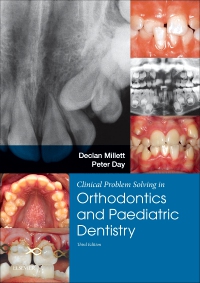

Clinical Problem Solving in Orthodontics and Paediatric Dentistry - Elsevier eBook on VitalSource, 3rd Edition
Elsevier eBook on VitalSource
-
- Useful ‘Clinical Case’ format promotes a logical approach to problem solving through history taking, clinical examination and diagnosis
- Contains approximately 350 photographs, 50 line artworks and 40 tables
- Provides two different approaches to the Clinical Cases – some topics include scenarios with questions and answers; others include differential diagnosis with a focus on how to plan and manage treatment effectively
- ‘Key-point’ boxes systematically emphasise core knowledge, assessment and treatment approaches
- Useful Mind Maps® provide a focused framework for learning and revision
-
1. Median diastema and ectopic eruption of an upper first permanent molar
2. Unerupted upper central incisor
3. Absent upper lateral incisors
4. Crowding and buccal upper canines
5. Severe crowding
6. Palatal canines
7. More canine problems
8. Infraoccluded primary molars
9. Increased overjet
10. Incisor crossbite
11. Reverse overjet
12. Increased overbite
13. Anterior open bite
14. Posterior crossbite
15. Bilateral crossbite
16. Late lower incisor crowding
17. Prominent chin and TMJDS
18. Drifting incisors
19. Appliance-related problems
20. Tooth movement and related problems
21. Cleft lip and palate
22. Nursing and early childhood caries
23. High caries risk adolescents
24. Pain control and treatment planning for carious primary teeth
25. Facial swelling and dental abscess
26. The uncooperative child and adolescent
27. Children with disabilities and learning difficulties
28. Common medical problems in children
29. The displaced primary incisor
30. The fractured immature permanent incisor crown
31. The root fractured permanent incisor
32. The avulsed incisor
33. Disorders of eruption and exfoliation
34. Poor quality first permanent molars
35. Tooth discoloration, hypomineralization and hypoplasia
36. Mottled teeth
37. Multiple missing and abnormally shaped teeth
38. Amelogenesis imperfecta
39. Dentinogenesis imperfecta
40. Dental erosion
41. Gingival bleeding and enlargement
42. Oral ulceration
43. Mind Maps®
APPENDICES
A1 The index of orthodontic treatment need: dental health component
A2 Classification and definitions
A3 Orthodontic problems: referral guide
A4 Implications of some medical problems for orthodontics
A5 Lateral cephalometric analysis
A6 A structured dental trauma history form -
-
Ways of Reading
- The appearance of the text and page layout can be modified according to the capabilities of the reading system (font family and font size, spaces between paragraphs, sentences, words, and letters, as well as color of background and text)
- This e-publication is accessible to the full extent that the file format and types of content allow, on a specific reading device, by default, without necessarily including any additions such as textual descriptions of images or enhanced navigation
- No information about nonvisual reading is available
-
Conformance
- No information is available
-
Navigation
- Table of contents to all chapters of the text via links
- Page list to go to pages from the print source version
-
Rich Content
- No information is available
-
Hazards
- No information is available
-
Product Content
- No information is available
-
Legal Considerations
- No information is available
-
Additional Accessibility Information
- Page breaks included from the original print source
- For readers with color vision deficiency, use of color (e.g., in diagrams, graphics and charts, in prompts, or on buttons inviting a response) is not the sole means of graphical distinction or of conveying information
- E-publication includes basic navigation (usually less detailed than TOC-based navigation)
- Where links, controls or buttons are included in the content, the purpose or functionality of each link, control or button is apparent from the associated text alone - or where it is unclear, separate link, control or button descriptions are provided
- All (or substantially all) textual matter is arranged in a single logical reading order (including text that is visually presented as separate from the main text flow, e.g., in boxouts, captions, tables, footnotes, endnotes, citations, etc.). Non-textual content is also linked from within this logical reading order. (Purely decorative non-text content can be ignored).
- The language of the text has been specified (e.g., via the HTML or XML lang attribute) to optimise text-to-speech (and other alternative renderings), both at the whole document level and, where appropriate, for individual words, phrases or passages in a different language.
-
Ways of Reading


 as described in our