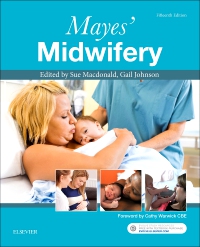

Mayes' Midwifery - Elsevier eBook on VitalSource, 15th Edition
Elsevier eBook on VitalSource
Now $58.49
Now available for the first time in full color, the 15th edition of Mayes Midwifery has an enhanced artwork program and comes with an extensive website which provides 600 MCQs and wide selection of case studies and reflective activities; a downloadable image bank assists with essay and assignment preparation.
New Edition Expected Availability: 06-07-2023

-
- New edition of a classic textbook updated and designed for today’s midwifery student!
- Chapters authored by experts in their field, including midwifery academics and clinicians as well as allied professionals such as researchers, physiotherapists, neonatal nurse specialists, social scientists and legal experts
- Evidence and research based throughout to help facilitate safe clinical practice
- Learning outcomes and key points help readers structure their study and recap on what they have learned
- Reflective activities encourage the application of theory to practice
- Contains practice based tools and checklists
- Presents and discusses the latest national and international guidelines
- Associated website with over 600 MCQs, reflective activities to encourage the application of theory to practice, case studies and additional learning tools
- Downloadable image bank to assist readers with essay preparation and other assignments
- Suitable for use in normal community and midwife led arenas, high tech environments and more rural areas of clinical practice
-
Part 1: The midwife in context
1. The place of the midwife in the global context: The global midwife
2. A history of the midwifery profession in the United Kingdom
3. Regulation of midwives
4. Clinical governance and the midwife
5. The midwife as a lifelong learner
6. Evidence-based practice and research for practice
7. Leadership and management in midwifery
8. An introduction to ethics and midwifery practice
9. The law and the midwife
10. Pharmacology and the midwife
Part 2: Childbirth in context
11. Sociocultural and spiritual context of childbearing
12. Psychological context of childbirth
13. Sexuality
14. National Health Service policy and midwifery
15. Legal frameworks for the care of the child
Part 3: Public health, health promotion in the context of childbirth
16. Epidemiology
17. Nutrition
18. Complementary therapies and natural remedies in pregnancy and birth: responsibilities of midwives
19. Health promotion and education
20. Preconception care
21. Education for parenthood
22. Physical preparation for childbirth and beyond, and the role of physiotherapy
23. Vulnerable women
Part 4: The anatomy and physiology of fertility, embryology and fetal development
24. Anatomy of male and female reproduction
25. Female reproductive physiology: Timed interactions between hypothalamus, anterior pituitary and ovaries
26. Genetics
27. Fertility and its control
28. Infertility and assisted conception
29. Fertilization, embryo formation and feto-placental development
30. The fetal skull
Part 5: Pregnancy
31. Maternal neurohormonal and systemic adaptations to feto-placental development
32. Confirming pregnancy and care of the pregnant woman
33. Antenatal investigations
34. Choice, childbearing and maternity care – the choice agenda and place of birth
Part 6: Labour and birth
35. Physiological changes from late pregnancy until the onset of lactation: from nesting to suckling-lactation and parental-infant attachment
36. Care in the first stage of labour
37. Care in the second stage of labour
38. Supporting choices in reducing pain and fear during labour
39. Care in the third stage of labour
40. The pelvic floor
Part 7: Postnatal care and the care of the newborn baby
41. Content and organization of postnatal care
42. Physiology, assessment and care of the newborn baby
43. Thermoregulation
44. Infant feeding and relationship building
Part 8: Women and babies with complex needs
45. The preterm baby and the small baby
46. Respiratory and cardiac disorders
47. Neonatal jaundice
48. Infection in the neonate
49. Congenital anomalies, neonatal surgery and pain management
50. Metabolic and endocrine disorders
51. Stillbirth and sudden infant death syndrome
52. Nausea and vomiting in pregnancy
53. Bleeding in pregnancy
54. Hypertensive and medical disorders in pregnancy
55. Sexually transmitted infections
56. Abnormalities of the genital tract
57. Multiple pregnancy
58. Preterm labour
59. Obstetric interventions
60. Induction of labour and prolonged pregnancy
61. Rhythmic variations of labour
62. Malpositions and malpresentations
63. Obstructed labour and uterine rupture
64. Shoulder dystocia
65. Presentation and prolapse of the umbilical cord
66. Maternal morbidity following childbirth
67. Complications related to the third stage of labour
68. Pregnancy loss and the death of a baby: grief and bereavement care
69. Maternal mental health and psychological issues
70. Midwifery for the future …where next? -
-
Ways of Reading
- The appearance of the text and page layout can be modified according to the capabilities of the reading system (font family and font size, spaces between paragraphs, sentences, words, and letters, as well as color of background and text)
- This e-publication is accessible to the full extent that the file format and types of content allow, on a specific reading device, by default, without necessarily including any additions such as textual descriptions of images or enhanced navigation
- No information about nonvisual reading is available
-
Conformance
- The publication was certified on 27-05-2026
-
Navigation
- Table of contents to all chapters of the text via links
- Page list to go to pages from the print source version
-
Rich Content
- No information is available
-
Hazards
- No information is available
-
Product Content
- No information is available
-
Legal Considerations
- No information is available
-
Additional Accessibility Information
- Page breaks included from the original print source
- For readers with color vision deficiency, use of color (e.g., in diagrams, graphics and charts, in prompts, or on buttons inviting a response) is not the sole means of graphical distinction or of conveying information
- E-publication includes basic navigation (usually less detailed than TOC-based navigation)
- Where links, controls or buttons are included in the content, the purpose or functionality of each link, control or button is apparent from the associated text alone - or where it is unclear, separate link, control or button descriptions are provided
- All (or substantially all) textual matter is arranged in a single logical reading order (including text that is visually presented as separate from the main text flow, e.g., in boxouts, captions, tables, footnotes, endnotes, citations, etc.). Non-textual content is also linked from within this logical reading order. (Purely decorative non-text content can be ignored).
- The language of the text has been specified (e.g., via the HTML or XML lang attribute) to optimise text-to-speech (and other alternative renderings), both at the whole document level and, where appropriate, for individual words, phrases or passages in a different language.
-
Ways of Reading

 as described in our