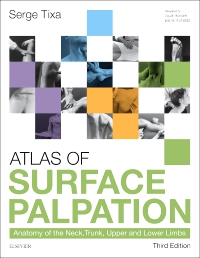

Atlas of Surface Palpation - Elsevier eBook on VitalSource, 3rd Edition
Elsevier eBook on VitalSource
Now $49.49
Serge Tixa presents in this highly popular book a method of palpatory anatomy called Manual Exploration of Surface Anatomy (MESA). MESA locates anatomical structures important to clinical examination allowing careful selection of the most appropriate manual therapy technique or manoeuvre.
The new edition presents precisely and visually the various anatomical structures with the help of more than 130 colour illustrations and close to 900 black and white photographs. For every photograph showing an anatomical structure accessible to palpation, a model whose physique shows the structure clearly has been chosen. Each chapter has up to four subsections, treating the various aspects of each body region. These cover osteology, myology (musculotendinous structures), arthrology (joints and ligaments) and lastly nerves and blood vessels.
Each photograph is carefully presented and accompanied by a section of text describing the method of approach to finding the structure concerned. Whenever necessary, reminders, essential for the proper use of the methods of approach (attachments, actions and innervations) are included. Clinical notes highlight the link between palpation and clinical diagnoses.
Atlas of Surface Palpation: Anatomy of the Neck, Trunk, Upper and Lower Limbs is aimed at students and practitioners who need a method of applied anatomy in their practice.
-
- All new artwork programme enhances accessibility and learning
- Useful template approach aids ready understanding and allows the reader to go at his or her own speed
- Presents almost 600 photographs and line artworks to render the learning experience as easy as possible
- Contains over 160 pull out boxes to act as useful aide memoires
- Clinical Hints and Tips boxes indicate points of relevance for the clinic
-
-
 Atlas of Surface PalpationPaperback
-
-
1. Neck
2. Trunk and Sacrum
3. Shoulder
4. Arm
5. Elbow
6. Forearm
7. Wrist and Hand
8. Hip
9. Thigh
10. Knee
11. Leg
12. Foot and Ankle -
-
Ways of Reading
- The appearance of the text and page layout can be modified according to the capabilities of the reading system (font family and font size, spaces between paragraphs, sentences, words, and letters, as well as color of background and text)
- This e-publication is accessible to the full extent that the file format and types of content allow, on a specific reading device, by default, without necessarily including any additions such as textual descriptions of images or enhanced navigation
- No information about nonvisual reading is available
-
Conformance
- No information is available
-
Navigation
- Table of contents to all chapters of the text via links
- Page list to go to pages from the print source version
-
Rich Content
- No information is available
-
Hazards
- No information is available
-
Product Content
- No information is available
-
Legal Considerations
- No information is available
-
Additional Accessibility Information
- Page breaks included from the original print source
- For readers with color vision deficiency, use of color (e.g., in diagrams, graphics and charts, in prompts, or on buttons inviting a response) is not the sole means of graphical distinction or of conveying information
- E-publication includes basic navigation (usually less detailed than TOC-based navigation)
- Where links, controls or buttons are included in the content, the purpose or functionality of each link, control or button is apparent from the associated text alone - or where it is unclear, separate link, control or button descriptions are provided
- All (or substantially all) textual matter is arranged in a single logical reading order (including text that is visually presented as separate from the main text flow, e.g., in boxouts, captions, tables, footnotes, endnotes, citations, etc.). Non-textual content is also linked from within this logical reading order. (Purely decorative non-text content can be ignored).
- The language of the text has been specified (e.g., via the HTML or XML lang attribute) to optimise text-to-speech (and other alternative renderings), both at the whole document level and, where appropriate, for individual words, phrases or passages in a different language.
-
Ways of Reading

 as described in our