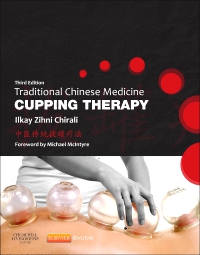

Traditional Chinese Medicine Cupping Therapy - Elsevier eBook on VitalSource, 3rd Edition
Elsevier eBook on VitalSource
Now $53.99
This new edition continues to offer readers a comprehensive exploration and description of techniques of cupping in the context of Traditional Chinese Medicine theory. Extensively updated throughout, and with a new website containing videos and a downloadable image bank, this volume will be ideal for students and practitioners of Traditional Chinese Medicine, and all other complementary health practitioners looking to expand their skill base.
-
- Text clarified and updated throughout, with an expanded artwork program and improved layout and design
- New chapters by specialist contributors cover Cupping’s Folk Heritage, Buddhist Medicine, and Thai Lanna Medicine
- New chapter on Cosmetic Cupping Techniques
- New section addressing Frequently Asked Questions
- An expanded discussion about the benefits of cupping therapy, including the treatment of new pathological conditions including myofascial pain
- Includes new evidence-based research on the effects of cupping therapy, including a systematic review
-
- Explains cupping therapy clearly, allowing the practitioner immediate access to a set of skills for everyday application
- Well illustrated to support the guidelines discussed in the text
- Includes website containing video clips showing 11 methods of cupping therapy plus picture gallery of more than 150 colour photographs
- Gives practical guidelines on the use of cupping in helping to treat more than 30 common conditions
- Looks closely at issues of safety, expectation and theoretical principles of action
-
Chapter 1 Traditional Chinese Medicine Cupping Therapy
Chapter 2 Cupping’s folk heritage, Bruce Bentley
Chapter 3.1Cupping in Buddhist Medicine, Pedro Pavia
Chapter 3.2Cupping in Thailand’s Traditional Lanna Medicine, Kei Ngu
Chapter 4 Benefits of Cupping Therapy
Chapter 5 Preparing the patient for cupping treatment
Chapter 6 Complementary and Alternative Medicine (CAM) therapies
Chapter 7 The Cupping Procedure
Chapter 8 What to Expect During and After Cupping Therapy
Chapter 9 Twelve Methods of Cupping Therapy
Chapter 10 Cupping Therapy on Children and Adults
Chapter 11 Cosmetic Cupping Therapy
Chapter 12 Cupping Therapy in the Treatment of Common Disorders
Chapter 13 Treating Miscellaneous Disorders with Cupping Therapy
Chapter 14 Sports Injuries
Chapter 15 Myofascial Trigger Points Cupping Therapy
Chapter 16 Cupping Therapy Evidence-Based Research Ilkay Chirali,
Roz Gibbs, Mark Bovey, Hossam Metwally, Hujian Cao and team
Chapter 17 Part 1 Frequently Asked Questions (FAQ)/Part 2 Precautions and Contraindications
-
-
Ways of Reading
- The appearance of the text and page layout can be modified according to the capabilities of the reading system (font family and font size, spaces between paragraphs, sentences, words, and letters, as well as color of background and text)
- This e-publication is accessible to the full extent that the file format and types of content allow, on a specific reading device, by default, without necessarily including any additions such as textual descriptions of images or enhanced navigation
- No information about nonvisual reading is available
-
Conformance
- No information is available
-
Navigation
- Table of contents to all chapters of the text via links
- Page list to go to pages from the print source version
-
Rich Content
- No information is available
-
Hazards
- No information is available
-
Product Content
- No information is available
-
Legal Considerations
- No information is available
-
Additional Accessibility Information
- Page breaks included from the original print source
- For readers with color vision deficiency, use of color (e.g., in diagrams, graphics and charts, in prompts, or on buttons inviting a response) is not the sole means of graphical distinction or of conveying information
- E-publication includes basic navigation (usually less detailed than TOC-based navigation)
- Where links, controls or buttons are included in the content, the purpose or functionality of each link, control or button is apparent from the associated text alone - or where it is unclear, separate link, control or button descriptions are provided
- All (or substantially all) textual matter is arranged in a single logical reading order (including text that is visually presented as separate from the main text flow, e.g., in boxouts, captions, tables, footnotes, endnotes, citations, etc.). Non-textual content is also linked from within this logical reading order. (Purely decorative non-text content can be ignored).
- The language of the text has been specified (e.g., via the HTML or XML lang attribute) to optimise text-to-speech (and other alternative renderings), both at the whole document level and, where appropriate, for individual words, phrases or passages in a different language.
-
Ways of Reading


 as described in our