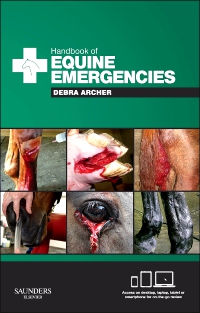

Handbook of Equine Emergencies - Elsevier eBook on VitalSource, 1st Edition
Elsevier eBook on VitalSource
-
- Suitable for all veterinary clinicians seeing horses
- Concise and practical layout and content
- Videos, audio, text summaries and images all accessible via your mobile device
- More than 150 full colour unique images
-
-
 Handbook of Equine EmergenciesHardcover
-
-
Wounds / dermatology emergencies
- Wounds of the head and neck
- Wounds to the body
- Wounds to the limbs
Musculoskeletal emergencies
- The collapsed / recumbent horse
- The severely lame horse
- Foot abscesses
- Foot penetrations
- Laminitis
- Synovial sepsis
- Rhabdomyolysis
Gastrointestinal tract emergencies
- Colic
- Dysphagia / choke
- Diarrhoea
- Grain overload
- Rectal tears
Respiratory tract emergencies
- Respiratory distress
- Epistaxis
Ophthalmic emergencies
- Corneal ulcers
- Uveitis
- Traumatic injuries to the cornea
- Eyelid lacerations
Neurological emergencies
- Head trauma
- Acute onset blindness / circling / seizures
Endocrine emergencies
- Hyperlipaemia
Reproductive tract emergencies
- Dystocia
- Uterine torsion
- Uterine prolapse & tears
- Uterine artery rupture
- Abortion
- Retained foetal membranes
- Penile trauma
- Post-castration emergencies
Urinary tract emergencies
- Urinary tract obstruction
Foal emergencies
- Meconium impaction
- Diarrhoea
- Septicaemia
- The dummy / weak foal
Emergency horse rescue
Emergency anaesthesia
Euthanasia
Miscellaneous
- Anaphylaxis
- Pyrexia of unknown origin
Chapter 1 The Basics
Chapter 2 Wounds And Other Integumentary Emergencies
Chapter 3Musculoskeletal Emergencies
Chapter 4 Oral & Gastrointestinal Emergencies
Chapter 5 Respiratory Emergencies
Chapter 6 Ophthalmic Emergencies
Chapter 7 Neurological Emergencies
Chapter 8 Reproductive Emergencies
Chapter 9 Urinary Tract Emergencies
Chapter 10 Cardiovascular Emergencies
Chapter 11 Hepatic, Endocrine And Metabolic Emergencies
Chapter 12 Emergencies In Foals
Chapter 13 Emergencies In Donkeys And Mules
Chapter 14 Iatrogenic Emergencies
Chapter 15 Infectious Diseases
Chapter 16 Poisoning, Bites And Stings
Chapter 17 Other Specific Emergency Situations
Chapter 18 Other Essentials
Chapter 19 How To…
Abbreviations and Symbols
Index
-
-
Ways of Reading
- The appearance of the text and page layout can be modified according to the capabilities of the reading system (font family and font size, spaces between paragraphs, sentences, words, and letters, as well as color of background and text)
- This e-publication is accessible to the full extent that the file format and types of content allow, on a specific reading device, by default, without necessarily including any additions such as textual descriptions of images or enhanced navigation
- No information about nonvisual reading is available
-
Conformance
- No information is available
-
Navigation
- Table of contents to all chapters of the text via links
- Page list to go to pages from the print source version
-
Rich Content
- No information is available
-
Hazards
- No information is available
-
Product Content
- No information is available
-
Legal Considerations
- No information is available
-
Additional Accessibility Information
- Page breaks included from the original print source
- For readers with color vision deficiency, use of color (e.g., in diagrams, graphics and charts, in prompts, or on buttons inviting a response) is not the sole means of graphical distinction or of conveying information
- E-publication includes basic navigation (usually less detailed than TOC-based navigation)
- Where links, controls or buttons are included in the content, the purpose or functionality of each link, control or button is apparent from the associated text alone - or where it is unclear, separate link, control or button descriptions are provided
- All (or substantially all) textual matter is arranged in a single logical reading order (including text that is visually presented as separate from the main text flow, e.g., in boxouts, captions, tables, footnotes, endnotes, citations, etc.). Non-textual content is also linked from within this logical reading order. (Purely decorative non-text content can be ignored).
- The language of the text has been specified (e.g., via the HTML or XML lang attribute) to optimise text-to-speech (and other alternative renderings), both at the whole document level and, where appropriate, for individual words, phrases or passages in a different language.
-
Ways of Reading

 as described in our