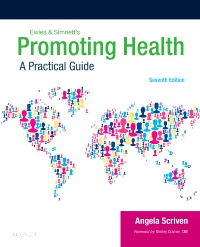

Promoting Health: A Practical Guide - Elsevier eBook on VitalSource, 7th Edition
Elsevier eBook on VitalSource
Now $56.04
Leading the field in public health for over 30 years, Ewles & Simnett’s seminal text is now in its seventh edition. This new edition, the second to be revised by Angela Scriven, has been thoroughly updated and aligned with national standards to provide an accessible, current, practical guide for all those involved in the what, why, who and how of health promotion and public health practice.
New Edition Expected Availability: 10-18-2023

Ewles and Simnett’s Promoting Health: A Practical Guide - Elsevier E-Book on VitalSource
-
- NEW! Nora AI - an AI-powered learning assistant exclusive to Elsevier ebooks on VitalSource's Bookshelf® platform - offers built-in AI learning support that provides personalized answers based on content from the Elsevier ebook
- New edition of a seminal text fully updated for today’s reader
- Focuses on the theories, principles and competencies for practice across a wide range of settings ranging from communities, schools, and workplaces, to GP surgeries and hospitals
- Authoritative and accessible writing style helps make learning easy
- Reflective activities help students consolidate their learning
- Case studies – many from real life – provide practical examples to help readers apply concepts to their own setting
- Gives emphasis to good communication and the effective use of communication tools
- Practice points help readers structure their study and recap on what they have learned
-
PART 1 THINKING ABOUT HEALTH AND HEALTH PROMOTION
1. What is health?
2. What is health promotion?
3. Who promotes health?
4. Values and ethical considerations in health promotion and public health
PART 2 PLANNING AND MANAGING FOR EFFECTIVE PRACTICE
5. Planning and evaluating health promotion
6. Identifying health promotion and public health practice needs and priorities
7. Evidence and research for health promotion and public health practice
8. Skills of personal effectiveness
9. Working effectively with other people
PART 3 DEVELOPING COMPETENCE IN HEALTH PROMOTION
10. Fundamentals of communication in public health
11. Using communication tools in health promotion and public health practice
12. Educating for health
13. Working with groups to promote health
14. Enabling healthier living through behaviour change
15. Working with communities
16. Influencing and implementing public health policy -
-
Ways of Reading
- The appearance of the text and page layout can be modified according to the capabilities of the reading system (font family and font size, spaces between paragraphs, sentences, words, and letters, as well as color of background and text)
- This e-publication is accessible to the full extent that the file format and types of content allow, on a specific reading device, by default, without necessarily including any additions such as textual descriptions of images or enhanced navigation
- No information about nonvisual reading is available
-
Conformance
- No information is available
-
Navigation
- Table of contents to all chapters of the text via links
- Page list to go to pages from the print source version
-
Rich Content
- No information is available
-
Hazards
- No information is available
-
Product Content
- No information is available
-
Legal Considerations
- No information is available
-
Additional Accessibility Information
- Page breaks included from the original print source
- For readers with color vision deficiency, use of color (e.g., in diagrams, graphics and charts, in prompts, or on buttons inviting a response) is not the sole means of graphical distinction or of conveying information
- E-publication includes basic navigation (usually less detailed than TOC-based navigation)
- Where links, controls or buttons are included in the content, the purpose or functionality of each link, control or button is apparent from the associated text alone - or where it is unclear, separate link, control or button descriptions are provided
- All (or substantially all) textual matter is arranged in a single logical reading order (including text that is visually presented as separate from the main text flow, e.g., in boxouts, captions, tables, footnotes, endnotes, citations, etc.). Non-textual content is also linked from within this logical reading order. (Purely decorative non-text content can be ignored).
- The language of the text has been specified (e.g., via the HTML or XML lang attribute) to optimise text-to-speech (and other alternative renderings), both at the whole document level and, where appropriate, for individual words, phrases or passages in a different language.
-
Ways of Reading

 as described in our