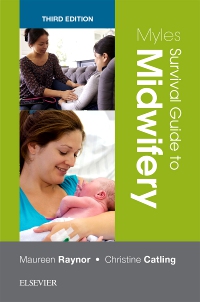

Myles Survival Guide to Midwifery - Elsevier eBook on VitalSource, 3rd Edition
Elsevier eBook on VitalSource
-
- Helpful bullet point style allows rapid access to essential information
- Useful revision guide for examinations and assessments
- Contains common abbreviations, medications, drug calculations, glossary of common terms, and normal values
-
SECTION 1 ANATOMY AND REPRODUCTION
1. The Female Pelvis and the Reproductive Organs
2. The Female Urinary Tract
3. Hormonal Cycles
4. The Placenta
5. The Fetus
SECTION 2 PREGNANCY
6. Preparing for Pregnancy
7. Change and Adaptation in Pregnancy
8. Common Disorders of and Exercises for Pregnancy
9. Antenatal Care
10. Specialised Fetal Investigations
11. Abnormalities of Early Pregnancy
12. Problems of Pregnancy
13. Common Medical Disorders Associated with Pregnancy
14. Hypertensive Disorders of Pregnancy
15. Sexually Transmissible and Reproductive Tract Infections in Pregnancy
16. Multiple Pregnancy
SECTION 3 LABOUR
17. The First Stage of Labour
18. The Second Stage of Labour
19. The Third Stage of Labour
20. Prolonged Pregnancy and Disorders of Uterine Action
21. Malpositions of the Occiput and Malpresentations
22. Operative Births
23. Midwifery and Obstetric Emergencies
SECTION 4 PUERPERIUM
24. Physiology and Care in the Puerperium
25. Physical Problems and Complications in the Puerperium
26. Perinatal Mental Health
SECTION 5 THE NEWBORN BABY
27. The Baby at Birth and Neonatal Resuscitation
28 .The Normal Baby
29. Infant Feeding
30. The Healthy Low-Birth-Weight Baby
31. Recognising the Ill Baby
32. Respiratory Problems
33. Trauma During Birth, Haemorrhage and Convulsions
34. Congenital Malformations
35. Jaundice and Infection
36. Metabolic Disturbances, Inborn Errors of Metabolism, Endocrine Disorders and Drug Withdrawal
37. Complementary Therapies and Maternity Care
Appendix
1. Drugs (Medicines)
2. An Aid to Calculations Used in Midwifery Practice
3. Normal Values in Pregnancy
4. Glossary of Selected Terms -
-
Ways of Reading
- The appearance of the text and page layout can be modified according to the capabilities of the reading system (font family and font size, spaces between paragraphs, sentences, words, and letters, as well as color of background and text)
- This e-publication is accessible to the full extent that the file format and types of content allow, on a specific reading device, by default, without necessarily including any additions such as textual descriptions of images or enhanced navigation
- No information about nonvisual reading is available
-
Conformance
- No information is available
-
Navigation
- Table of contents to all chapters of the text via links
- Page list to go to pages from the print source version
-
Rich Content
- No information is available
-
Hazards
- No information is available
-
Product Content
- No information is available
-
Legal Considerations
- No information is available
-
Additional Accessibility Information
- Page breaks included from the original print source
- For readers with color vision deficiency, use of color (e.g., in diagrams, graphics and charts, in prompts, or on buttons inviting a response) is not the sole means of graphical distinction or of conveying information
- E-publication includes basic navigation (usually less detailed than TOC-based navigation)
- Where links, controls or buttons are included in the content, the purpose or functionality of each link, control or button is apparent from the associated text alone - or where it is unclear, separate link, control or button descriptions are provided
- All (or substantially all) textual matter is arranged in a single logical reading order (including text that is visually presented as separate from the main text flow, e.g., in boxouts, captions, tables, footnotes, endnotes, citations, etc.). Non-textual content is also linked from within this logical reading order. (Purely decorative non-text content can be ignored).
- The language of the text has been specified (e.g., via the HTML or XML lang attribute) to optimise text-to-speech (and other alternative renderings), both at the whole document level and, where appropriate, for individual words, phrases or passages in a different language.
-
Ways of Reading

 as described in our