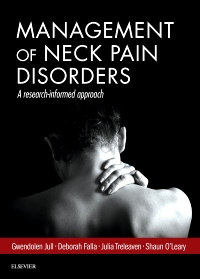

Management of Neck Pain Disorders Elsevier eBook on VitalSource, 1st Edition
Elsevier eBook on VitalSource
Now $38.49
Written by world renowned researchers and clinicians in the field, Management of Neck Pain Disorders provides a comprehensive insight into the nature of neck pain disorders within a biopsychosocial context to inform clinical reasoning in the management of persons with neck pain. Emphasising a patient centred approach, this book practically applies knowledge from research to inform patient assessment and management. It also provides practical information and illustrations to assist clinicians to develop treatment programs with and for their patients with neck pain.
-
The book covers:
- Current issues and debates in the field of neck pain disorders
- Research informing best practice assessment and management
- Biological, psychological and social features which need to be considered when assessing and developing a management program with the patient
- A multimodal conservative management approach, which addresses the presenting episode of pain as well as rehabilitation strategies towards prevention of recurrent episodes
-
Section 1 Introduction
1. Neck Pain Disorders
Section 2 Clinical Sciences
2. Nociception and Pain perception
3. Movement and Posture in Neck Pain Disorders
4. Neural Tissue in Neck Pain Disorders
5. Neuromuscular Disturbances in Neck Pain Disorders
6. Sensorimotor Control Disturbances in Neck Pain Disorders
7. Psychological and Social Considerations in Neck Pain Disorders
Section 3 Clinical Assessment
8. Clinical Assessment: The patient interview
9. Clinical Assessment: The physical examination
10. The Differential Diagnosis of Symptoms and Signs of Sensorimotor Control Disturbances
11. Headache: The Differential Diagnosis of Cervical Musculoskeletal Causes or Contributors
Section 4 Clinical Management
12. Principles of Management
13. Communication, Education and Self-Management
14. Management of Joint and Movement Dysfunction
15. Management of Neuromuscular Dysfunction
16. Management of Sensorimotor Control Disturbances
17. Management of Nerve Tissue
18. Case Presentations: Clinical reasoning and clinical decision making
19. Concluding Remarks: Focussing on prevention -
-
Ways of Reading
- The appearance of the text and page layout can be modified according to the capabilities of the reading system (font family and font size, spaces between paragraphs, sentences, words, and letters, as well as color of background and text)
- This e-publication is accessible to the full extent that the file format and types of content allow, on a specific reading device, by default, without necessarily including any additions such as textual descriptions of images or enhanced navigation
- No information about nonvisual reading is available
-
Conformance
- No information is available
-
Navigation
- Table of contents to all chapters of the text via links
- Page list to go to pages from the print source version
-
Rich Content
- No information is available
-
Hazards
- No information is available
-
Product Content
- No information is available
-
Legal Considerations
- No information is available
-
Additional Accessibility Information
- Page breaks included from the original print source
- For readers with color vision deficiency, use of color (e.g., in diagrams, graphics and charts, in prompts, or on buttons inviting a response) is not the sole means of graphical distinction or of conveying information
- E-publication includes basic navigation (usually less detailed than TOC-based navigation)
- Where links, controls or buttons are included in the content, the purpose or functionality of each link, control or button is apparent from the associated text alone - or where it is unclear, separate link, control or button descriptions are provided
- All (or substantially all) textual matter is arranged in a single logical reading order (including text that is visually presented as separate from the main text flow, e.g., in boxouts, captions, tables, footnotes, endnotes, citations, etc.). Non-textual content is also linked from within this logical reading order. (Purely decorative non-text content can be ignored).
- The language of the text has been specified (e.g., via the HTML or XML lang attribute) to optimise text-to-speech (and other alternative renderings), both at the whole document level and, where appropriate, for individual words, phrases or passages in a different language.
-
Ways of Reading

 as described in our