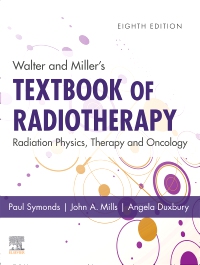

Walter and Miller's Textbook of Radiotherapy: Radiation Physics, Therapy and Oncology - Elsevier eBook on VitalSource, 8th Edition
Elsevier eBook on VitalSource
Now $105.29
Walter and Miller’s Textbook of Radiotherapy is a key textbook for therapeutic radiography students as well as trainee clinical and medical oncologists, clinical physicists and technologists. The book is divided into 2 sections. The first section covers physics and provides a comprehensive review of radiotherapy physics. This section is designed to be non-physicist friendly, to simply and clearly explain the physical principles upon which radiotherapy and its technology are based. The second section is a systematic review by tumour site giving an up to date summary of radiotherapy practice. The title also covers the place of chemotherapy, surgery and non-radiotherapy treatments as well as the principles of cancer patient treatment including supportive care and palliative treatments. It is a comprehensive must-have resource for anyone studying therapeutic radiotherapy.
-
- Highly illustrated in full colour including 350 photographs
- Clearly and simply explains the fundamental physics for clinicians
- Gives an up to date summary of radiotherapy practice organised by tumour site making it very easy to navigate
- Describes the wide range of devices and clearly explains the principles behind their operation
- Comprehensively explains the calculation models of dose predictions for treatment preparation
-
SECTION 1
1. Atoms, Nuclei and Radioactivity
2. Interactions of Ionising Radiation With Matter
3. Radiation Detection and Measurement
4. Radiation Protection
5. Imaging With X-Ray, Magnetic Resonance Imaging and Ultrasound
6. Imaging With Radionuclides
7. Therapy With Unsealed Radionuclides
8. Radiotherapy Devices With Kilovoltage X-Rays and Radioisotopes
9. Beam Production: Megavoltage Accelerators
10. Radiation Treatment Planning: Immobilisation, Localisation and Verification Techniques
11. Radiation Treatment Planning: Beam Models, Principles and Practice
12. Networking, Data, Image Handling and Computing in Radiotherapy
13. Quality Control
14. Quality Management in Radiotherapy
SECTION 2
15. Epidemiology of Cancer and Screening
16. Biological and Pathological Introduction
17. Molecular, Cellular and Tissue Effects of Radiotherapy
18. Principles of Management of Patients With Cancer
19. Chemotherapy and Hormones
20. Skin and Lip Cancer
21. Head and Neck Cancer—General Principles
22. Sino-Nasal, Oral, Larynx and Pharynx Cancers
23. Thyroid Cancer
24. Gastrointestinal Cancer
25. Tumours of the Thorax
26. Breast Cancer
27. Gynaecological Cancer
28. Cancer of Kidney, Bladder, Prostate, Testis, Urethra and Penis
29. Lymphoma and Disease of Bone Marrow
30. Tumours of the Central Nervous System
31. Eye and Orbit
32. Sarcomas
33. Principles of Paediatric Oncology
34. Care of Patients During Radiotherapy
35. Medical Complications of Malignant Disease
36. Proton Beam Therapy -
-
Ways of Reading
- The appearance of the text and page layout can be modified according to the capabilities of the reading system (font family and font size, spaces between paragraphs, sentences, words, and letters, as well as color of background and text)
- This e-publication is accessible to the full extent that the file format and types of content allow, on a specific reading device, by default, without necessarily including any additions such as textual descriptions of images or enhanced navigation
- No information about nonvisual reading is available
-
Conformance
- No information is available
-
Navigation
- Table of contents to all chapters of the text via links
- Page list to go to pages from the print source version
-
Rich Content
- No information is available
-
Hazards
- No information is available
-
Product Content
- No information is available
-
Legal Considerations
- No information is available
-
Additional Accessibility Information
- Page breaks included from the original print source
- For readers with color vision deficiency, use of color (e.g., in diagrams, graphics and charts, in prompts, or on buttons inviting a response) is not the sole means of graphical distinction or of conveying information
- E-publication includes basic navigation (usually less detailed than TOC-based navigation)
- Where links, controls or buttons are included in the content, the purpose or functionality of each link, control or button is apparent from the associated text alone - or where it is unclear, separate link, control or button descriptions are provided
- All (or substantially all) textual matter is arranged in a single logical reading order (including text that is visually presented as separate from the main text flow, e.g., in boxouts, captions, tables, footnotes, endnotes, citations, etc.). Non-textual content is also linked from within this logical reading order. (Purely decorative non-text content can be ignored).
- The language of the text has been specified (e.g., via the HTML or XML lang attribute) to optimise text-to-speech (and other alternative renderings), both at the whole document level and, where appropriate, for individual words, phrases or passages in a different language.
-
Ways of Reading

 as described in our